
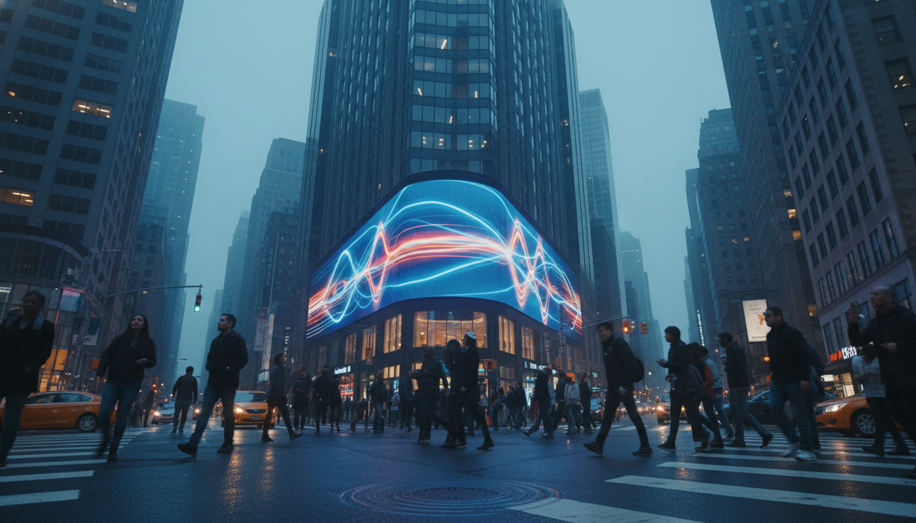

On a busy city concourse, a commuter pauses—not because of what they see, but because of what they hear. A faint rustle of leaves cuts through the murmur of traffic. A few notes of a melody hover at the edge of perception, seemingly coming from nowhere. Only after a second or two does the eye catch up with the ear, landing on a digital screen for an eco-travel brand that’s using sound, not just sight, to stop people in their tracks.
Out-of-home has always been defined by its visual power: big ideas, bold type, high contrast, one compelling image. But as urban environments grow noisier—and as audiences grow more adept at tuning out visual clutter—sound is emerging as OOH’s most underused dimension. The next wave of outdoor campaigns is no longer just about being seen; it’s about being heard, often in ways that are subtle, hyper-targeted and deeply psychological.
The foundations are already in place. Multi-sensory OOH, often discussed in the context of scent or touch, increasingly includes audio as a core component. At the simplest level, brands are adding speakers to street furniture and digital panels to play short audio loops. Yet the most interesting work is moving beyond “sound as an add-on” toward crafted soundscapes, directional audio and context-aware triggers that work with the environment rather than shouting over it.
Subtle soundscapes are where many innovators are starting. Instead of full-blown jingles or voiceovers, these campaigns lean on ambience and texture: the clink of glasses for a drinks brand near nightlife districts, a soft heartbeat and hospital monitors for a healthcare message in a transit hub, or gentle waves for a coastal tourism board in the middle of a landlocked city. The audio isn’t always consciously noticed. It’s often mixed just below typical speech level, so it feels like the city itself has shifted for a moment. Neuroscience research has long shown that ambient sound can influence mood and recall; in OOH, that means brands can shape the emotional “weather” surrounding their message without resorting to bombastic volume.
Directional audio is where the medium becomes almost magical. Using ultrasonic or focused speakers, sound can be projected in tight beams, audible only when you stand in a specific zone. This solves the biggest historical problem with sound in public space—annoyance—by making the audio feel private and opt-in. Stand under one section of a canopy and you hear a whispered product story; take two steps left and the city’s normal soundtrack returns. For brands, this is akin to having a radio spot embedded in a single square metre of pavement.
The creative possibilities are wide. A film studio can “cast” a character’s voice onto a bus stop so that anyone at the shelter hears a line of dialogue, while passers-by hear nothing. A financial brand could use directional audio near an office district to deliver quick, spoken market updates during morning rush hour, anchoring its image as timely and expert. Importantly, these ideas align with classic OOH principles: one idea, a few elements, high contrast—only now, contrast is not just visual but sensory. Silence around the message becomes a tool as powerful as colour.
Then there are sound triggers: audio that responds to movement, time of day or environmental conditions. Motion sensors can activate a sound cue only when someone approaches the panel, offering a clear exchange—you come closer, the campaign “speaks” to you. A sportswear brand might trigger crowd-cheering and sneaker squeaks when someone walks past a running-themed display. A coffee brand could sync a soft hiss of steam and a pouring sound with morning commute hours, then switch to ice clinks and café chatter in the afternoon. The core OOH rule—contextual relevance—suddenly has a sonic layer.
Digital out-of-home networks make this more scalable. Programmatic platforms already adjust visuals based on weather, traffic or time. Adding sound logic to this is a short technical step but a major creative leap. Imagine a car ad whose audio shifts from rain on metal to crickets and open-road wind as the forecast changes, enriching the same visual with different emotional cues. Or a public safety campaign that remains silent most of the day but activates a sharp, attention-grabbing tone when air quality levels cross a threshold, instantly reframing the adjacent copy.
Of course, audio in public spaces comes with challenges. Regulations and local permissions vary, and nobody wants an urban landscape full of competing jingles. The most successful sound-led OOH work is careful, not loud. It treats sound design the way the best creatives treat typography: disciplined, purposeful, and in service of a singular idea. That means embracing restraint, using shorter loops, avoiding repetition fatigue and making sure the message still works visually when audio is off.
Technical craft matters. Poorly mixed audio that’s muddy in traffic noise, or too high-pitched for older ears, undermines the experience. Collaboration between sound designers, media owners and OOH creatives is essential to tune levels, frequency ranges and placement to each site. There is also an accessibility aspect: integrating clear audio cues can benefit people with visual impairments, while ensuring that essential information is never sound-only respects those who are deaf or hard of hearing.
Measurement, historically a sticking point for sensory innovation, is catching up. Dwell-time tracking, directional audio zones and interactive triggers all generate behavioural data—how many people entered the “sound cone,” how long they stayed, whether they engaged with a linked QR code or mobile site. Studies that pair these metrics with brand lift surveys are beginning to show what audio professionals have known from radio for decades: sound builds memory, fast. A three-second sonic logo or distinctive sound bed, heard on a bus shelter and later in a podcast, can glue a fragmented media journey together.
For OOH practitioners, the opportunity is to think of sound not as an embellishment but as a second creative track that runs in parallel to the visual. The same strategic discipline applies: one clear thought, expressed simply, with a hierarchy that guides the audience from sensation to understanding. The visual may say “Escape the city.” The soundscape—rustling leaves, distant birds, a zipper on a tent—makes that promise feel real enough to step into, even if only for the few seconds it takes to pass by.
As cities get smarter and screens more interactive, the most memorable OOH campaigns may be those that don’t just occupy space, but also carefully shape its sound. The unseen dimension is already here, humming just beneath the noise. The brands that learn to design with it will not only catch attention; they will linger in memory long after the billboard itself is out of sight.