
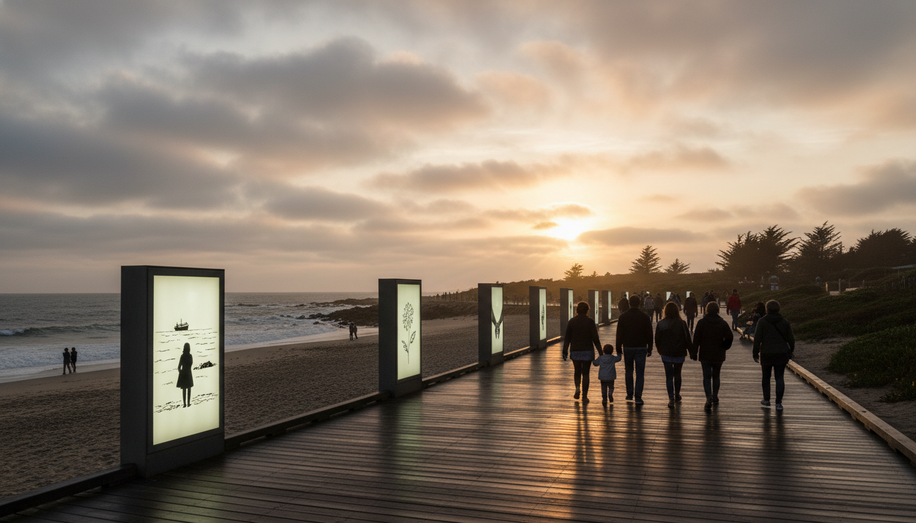

On a chilly Monday morning commute, a commuter steps out of the subway and meets the first frame of a story: a worried protagonist staring at a cracked phone screen. Two blocks later, the same commuter encounters the second frame: the same character discovering a solution. By the time they reach the office, the narrative has resolved on a digital panel by the lobby entrance, revealing the brand and a clear call to action. This is the promise of sequential out-of-home advertising: transforming static placements into chapters of a living story woven through the city.
Sequential OOH is emerging as one of the most potent ways to cut through urban noise. Instead of treating each billboard, street kiosk or transit shelter as an isolated impression, brands are designing narrative journeys that unfold over space and time. The approach borrows heavily from the fundamentals of brand storytelling—character, conflict, setting, and resolution—but adapts them to the rhythms of real-world movement: the walk from station to office, the drive along a major arterial road, the stroll through a shopping district.
At its core, storytelling in marketing is about emotional connection. Research into brand narratives shows that when people “love” a brand’s story, they are more likely to buy, stay loyal and advocate. OOH adds a crucial dimension to this equation: context. The environment in which a story is encountered shapes how it is felt and remembered. A playful narrative about spontaneity hits differently when discovered on a weekend promenade; a reassuring financial story carries more weight when told along the daily commute home.
The first step for any sequential OOH narrative is clarity of intent. Brands need a precise answer to three questions: who is the audience, what journey are they taking, and what role should the story play along that journey? A route used predominantly by young professionals might lend itself to a career-focused storyline; a path through a retail district may be better suited to tales of discovery and reward. Mapping the physical journey—where people enter, pause, and exit—provides the backbone for a narrative arc that feels natural rather than forced.
Once the route is understood, creative strategy turns to structure. Effective brand storytelling often follows a classic arc: introduction, rising tension, payoff. Sequential OOH allows each placement to embody a distinct chapter of that arc. The first encounter sets the scene, establishes the tone and introduces a character or situation. Subsequent panels deepen the drama, introduce a problem, or pose a question. The final touchpoints resolve the story and make the brand’s proposition explicit. When done well, each individual placement still works in isolation, but together they deliver a richer, more satisfying narrative.
Human presence is critical. Studies into effective advertising show that the right hemisphere of the brain responds strongly to human connection, dialogue and a clear sense of time and place. Sequential OOH can lean into this by making characters and situations consistent across multiple touchpoints. A commuter might first see a parent juggling work and family on a station poster, then glimpse a continuation of that moment at a bus shelter, before witnessing the uplift—thanks to the brand—on a roadside digital billboard. The repetition of familiar faces and settings fosters a feeling of continuity and recognition, deepening engagement with each exposure.
Visual storytelling techniques are especially powerful in this format. A series of placements can function like frames of a film, using composition, color and perspective to guide the viewer’s eye and signal progression. A narrative that begins in close-up can gradually “pull back” across the route to reveal the bigger picture—literally and metaphorically. Changes in lighting, weather or time of day within the visuals can mirror the real-world environment, enhancing the sense that the story belongs to the city itself.
Timing is another crucial element. Neuroscience research on storytelling highlights the importance of the first few seconds in capturing attention and setting emotional stakes. In OOH, that translates into the first panel needing to do the heavy lifting: intrigue, emotion, or a surprising image that invites mental participation. Later panels can afford to be more explanatory or product-focused, once the initial hook has done its job. On digital OOH, this principle extends further: creative can be day-parted so that specific “chapters” run during the morning rush, lunchtime or evening commute, echoing the evolving mood of the audience across the day.
Data and technology are pushing sequential OOH to new levels of sophistication. Location data can identify common travel patterns, informing where and in what order ads should appear. Dynamic content allows stories to adapt based on time, weather or nearby events—imagine a narrative that shifts when it starts to rain or when a local team wins a match. These tools do not replace creativity; they sharpen it, ensuring that the right chapter is delivered at the right moment in the right place.
Measurement, long viewed as a challenge for OOH, is also evolving in ways that strengthen the case for narrative campaigns. Exposure modelling, mobile location metrics and brand lift studies can help quantify how sequential storytelling affects recall, brand favourability and purchase intent. Early findings suggest that when people experience a coherent narrative across multiple placements, they are more likely to remember both the brand and its message than when they encounter a series of disconnected executions.
Of course, sequential storytelling is not without pitfalls. Overly complex plots can confuse hurried passers-by. If the creative relies too heavily on seeing every single chapter, many will miss the point. The craft lies in designing each placement to stand alone while still rewarding those who catch the full sequence. The narrative should be simple enough to grasp in a glance, yet layered enough to feel rewarding when encountered multiple times.
Urban environments are increasingly saturated with messages, but they are also filled with paths, routines and micro-journeys that can carry stories. When brands use sequential OOH to tell narratives that respect those patterns—stories with clear characters, emotional stakes and satisfying resolutions—they transform the city into a canvas for serialized storytelling. In doing so, they turn fleeting impressions into unfolding experiences, and static media into a living narrative that moves with the people it seeks to reach.
Successfully orchestrating these complex, location-aware narratives requires sophisticated tools for precision and optimization. Blindspot empowers brands to master sequential OOH by leveraging location intelligence for strategic site selection along audience journeys, and programmatic DOOH campaign management for dynamic content adaptation across each narrative chapter. This powerful combination, coupled with robust ROI measurement, ensures brands can precisely quantify the impact of their unfolding urban stories. Learn more at https://seeblindspot.com/