
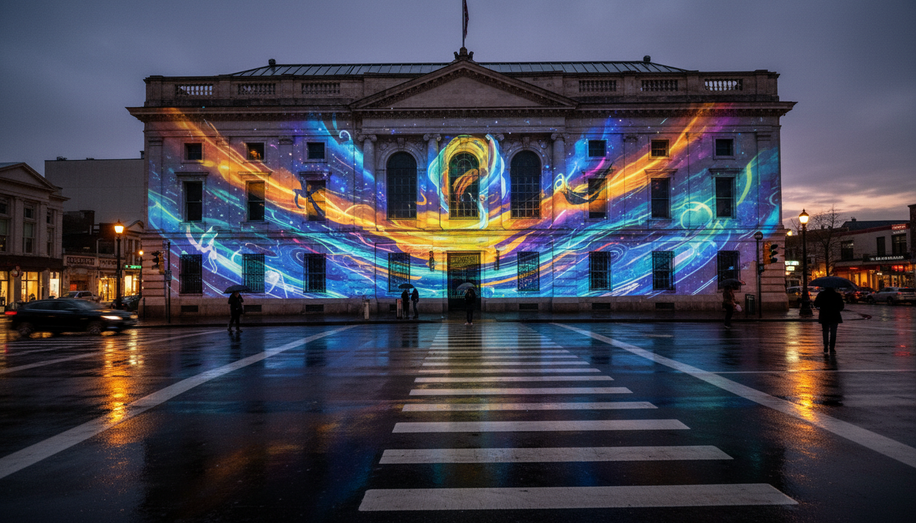

The urban landscape has undergone a profound transformation in recent years, with buildings and surfaces once destined to remain static canvases now becoming dynamic storytelling mediums. Projection mapping represents a watershed moment in out-of-home advertising, blending technical precision with creative artistry to reshape how brands communicate in public spaces.
Unlike traditional outdoor advertising, projection mapping operates at the intersection of architecture, software engineering, and visual design. The process begins with meticulous surface scanning and three-dimensional modeling. Technicians capture the precise contours, dimensions, and architectural features of target surfaces—whether a soaring skyscraper, an intricate sculpture, or an ordinary street-level wall. This digital blueprint becomes the foundation upon which everything else builds, ensuring that projected imagery aligns perfectly with the physical environment rather than simply overlaying content onto a flat plane.
The sophistication of projection mapping lies in its ability to make content appear as if it’s part of the structure itself. When images wrap around building features—corners, windows, architectural protrusions—they create an illusion of seamless integration. This is where projection mapping fundamentally diverges from standard digital outdoor advertising. A ten-second display projected onto a blank wall lacks the spatial intelligence and contextual awareness that defines true projection mapping. Instead, designers develop bespoke content specifically engineered to interact with and amplify a building’s unique characteristics, transforming the architecture into a complicit partner in the narrative.
Several projection methodologies have emerged to address different urban environments and creative objectives. Planar projection mapping works effectively on flat surfaces, while spherical projection involves synchronizing multiple projectors to create seamless three-dimensional effects. Panoramic approaches enable expansive horizontal displays across wide building facades. More sophisticated techniques like “vying” synchronize visuals with music and sound, creating immersive audio-visual narratives that engage audiences on multiple sensory levels.
The applications across urban settings continue to evolve. Billboard replacement represents perhaps the most direct commercial application, allowing brands to display moving images and videos where static billboards once stood—capturing attention with dynamic content impossible in traditional formats. Product launches benefit from event-specific projections that transform entire venues into branded environments. Vehicles themselves become moving canvases, particularly effective in dense urban centers and at high-traffic events. The technology even enables augmented reality integration, where smartphone users can point their devices at projections to unlock additional layers of interactive content and information.
The creative possibilities appear almost limitless, yet technical constraints remain meaningful. Environmental factors demand careful consideration—ambient light pollution can diminish projection quality, requiring strategic timing and location selection. Building specifications, structural integrity concerns, and regulatory compliance all factor into campaign feasibility. Weather conditions, from fog to rain, can impact visual clarity. These practical realities distinguish successful campaigns from failed executions.
What elevates projection mapping beyond technical novelty is its documented impact on audience engagement and brand recall. The visually stunning, impossible-to-ignore nature of large-scale projections captures attention in ways that static advertisements cannot replicate. This memorability translates to meaningful brand impact, particularly valuable for major product launches and high-profile campaigns targeting wide audiences.
The experiential economy has fundamentally shifted consumer expectations. Static billboards now feel antiquated against the backdrop of immersive digital experiences. Brands employing projection mapping as a cinematic storytelling vehicle consistently achieve longer audience engagement and wider social reach. When campaigns incorporate social media integration—encouraging attendees to share experiences with branded hashtags—organic amplification multiplies the campaign’s reach exponentially beyond the initial projection.
Looking forward, projection mapping continues incorporating increasingly interactive elements, allowing real-time audience engagement and adaptive content responding to environmental variables. The convergence of cinematic production values, spatial computing, and audience participation suggests that projection mapping will remain at the forefront of innovative out-of-home advertising for years to come.