
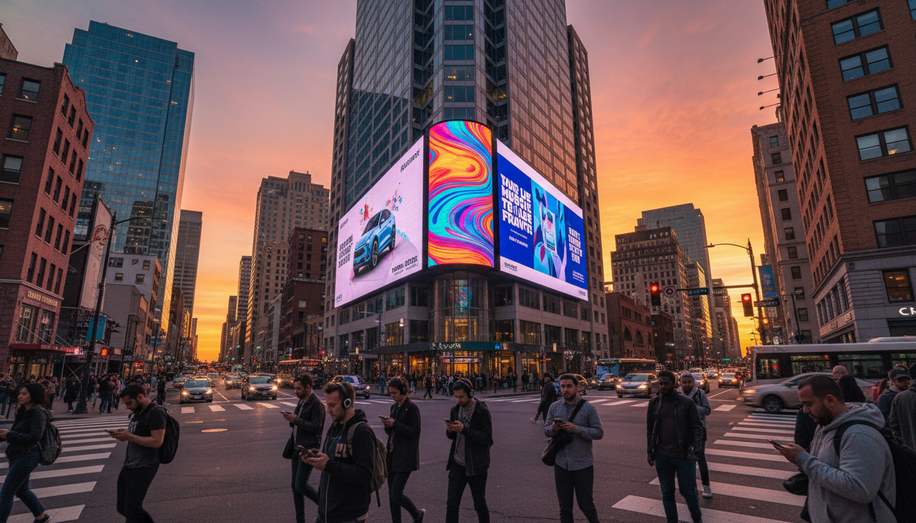

In the fragmented media landscape of today, out-of-home (OOH) advertising has evolved from a standalone powerhouse into a vital amplifier for digital, TV, and social media campaigns, creating seamless cross-channel synergy that drives superior return on investment. Brands that integrate OOH with these channels don’t just extend their reach—they forge immersive experiences that reinforce messaging across touchpoints, boosting effectiveness by up to 31% when paired with online ads and expanding overall audience exposure by 68%. This convergence transforms passive encounters into active engagements, turning commuters spotting a billboard into social media sharers and digital converters.
OOH’s unique strength lies in its real-world visibility, anchoring multi-channel strategies with high-impact physical presence that digital alone can’t replicate. Consider a consumer gliding past a dynamic billboard during rush hour: the bold visual lingers in their mind, priming them for reinforcement elsewhere. When that same ad echoes in a geo-targeted social media post or a mobile retargeting banner, it creates cross-channel recognition that sharpens brand recall, builds trust, and elevates conversion likelihood. Industry data underscores this: OOH integration with paid social media can lift effectiveness by 56%, while amplifying search by 80%, according to the Canadian Out of Home Marketing and Management Bureau. The result is a cohesive narrative that feels omnipresent, not intrusive.
Pairing OOH with digital channels exemplifies this synergy most vividly. Digital’s precision targeting—based on demographics, behaviors, and location—complements OOH’s mass reach in high-traffic zones, extending frequency and personalization. Strategies like mobile retargeting serve follow-up ads to devices near OOH placements, capturing audiences in the moment of exposure and guiding them to campaign landing pages. One proven tactic involves QR codes or custom URLs on billboards that funnel traffic straight to personalized digital experiences, blending the tactile pull of outdoor ads with online interactivity. This not only measures footfall-to-click attribution but also yields 65% higher conversion rates in cross-channel setups, providing advertisers with comprehensive data across platforms.
Social media takes this amplification further, turning static OOH displays into catalysts for viral conversations. Over half of consumers report that OOH ads with social components make them more likely to engage online, while nearly half say such ads influence their decision to follow brands on platforms like Instagram or Twitter. Hashtag campaigns shine here: a striking OOH creative featuring #BrandMoment invites passersby to snap photos and share, sparking user-generated content that extends reach organically. Geo-targeted social ads synced to OOH locations create synchronized hits, where a downtown billboard prompts immediate feeds tailored to local audiences. Social listening tools then monitor real-time sentiment, allowing brands to pivot—responding to feedback or fueling trending topics—while 33% of those exposed to OOH ads search social media for more brand info, per a Comscore/OAAA study. This feedback loop connects street-level buzz to digital amplification, making campaigns interactive and shareable.
Television campaigns, often siloed in living rooms, gain new life through OOH integration, propelling messages into the physical world. Broadcast TV builds initial awareness, but OOH extends its relevance, keeping brands top-of-mind during daily movements when screens are out of reach. A TV spot for a new product line, followed by transit ads echoing the same creative, creates continuity that “flies off screens,” as one expert puts it, sustaining engagement beyond viewing hours. This pairing not only boosts recall but also harmonizes with digital layers, like social recaps of TV moments displayed on digital OOH (DOOH) screens, revolutionizing omnichannel engagement.
The ROI payoff is undeniable. Integrated OOH strategies foster omnichannel harmony where each medium feeds the others: OOH provides credibility and mass exposure, digital delivers precision and measurement, TV offers storytelling depth, and social ignites participation. Brands achieve extended reach, heightened frequency, and measurable lifts— from 31% better online ad performance to turbocharged social behaviors. Yet success hinges on consistency: unified visuals, messaging, and calls-to-action ensure seamless transitions, whether from subway poster to Instagram story or TV commercial to street mural.
Forward-thinking marketers are already reaping these rewards. Campaigns blending DOOH with social media, for instance, prioritize multi-channel activation, meeting consumers on streets and screens alike. As attention spans fragment further, OOH’s role as the stabilizing force in multi-channel mixes will only grow, proving that true amplification comes not from more channels, but from smarter integration. For advertisers, the message is clear: in a world of digital noise, OOH isn’t just visible—it’s the spark that ignites everything else.
To fully leverage this cross-channel synergy and unlock superior ROI, advertisers need robust tools for strategic planning and optimization. Blindspot provides precise location intelligence and programmatic DOOH campaign management, enabling brands to seamlessly integrate OOH with digital strategies and measure multi-channel ROI effectively, transforming street-level buzz into quantifiable business outcomes. Discover how at https://seeblindspot.com/