
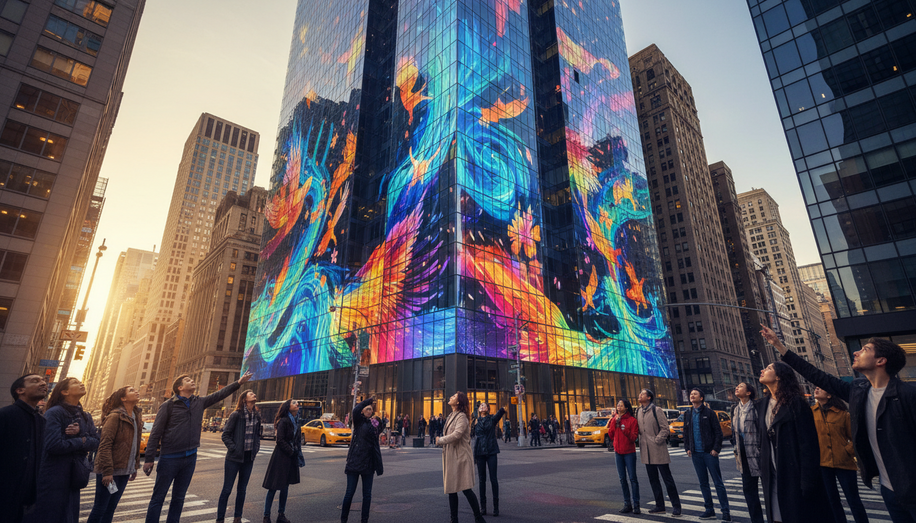

In the bustling heart of a city, a towering projection suddenly animates a blank building facade, transforming it into a cascading waterfall of branded chocolate bars that appear to melt under the evening lights. Moments like these define temporary out-of-home (OOH) installations, where brands ditch static billboards for fleeting, immersive experiences that hijack public spaces and ignite social media frenzy. From pop-up shops tucked into abandoned storefronts to holographic projections that defy gravity, these non-traditional activations blend creativity with logistics to deliver high-impact buzz, proving that ephemerality can outshine permanence in the attention economy.
Pop-up shops represent the ultimate in temporary OOH, materializing overnight in high-footfall zones like urban alleys or transit hubs to offer tactile brand encounters. IKEA’s “Sleepover in a Store” stunt invited customers to spend the night amid fully furnished showrooms, turning retail spaces into experiential playgrounds that garnered global media coverage and showcased bedding products in real-life scenarios. These installations thrive on surprise: a fitness brand might erect a pop-up gym near a park, complete with free workouts and photo ops, linking messaging to natural environments for contextual relevance. Logistically, they demand swift permitting—often just 24-48 hours in many municipalities—along with modular structures for quick assembly and disassembly. Power sources via generators or nearby grids, waste management plans, and 24/7 security mitigate risks, while data trackers like QR codes capture footfall metrics to justify ROI.
Projections take this a step further, projecting dynamic visuals onto unconventional canvases like skyscrapers or bridges for nighttime spectacles. BMW’s “Don’t Blink” 3D billboard simulated a car bursting from its frame using anamorphic illusions, captivating onlookers who shared videos virally across platforms. British Airways employed interactive projections at airports that reacted to passing planes, scaling aircraft silhouettes to emphasize spacious cabins. These setups require high-lumen projectors (10,000+ lumens for urban glare), precise mapping software to align images with surfaces, and temporary scaffolding for equipment. Permissions hinge on light pollution bylaws and neighbor consultations, with run times limited to dusk-to-dawn to avoid disruptions. Weatherproofing and backup power ensure reliability, turning potential downtime into a feature—projections that “react” to rain amplify immersion.
Street-level activations amplify intimacy by hijacking everyday fixtures. Bus shelters become portals: Pepsi Max fitted London stops with screens and cameras to overlay fantastical scenarios—like meteors hurtling toward passersby—blending real-time street views with digital mayhem. Dreamies cat food scaled up feline sculptures to “climb” building facades, hand-painted for hyper-realism and positioned as Instagram bait. Transit wraps extend this mobility, enveloping buses or trams in full-vehicle graphics that snake through traffic, as seen in Spotify’s Wrapped takeover, where subway stations pulsed with personalized user stats from October to November campaigns. Street furniture ads on benches or kiosks add QR codes for instant engagement, ideal for dense pedestrian zones where dwell time peaks during waits.
Logistical mastery separates viral hits from headaches. Site scouting prioritizes visibility and audience flow—proximity to events or demographics boosts efficacy—while utility audits confirm power and fiber access for digital elements. Budgets scale with ambition: a basic pop-up might run $50,000-$100,000 including fabrication and labor, escalating to $500,000+ for projections with custom tech. Insurance covers liabilities like structural failures or public injuries, and compliance with zoning laws prevents fines. Timing activations to cultural moments, like Taylor Swift lyrics transposed into massive Aussie billboards by Vegemite, maximizes organic amplification.
Yet the true power lies in integration. KFC’s Tower Burger displays used oversized projections to exaggerate product scale, driving crave-worthy visuals that lingered in memory. Tinder’s “Swipe Night” billboards shifted content based on real-time interactions, bridging OOH with digital realms. These hybrids leverage sensors or apps for personalization, as in the Financial Times’ Heathrow displays targeting transatlantic flights via API-fed data. Measuring success demands more than impressions: social listening tracks shares, while promo codes tie lifts to sales.
Temporary OOH thrives on constraint, forcing ingenuity that static formats can’t match. As urban spaces grow saturated, brands like Kit Kat reshaping benches into “break” zones or Lego crafting bus-stop “portals” to brick-built worlds remind us that buzz stems from delight. With declining costs for LED projections and AR overlays, expect more: pop-ups evolving into hybrid metaverses, projections syncing with live events. For marketers, the equation is clear—master the logistics, unleash the creativity, and watch temporary become timeless.