
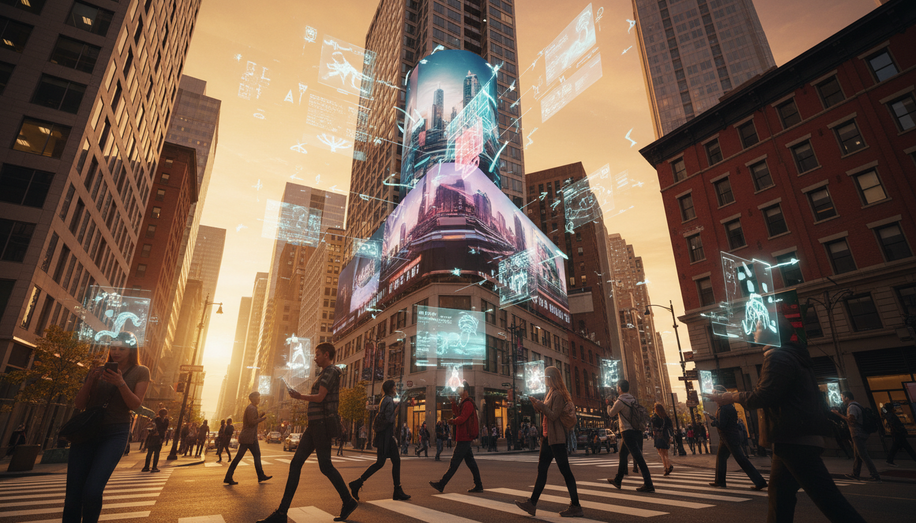

Augmented reality has moved beyond the smartphone screen and into the urban landscape, fundamentally reshaping how brands connect with pedestrians in real time. What once seemed like science fiction—billboards that come alive when viewed through a mobile camera, murals that animate with 3D creatures, and digital overlays that transform mundane cityscapes—is now standard practice in out-of-home advertising. This technological evolution represents a pivotal shift for the industry, merging the physicality of street-level advertising with the interactivity of digital experiences.
The transformation began with landmark campaigns that proved AR’s potential in public spaces. Pepsi Max’s “Unbelievable” bus shelter in London exemplified this breakthrough moment in 2015, using cameras embedded in the shelter to create a live feed of the street that appeared to show asteroids falling, UFOs invading, and tentacles emerging from the pavement to grab passersby. The campaign went viral with over six million YouTube views, establishing that AR could capture attention and generate substantial social media buzz in ways traditional OOH could not.
Today’s AR campaigns operate across multiple formats and environments, each designed to capitalize on the ubiquity of smartphone cameras. Digital screens replacing static billboards now leverage spatial computing to transform any city location into an interactive advertisement opportunity. Users simply scan a QR code or point their mobile device at a mural, billboard, or digital display to unlock layered experiences—animations, audio narratives, mini-games, and 3D graphics that emerge from the physical world around them.
The creative applications are remarkably diverse. Verizon’s collaboration with BrandXR during Art Basel 2024 deployed three AR murals across Miami neighborhoods, each tailored to its local context. In Midtown, a vibrant cityscape came alive with moving vehicles and lights when viewed through a smartphone. Coconut Grove featured digital vines growing over neon circuit boards, symbolizing the intersection of nature and technology. Hialeah’s mural transformed portraits of local residents into futuristic 3D visuals, emphasizing how connectivity powers human connections. Electrifly Detroit took the concept further, embedding AR features in 15 murals across the city, turning streets into a digital art gallery where festival-goers could unlock animations and audio stories using a dedicated app.
Beyond murals, brands have repurposed competitor advertising space itself. Burger King’s “Burn that ad” campaign in Brazil allowed users to virtually ignite competitor billboards through the Burger King app, replacing them with the brand’s own messaging and offering free Whopper coupons as digital rewards. Ally Bank partnered with Monopoly to create a 36-square treasure hunt game across six US cities, using web AR technology to deliver financial literacy content gamified around the beloved board game.
The measurable impact of these campaigns has proven compelling for advertisers. Vodafone’s AR initiative reached 50 million people, with 40 percent of engaged users visiting physical stores and 82 percent expressing excitement about the experience. The campaign generated over 17,000 minutes of active brand interaction, hundreds of thousands of social shares, and demonstrated a 10 percent boost in brand uniqueness with 5 percent higher consideration among participants. These metrics reveal that AR experiences don’t simply entertain—they drive real business outcomes by compelling foot traffic and purchase intent.
What makes AR particularly powerful in OOH is its ability to create genuine emotional connection. Unlike passive billboard consumption, AR demands active participation, transforming strangers into engaged brand participants. The technology captures real-time analytics on user engagement, revealing which specific elements resonate most and enabling rapid optimization. Location selection remains crucial—high-traffic areas near events, tourist attractions, and trendy neighborhoods consistently deliver higher user engagement.
As digital outdoor advertising infrastructure continues advancing, AR technology has become increasingly accessible and affordable for brands of all sizes. The convergence of better smartphone capabilities, improved AR platforms, and proven campaign frameworks suggests that interactive digital overlays will soon become the expectation rather than the exception in out-of-home advertising. The street, once a one-way communication medium, has become a canvas for two-way dialogue between brands and the urban audiences that inhabit it.