
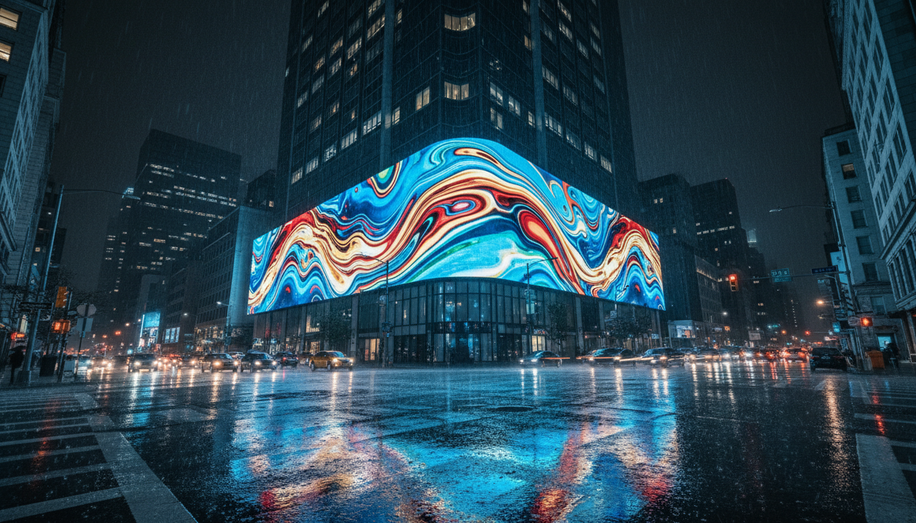

In the bustling arteries of urban life, where commuters rush past towering billboards and digital spectacles dominate cityscapes, out-of-home (OOH) advertising asserts itself through unyielding physical dominance. These massive displays—often spanning dozens of feet—don’t merely advertise; they command space, imprinting brands into the collective consciousness with a scale that digital screens can only mimic. This imposing presence triggers profound psychological responses, elevating brand authority, sharpening recall, and fostering consumer trust in ways that subtle online impressions cannot match.
The sheer size of OOH installations exploits the brain’s orienting response, an involuntary mechanism that snaps attention toward novel or dominant stimuli in the environment. Unlike fleeting digital ads that can be scrolled away, a billboard’s enormity ensures it registers peripherally, even during a hurried drive. Neuroscientifically, this engages spatial navigation systems alongside visual processing, creating dual-encoded memory traces that link the brand not just to imagery, but to geography itself. Premium locations like Times Square amplify this: visitors linger an average of 81 minutes, with 89% sharing on social media, forging multi-layered associations that persist long after the encounter. The result? Brands appear monumental, their scale signaling stability and prominence, much like ancient monuments that conveyed power through physicality.
This dominance builds brand authority by leveraging the mere exposure effect, a robust psychological phenomenon confirmed across 208 experiments showing that repeated, passive encounters increase liking without conscious awareness. Drivers may claim to ignore the colossal Coca-Cola sign or Nike spectacle, yet their brains quietly construct preference architectures. Bornstein’s 1989 meta-analysis underscores its universality across cultures and stimuli, including logos. OOH’s physical inescapability—immune to ad blockers—means exposure accumulates daily, transforming indifference into implicit endorsement. Consumers subconsciously equate size with substance: a brand bold enough to claim vast real estate must be established, reliable, a market leader unworthy of doubt.
Memorability surges from this scale-driven repetition, harnessing context-dependent memory and the spacing effect. Billboards viewed in the same commute context—say, that tenth pass at a familiar intersection—strengthen recall through geographic indexing, making the brand pop when shopping cues arise later. Working memory holds visuals for mere seconds, but OOH’s simplicity and boldness transfer them to long-term storage. Studies show 68% of consumers make unplanned purchases post-exposure, as environmental triggers connect repeated sightings to retail decisions. The brain retrieves the familiar first, mistaking recognition for preference: “I’ve seen this everywhere; it must be the choice.” Unlike cramped social feeds, OOH’s vast canvas allows uncluttered messaging—bold typography, vivid colors—that triggers the reticular activating system, cutting through visual noise for effortless cognitive fluency.
Yet scale’s power extends to consumer trust, rooted in emotional resonance and familiarity. Massive OOH evokes awe, akin to natural wonders, releasing dopamine that ties positive feelings to the brand. Emotional triggers—humor disarming skepticism, inspiration fueling aspiration, or FOMO via scarcity—amplified by size, bypass rational defenses. The amygdala, processing emotions, collaborates with the hippocampus for memory formation, ensuring evocative giants like a nostalgic holiday billboard linger over factual digital banners. Repetition in dominant formats builds trust incrementally: familiarity breeds comfort, scale implies endorsement by the environment itself. In high-dwell zones, this creates social proof—others see it too, validating the brand’s ubiquity.
Critics point to drawbacks like ad fatigue from oversaturation, where clutter dilutes impact, but strategic scale counters this by prioritizing dominance over density. When executed well, OOH’s physicality sidesteps digital resistance, embedding brands into lived experience. Premium placements multiply effects: emotional engagement plus repetition yields behavioral shifts, with passive presence proving more persuasive than overt persuasion.
Consider luxury brands like Chanel or Rolex, whose supersized OOH campaigns project exclusivity through grandeur. Consumers report heightened prestige perception, as the format mirrors the product’s aspirational aura. Fast-food giants exploit urgency on vast wraps, nudging impulse stops via scale-amplified FOMO. Data bears this out: OOH drives 68% unplanned buys, outpacing many channels by fostering unconscious authority.
In an era of fragmented attention, OOH’s imposing scale reclaims the physical world for branding. It doesn’t demand eyes; it claims them. By dominating sightlines, it forges authority through perceived power, cements recall via relentless exposure, and cultivates trust through emotional and familiar bonds. Brands ignoring this medium forfeit the primal psychology of presence, while those embracing it tower over digital rivals—literally and figuratively. As cities evolve, so does OOH, blending scale with interactivity for even deeper imprinting. The message is clear: in advertising, size doesn’t just matter; it rules the mind.