
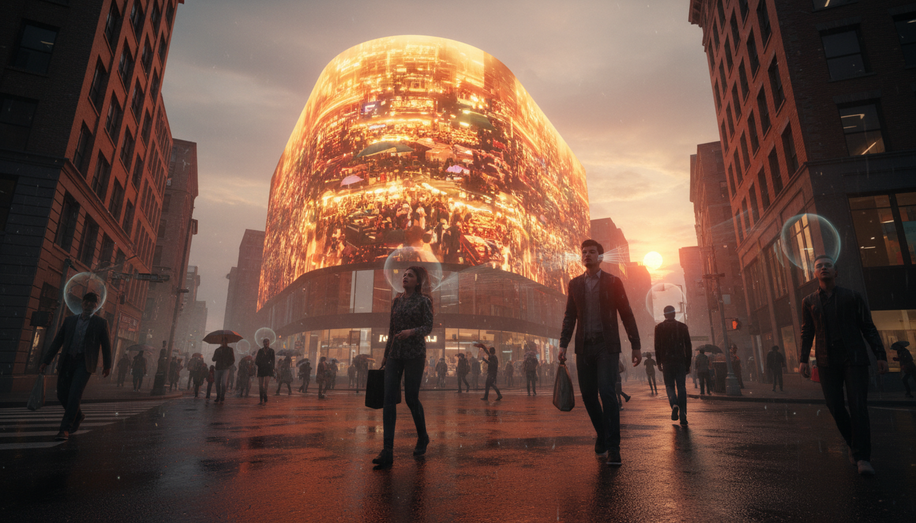

In the cacophony of urban streets, where visual billboards compete for fleeting glances, a new layer of sensory engagement is emerging: sound. Directional audio technology, which beams sound precisely like a spotlight, is transforming out-of-home (OOH) advertising from passive visuals into immersive sonic experiences, capturing attention without the blight of noise pollution. Paired with large digital screens in city centers, business districts, and transit hubs, this innovation focuses audio on targeted zones, ensuring messages cut through ambient clamor while sparing surrounding areas.
Consider the bustling streets of Amsterdam, where a massive Nokia music phone poster came alive not just through imagery, but with targeted music and voiceovers projected via Holosonics’ Audio Spotlight speakers. The directional beams drew crowds, reinforcing the phone’s musical appeal and amplifying campaign impact amid pedestrian hustle. Similarly, in New York City’s Lower Manhattan, a seven-story A&E billboard for “Paranormal State” used paired AS-24i speakers mounted atop the structure to hurl eerie whispers directly onto the sidewalk below, startling passersby into engagement without echoing through nearby buildings. These installations demonstrate how directional sound turns static OOH displays into dynamic narratives, boosting dwell time and recall.
The technology’s core advantage lies in its physics: ultrasonic speakers generate a narrow beam of sound that remains coherent over distance, delivering clarity as if listeners wore headphones. Audfly Technology’s outdoor models, like the YS-V112CH and SA-2001A, exemplify this for large screens in tourist hotspots, concentrating audio to enhance high-definition visuals while mitigating noise complaints—a persistent hurdle for traditional speakers that broadcast omnidirectionally. In Hong Kong, JCDecaux harnessed Audio Spotlight AS-16i units at bus shelters to pipe Star Wars character voices exclusively to sidewalk sweet spots, hyping Disneyland’s Tomorrowland without irking adjacent eateries or shops.
Beyond precision, directional audio fosters interactivity. Sensors can trigger personalized soundscapes as proximity is detected, evolving ads into conversational encounters. A Zurich train station campaign for Switzerland’s Graubünden region featured a virtual mountaineer on a digital screen inviting yodels for vacation prizes; directional audio made his calls feel intimate, shocking commuters into participation and virally extending reach. In retail corridors like malls or airports, this pairs with promotional content—imagine pool splashes luring swimmers to one aisle while touchdown cheers beckon athletes elsewhere—driving impulse buys without store-wide intrusion.
Ambient soundscapes take this further, crafting layered auditory environments that envelop without overwhelming. Rather than blunt announcements, OOH setups now weave subtle, thematic audio into visuals: roaring racetracks and AC/DC riffs beaming onto a TNT NASCAR banner in Charlotte’s EpiCentre, immersing passersby in high-octane energy targeted to a 26-foot logo zone. At Clark/Lake station in Chicago, Intersection’s video wall integrates exclusive directional sound, allowing advertisers to layer commuter-tailored narratives that resonate precisely where feet meet pavement. Museums have long pioneered this—directional speakers provide exhibit-specific commentary, preserving serene galleries—proving the tech’s versatility for OOH’s public realms.
Sales data underscores the payoff. A study cited in directional audio analyses found beverage promotions with matched soundscapes lifted sales nearly 60 percent in retail settings, with greater lifts in larger stores where impulse reigns. OOH campaigns echo this: Audfly’s systems not only sharpen message comprehension but also promote “green advertising” by confining sound, dodging regulatory ire in noise-sensitive zones like subways or high streets. Holosonics’ Obie-winning applications in guerrilla projections and in-store activations further validate the edge, pushing creative boundaries where silence once limited audio’s role.
Challenges persist, chiefly integration and scalability. Optimal beam distances vary by model—Audfly advises site-specific calibration—and harsh weather demands rugged outdoor units. Yet, as programmatic audio evolves, pairing directional tech with data-driven targeting promises hyper-personalized soundscapes, like weather-reactive ads or demographic-tuned tracks. Focusonics and Brown Innovations highlight corporate video walls benefiting from “crystal clear” zoning, minimizing office disruptions while maximizing employee exposure.
The sonic layer redefines OOH’s potency, marrying sight and sound for multisensory memorability. In an era of ad fatigue, brands wielding directional audio and ambient designs don’t just advertise—they orchestrate experiences that linger in the mind long after the street fades. As deployments proliferate from billboards to bus stops, the message is clear: hearing is believing, and precision is the key to unlocking it.