
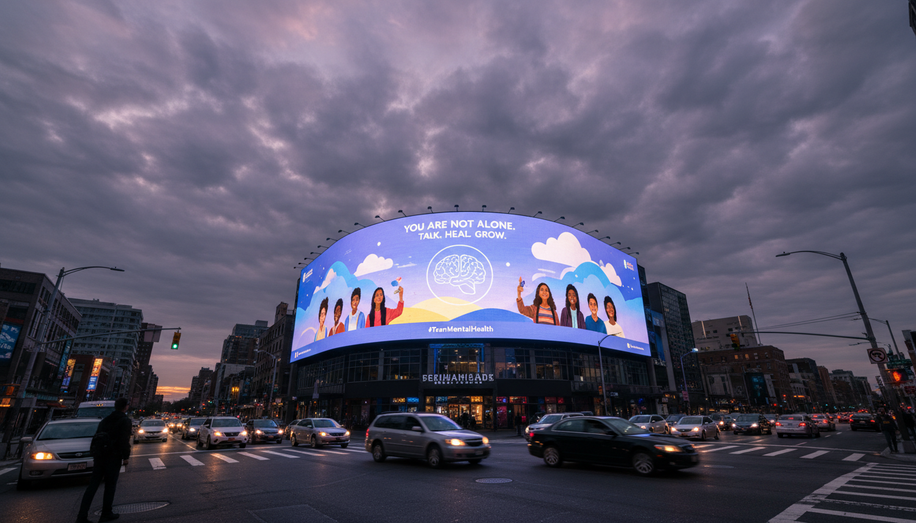

In the bustling arteries of cities worldwide, out-of-home (OOH) advertising transcends its commercial roots, emerging as a potent force for public good. Non-profits and government agencies have harnessed billboards, digital screens, and transit displays to ignite awareness, spur behavioral shifts, and foster social change, proving that OOH’s unmissable presence can rally communities around shared causes.
Consider Mothers Against Drunk Driving (MADD), whose stark billboards have long pierced the holiday haze of revelry. Featuring grim statistics and haunting visuals of crash victims, these displays target high-risk periods like New Year’s Eve and Independence Day, reminding motorists of the lethal perils of impaired driving. The emotional punch—evoking the raw sorrow of preventable tragedies—compels viewers to rethink their choices, demonstrating OOH’s knack for blending visual shock with urgent messaging.
Environmental advocates have similarly commandeered OOH to safeguard the planet. Agencies spotlighting water conservation and wildlife preservation deploy evocative imagery: majestic animals amid threatened habitats, paired with pleas to recycle or support protection efforts. The World Wildlife Fund (WWF), for instance, leverages public service announcements (PSAs) across billboards to stir awe and accountability, transforming passive passersby into active stewards of nature.
The COVID-19 pandemic underscored OOH’s real-time responsiveness. Governments blanketed urban landscapes with directives on mask-wearing, vaccination sites, and hygiene, delivering critical updates where people congregate—highways, bus stops, and squares. These campaigns cut through information overload, providing digestible, location-relevant guidance that saved lives by embedding public health into everyday commutes.
Digital out-of-home (DOOH) elevates this impact with precision and interactivity. Australia’s Lifeblood blood service exemplifies this, triggering donor appeals on screens during peak need, corroborated by footfall studies showing surges in center visits. The campaign’s data-driven targeting not only boosted awareness and donation intent but clinched awards for behavior change, illustrating how DOOH synchronizes messages with societal pulses.
In Finland, OOH operators like JCDecaux and Ocean Outdoor donated digital screens for Ukraine aid alerts, mimicking phone notifications with donation prompts via MobilePay. Amid the ongoing conflict, these unbidden interruptions on nearly every city screen galvanized support, connecting distant audiences to global crises and underscoring OOH’s role in humanitarian mobilization.
Health crises find a resonant ally in OOH too. Sweden’s Alzheimer Foundation commandeered donated billboards from Ocean Outdoor, repurposing the universal loading icon to depict the disease’s theft of memories—real photos of affected loved ones fading like stalled screens. With dementia cases projected to double by 2050, this visceral campaign across TV and social amplified calls for research funding, turning abstract statistics into intimate imperatives.
Even cultural initiatives reveal OOH’s societal muscle. The Outdoor Advertising Association of America’s 2014 Art Everywhere campaign blanketed the U.S. with voter-selected masterpieces from institutions like the Art Institute of Chicago. Public installations sparked social media frenzy under #ArtEverywhereUS, generating 50 million impressions and proving OOH’s power to democratize art, bridging museums and streets.
Political and grassroots efforts further amplify this. Local candidates pair billboards with social hashtags to engage voters, while anti-drug PSAs like “This Is Your Brain on Drugs” from the Partnership for a Drug-Free America use unforgettable metaphors to deter youth. The Ad Council sustains such drives on topics from safety to equity, their videos and OOH executions fostering long-term community resilience.
What binds these triumphs? Emotional resonance and clear calls to action. PSAs thrive by tugging heartstrings—joy in unity, grief in loss—then channeling it via hotlines, websites, or QR codes. OOH’s ubiquity ensures broad reach without digital fatigue, its static or dynamic formats lingering in minds during idle moments.
Yet challenges persist: measuring intangible shifts like attitude change demands creative metrics, from footfall analytics to social lift. Still, as non-profits and agencies innovate—weather-triggered health pleas or geo-fenced donation drives—OOH solidifies as a beacon beyond commerce.
Ultimately, these campaigns affirm OOH’s evolution into a public trust. By forgoing sales pitches for societal uplift, billboards and screens become communal conscience-keepers, driving education, empathy, and action where it matters most: in the open, under the sky.
However, making OOH an even more potent force for public good requires cutting-edge tools to maximize its impact and demonstrate accountability. Platforms like Blindspot offer the precision necessary, with location intelligence, audience measurement, and programmatic DOOH capabilities ensuring critical messages reach the right communities at the optimal moment, while real-time performance tracking quantifies their vital societal influence. Learn more at https://seeblindspot.com/