
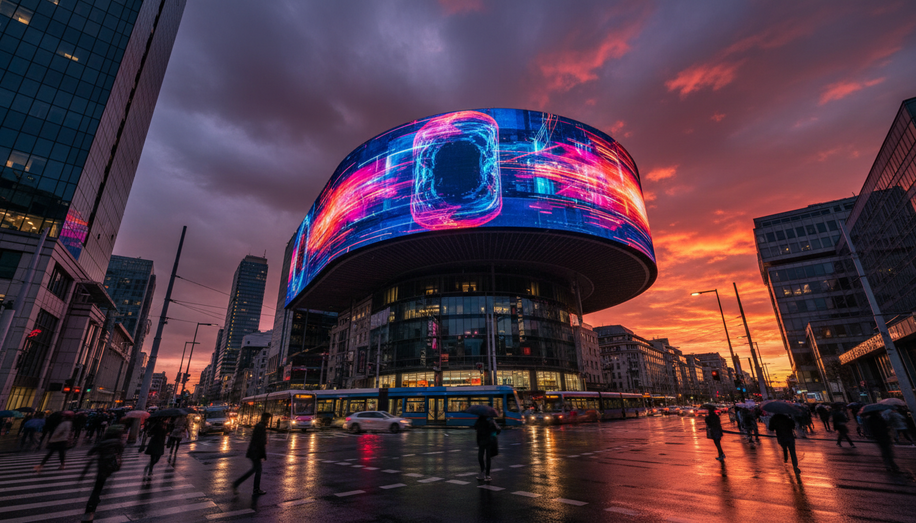

In the fleeting glance of a commuter hurtling past a billboard at 60 miles per hour or a pedestrian dodging crowds under harsh midday sun, out-of-home (OOH) advertising demands instant comprehension. Creatives must master the visual language of the street, where color theory and typography converge to cut through visual noise, ensuring messages not only register but lodge in memory. High color contrast alone can boost recall by 38 percent, according to research from PSA Research Center, while strategic font choices amplify clarity in diverse, high-speed conditions.
Color psychology forms the bedrock of this discipline, wielding hues as emotional triggers tailored to OOH’s unforgiving environment. Red commands attention with its associations of energy, urgency, and passion, making it ideal for promotions or calls to action that spur immediate response—think Coca-Cola’s iconic crimson campaigns that evoke celebration amid urban bustle. Blue counters with trust and professionalism, offering visual calm that stands out against summer glare or cluttered cityscapes, where cool tones provide perceptual relief from heat and brightness. Green signals harmony and nature, perfect for eco-brands, while yellow injects optimism and dynamism but risks fading in sunlight unless paired thoughtfully. These choices aren’t arbitrary; they influence brand perception, with studies showing colors can heighten recognition by 80 percent and sway buying decisions by 85 percent.
Yet psychology alone falters without environmental savvy. Summer’s intense light washes out low-contrast palettes, blending warm tones like orange into hazy skies or reflective surfaces, while high humidity dulls subtlety. Advision Digital emphasizes limiting palettes to four colors—such as red for punch, blue for balance, green for growth, and a neutral like black or white for grounding—to maximize impact without overwhelming the viewer. High-contrast combinations, like dark backgrounds with light text or blue fields accented by bold yellow, ensure legibility from afar, as validated by multiple OOH experts. Testing in natural conditions trumps studio mockups, accounting for glare, distance, and backdrop—trees bleeding green into signage or urban grays muting vibrancy.
Typography elevates this foundation, transforming color into readable narrative. In OOH, where exposure lasts mere seconds, fonts must prioritize scalability and simplicity. Bold, sans-serif typefaces like Helvetica or Futura dominate because their clean lines maintain shape at speed and scale, resisting distortion from motion blur or peripheral vision. Research underscores that high hue and value contrast between text and background is non-negotiable; low-contrast pairs like yellow on white vanish, while black on yellow or white on navy pierce the haze. Limit text to seven words or fewer, with hierarchy guiding the eye: largest for the hook, medium for the brand, smallest for the call to action, all kerned generously to avoid crowding.
Readability thrives on these principles amid OOH’s chaos—diverse audiences, varying literacy levels, and multicultural contexts demand universality. For global campaigns, avoid culturally loaded colors; red signifies luck in Asia but danger elsewhere, so anchor in high-contrast neutrals. Digital out-of-home (DOOH) adds dynamism, with video walls pulsing accents via software for personalized palettes, yet static rules persist: saturated primaries over pastels for punch, and ample white space for “breathing room” that eases cognitive load. Effortless Outdoor Media advises cool backgrounds in heat-prone seasons, reserving warms as accents to balance aggression with approachability.
Real-world mastery shines in execution. Starbucks leverages green’s soothing vibe against white for crisp logos visible in rain-slicked streets, while IKEA’s blue-yellow duo recalls Swedish heritage without sacrificing contrast. Blip Billboards champions dark fields with luminous text, proven for distance readability, as in a blue backdrop with yellow “Exit Now” that pops ethically and urgently. Creatives should prototype at full scale, simulating drive-bys or walks, adjusting saturation for overcast days when colors desaturate.
Ultimately, optimizing color and typography for OOH means harmonizing emotion with engineering. Align palettes to brand ethos—vibrant for youth, muted for luxury—while enforcing contrast for inclusivity. In high-speed streets, where diverse eyes skim in fragments, this visual grammar crafts memorability: a red slash urging action, blue anchoring trust, sans-serif clarity sealing the deal. Brands that wield it don’t just advertise; they imprint on the urban psyche, turning passersby into recall-ready advocates. This is where platforms like Blindspot become indispensable, offering location intelligence to optimize ad placement against environmental variables and real-time performance tracking to ensure color and typography choices resonate with diverse audiences, transforming theoretical best practices into measurable impact. Discover more at https://seeblindspot.com/