
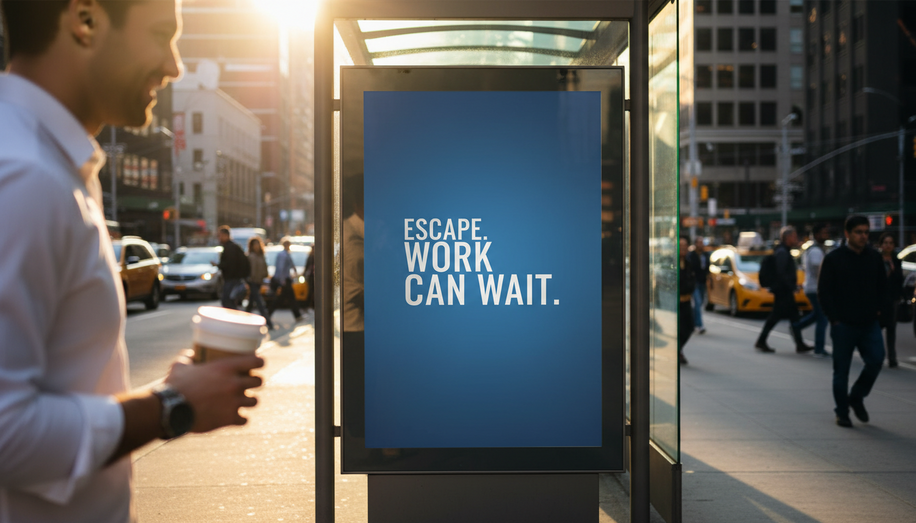

In the split-second world of out-of-home advertising, where a driver’s gaze lingers for just five to ten seconds on a highway billboard, the power of words hinges on their scarcity. Micro-copy—the ultra-concise phrasing engineered for fleeting glances—transforms passive passersby into engaged prospects by delivering instant clarity and memorability. Mastering this craft demands stripping away excess, wielding simplicity like a scalpel to carve messages that stick amid the blur of motion.
The foundational rule is brutal: seven words or fewer. This isn’t arbitrary; it’s rooted in the physics of perception. At 500 feet or more, billboard text must tower at least a foot high, with generous spacing to pierce distance and speed. Pack in more, and comprehension collapses. “Don’t cram several messages into one ad,” experts advise, urging instead a single, punchy line that complements a dominant visual rather than competing with it. Consider the highway sequence: one billboard teases a benefit, the next reveals the brand, building a narrative arc without overwhelming the viewer. This brevity ensures recall, turning a glance into a mental bookmark.
Clarity reigns supreme, demanding language that’s stark and jargon-free. Simplicity sells because the brain, bombarded by urban chaos, craves the straightforward. Effective micro-copy speaks directly to the audience’s immediate needs, evoking emotion in a flash—humor to disarm, urgency to propel, nostalgia to linger. A fast-food chain might deploy “Hungry? Exit Now,” pairing visceral craving with a clear directive, its bold contrasts popping against the asphalt haze. Here, transparency fuses with empathy: the copy acknowledges the driver’s rumble of hunger without belaboring features or fine print.
Visual-text synergy elevates micro-copy from mere words to a holistic strike. The text doesn’t dominate; it dances with imagery. A high-resolution, singular focal point image—never grainy or cluttered—anchors the message, while copy rides its momentum. Bright, contrasting colors ensure legibility from afar, dodging camouflage against skies or streets. Layout follows the rule of thirds, funneling eyes to the core: logo low, call-to-action punchy, whitespace breathing room for focus. On street furniture or transit shelters, where dwell time stretches to 50 feet or less, font sizes shrink to one to four inches, allowing slightly more nuance—but never straying from micro-copy’s ethos.
The call-to-action (CTA) seals the deal, bridging impulse to behavior in mere syllables. “Scan. Save. Smile.” with a QR code invites interaction, leveraging digital bridges that seven in ten adults now expect in OOH. These elements—handles, codes, AR triggers—morph static displays into dynamic portals, trackable via scans and shares. Yet functionality trumps flair; the CTA must propel user action explicitly, promising tangible gain like “Unlock 50% Off Now.” Personality infuses subtly—a brand’s wry tone, perhaps—but never at clarity’s expense.
Tailoring to placement is non-negotiable, as context dictates execution. Highway bulletins demand outsized simplicity: make small objects bigger, text minimal. Closer venues like malls or airports permit denser interplay, with fonts scaling from one inch up. Audience behavior informs all: commuters barreling at 70 mph need idiotic-proof phrasing, while urban walkers absorb layered wit. Vibrant, on-brand imagery balances the triad of copy, visuals, and void, preventing suffocation.
Legendary campaigns embody this mastery. Coca-Cola’s “Open Happiness” distilled joy to two words, visuals bubbling with effervescence for universal punch. Apple’s sequential “Shot on iPhone” billboards layered user stories across exposures, each micro-copy—”Breathe”—a poetic hook amplifying the photo’s proof. These succeed by emotional resonance, not volume; they feel personal, urgent, inevitable.
Critics might argue brevity risks dilution, but data counters: shorter messages yield higher recall and engagement. In OOH’s metrics—reach via traffic flows, frequency for repetition, interactions via CTAs—micro-copy outperforms verbosity every time. It forges connections in the ephemeral, proving less is exponentially more.
Yet the art evolves. As digital OOH proliferates, micro-copy adapts, embedding scannable prompts that extend the glance into journeys. Agencies now sequence programmatic boards, rotating messages for personalized hits based on time or traffic. Still, the core endures: distill to essence, amplify with visuals, ignite action.
Ultimately, crafting micro-copy for OOH is alchemy—transmuting constraints into impact. It rewards the disciplined writer who edits ruthlessly, tests relentlessly, and empathizes deeply. In an attention economy ruled by motion, these microscopic words wield macroscopic might, ensuring your brand doesn’t just appear, but imprints. Blindspot empowers brands to transcend these challenges, leveraging programmatic DOOH management to sequence dynamic micro-copy for optimal impact and personalization. By providing real-time audience measurement and performance tracking, Blindspot ensures that every meticulously crafted, concise message hits its mark, transforming fleeting glances into measurable engagement and robust ROI. Learn more at https://seeblindspot.com/