
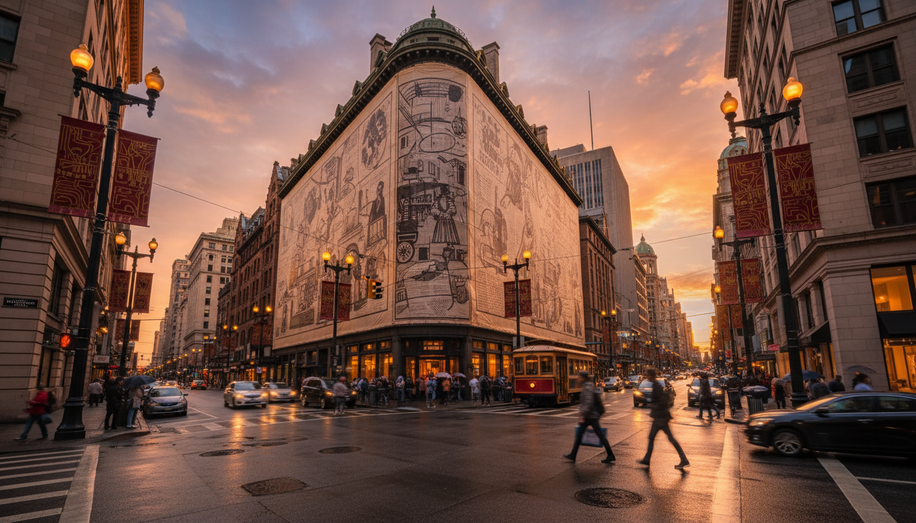

In the shadow of programmatic digital out-of-home (DOOH) advertising’s rapid ascent, a quieter revolution is stirring: the extension of automation principles to static and non-digital OOH formats like printed billboards, bus wraps, posters, and transit panels. While pDOOH has transformed digital screens into data-responsive powerhouses—enabling real-time bidding, audience targeting, and dynamic creative swaps based on weather, traffic, or time of day—extending these efficiencies to traditional static inventory promises to unlock untapped scale and precision for the broader OOH ecosystem. This nascent frontier, often dubbed programmatic static OOH, reimagines inventory management, placement decisions, and even creative production through software-driven workflows, potentially automating what has long been a manual, labor-intensive process.
The core appeal lies in bridging the gap between static OOH’s enduring strengths—long-term brand presence, high visibility in high-traffic areas, and cost-effectiveness—and the agility of programmatic digital buying. Traditional static campaigns require months of advance planning: site selection, vinyl printing, installation scheduling, and fixed-term contracts that lock in locations regardless of audience fluctuations. Programmatic static OOH flips this script by introducing demand-side platforms (DSPs) and supply-side platforms (SSPs) tailored for non-digital assets. Advertisers could bid in real time not just for impressions but for physical placements, using aggregated data signals like foot traffic patterns, demographic profiles from nearby mobile devices, or environmental triggers to match campaigns to optimal sites. Imagine a retail chain programmatically securing bus shelter panels near shopping districts during peak sales periods, or a beverage brand automating billboard swaps in response to seasonal demand, all without human intervention.
Early implementations hint at the mechanics. Inventory platforms are emerging to catalog static assets with granular metadata—screen types evolve into descriptors like “6×3 posters,” “dominators,” or “street furniture”—enabling automated auctions where DSPs optimize for audience proximity to points of interest, commute flows, or even local events. Data from geofencing, footfall sensors, and first-party sources could inform placement algorithms, shifting from “buying the location” to “buying the audience,” much like pDOOH’s evolution. Production workflows, too, stand to automate: AI could generate print-ready creatives dynamically, predict installation timelines via IoT-enabled logistics, and track performance through post-campaign audits using computer vision or anonymized device tracking. Lamar Advertising, for instance, already experiments with programmatic access to urban panels that blend static and limited digital elements, suggesting a hybrid pathway forward.
Yet challenges abound, tempering the hype. Static OOH’s physicality imposes hard limits that digital screens evade. Lead times for printing and installation—often weeks—clash with programmatic’s demand for near-instant execution, necessitating predictive bidding models that forecast inventory availability days or months ahead. Measurement remains elusive: while DOOH leverages pixel-perfect impression counts, static formats rely on estimates from traffic counters or mobile lift studies, introducing variability that erodes advertiser confidence. Supply fragmentation exacerbates this; thousands of independent operators manage disparate static inventories, lacking the unified exchanges that power online programmatic. Regulatory hurdles loom as well—zoning laws, permitting delays, and content restrictions on alcohol or political ads on certain panels complicate automated deployment.
Scalability hinges on technology partnerships. Emerging platforms aim to unify static supply through blockchain-like ledgers for transparent inventory tracking or AI for predictive maintenance, reducing downtime from weather damage or vandalism. Integrations with existing DSPs could enable cross-channel campaigns, where static buys complement DOOH for omnichannel reach—say, a vinyl billboard reinforcing a real-time digital trigger nearby. Pilot programs from agencies like Plug Talk Media demonstrate feasibility: they’ve applied programmatic logic to static formats by pooling high-impact locations and using data overlays for smarter placements, yielding measurable lifts in brand recall without full digital infrastructure.
Critics argue static OOH may resist full automation, preserving its value in deliberate, high-impact placements like hand-painted wallscapes that demand human curation. Direct buys retain advantages for guaranteed slots in premium venues, where programmatic variability could falter during high-demand events. Still, as data ecosystems mature—fueled by 5G-enabled sensors and privacy-compliant aggregation—the economics tilt toward hybrid models. Brands could allocate budgets dynamically across static and digital, optimizing for ROI via unified dashboards that blend impression-based pricing with traditional CPMs.
Looking ahead, programmatic static OOH could democratize the medium for small businesses, slashing entry barriers through self-serve platforms and fractional inventory shares. Global expansion beckons, particularly in markets with dense static networks like Europe’s posters or Asia’s transit wraps. Success demands collaboration: media owners investing in digital twins of physical assets, tech firms building robust APIs, and advertisers embracing probabilistic targeting over pixel-perfect control. By 2030, analysts predict this convergence could capture 30 percent of static OOH spend, blending the tactile power of traditional formats with digital-era intelligence. The result? OOH reborn—not as a relic, but as a programmable canvas for the physical world.