
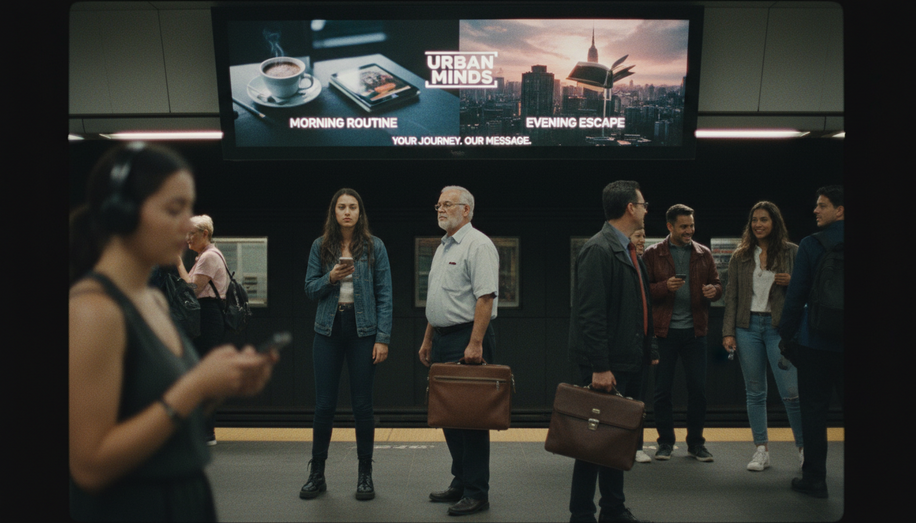

In the dim fluorescence of subway stations and the rhythmic sway of metro cars, commuters navigate a world suspended between home and work, a limbo where minds wander amid the roar of arriving trains. This underground realm shapes a distinct psychology: part anticipation, part resignation, marked by extended dwell times on platforms and uninterrupted exposure inside carriages. Advertisers who grasp this mindset can craft out-of-home (OOH) campaigns that don’t just interrupt the journey but propel it forward, turning passive riders into engaged consumers.
Commuters underground are a captive audience, their attention unclaimed by smartphones or street distractions. Unlike fleeting billboard glimpses, subway riders spend minutes—or longer—waiting for trains, eyes scanning walls, floors, and ceilings for relief from monotony. Research highlights this “extended dwell time” as a core advantage, allowing brands to deliver complex messages that build over repeated exposures. During rush hour, professionals clutch briefcases, mentally rehearsing meetings; off-peak, students and tourists drift in reverie. This variance demands tailored messaging: bold visuals for the harried morning crowd, aspirational narratives for evening unwinders seeking escape.
Understanding commuter psychology starts with the journey’s stages. On platforms, impatience reigns—eyes dart to digital clocks, bodies shift toward track edges. Here, eye-catching visuals dominate: vibrant colors, oversized imagery, and concise slogans that pierce the crowd’s peripheral vision. A coffee brand might deploy station domination, wrapping escalators in steaming mug motifs with a tagline like “Fuel the Rush,” timed for 8 a.m. peaks when caffeine cravings peak. Inside trains, the mindset shifts to introspection; riders lean against poles, zoning out as stations blur by. Train wraps or interior panels excel here, offering uninterrupted views that foster familiarity. Repetition along fixed routes reinforces recall—commuters see the same ad daily, etching it into subconscious memory.
Demographics further refine the approach. Metro systems thread through urban veins, serving diverse profiles: finance workers near business districts, creatives in artsy neighborhoods, families on weekends. Data analytics on peak patterns—morning pros versus evening shoppers—enable precise targeting. Place luxury watch ads at executive-heavy stations during commutes home, when disposable income thoughts surface; student-oriented promo codes for apps at campus-adjacent stops. This isn’t scattershot exposure; it’s psychological alignment, matching messages to mindsets. A fitness chain, for instance, could hit platforms with motivational bursts—”Reclaim Your Day”—leveraging post-work guilt, then follow with train car testimonials for deeper persuasion during the ride.
Yet resonance requires more than placement; it hinges on emotional attunement. Underground travelers crave purpose amid drudgery—escape, efficiency, connection. Campaigns that mirror this transform ads into companions. Interactive digital screens adapt in real-time: weather-tied offers (“Rainy commute? Warm up with us”) or QR codes for instant rewards, bridging idle moments to action. Storytelling thrives too; narrative sequences across platforms and cars mimic the journey itself, unfolding a brand’s tale as riders progress. Consider a travel agency: platform teasers evoke wanderlust with sunset beaches, train interiors detail deals, culminating in a call-to-action at the destination station. Such progression exploits the linear psychology of transit, turning commutes into immersive brand experiences.
Challenges persist—overcrowding dilutes impact in peak hours, while fast paces limit absorption—but savvy design counters them. Concise copy, under 10 words, pairs with striking imagery to seize fleeting glances; bold fonts ensure readability from afar. Integration amplifies reach: subway OOH synced with social retargeting creates multi-touch journeys, extending underground impressions above ground. Metrics validate success—high visibility to millions daily, boosted recall from captive settings, measurable lifts in brand awareness and foot traffic.
Ultimately, commuting with purpose means viewing the subway not as mere transport but a psychological corridor ripe for connection. Brands that decode the underground mindset—impatience on platforms, reflection en route, diversity in demographics—unlock OOH’s full potency. In these tunnels, where millions transition daily, tailored campaigns don’t just advertise; they accompany, inspire, and convert, proving that the most effective messages travel as far as the mind.