
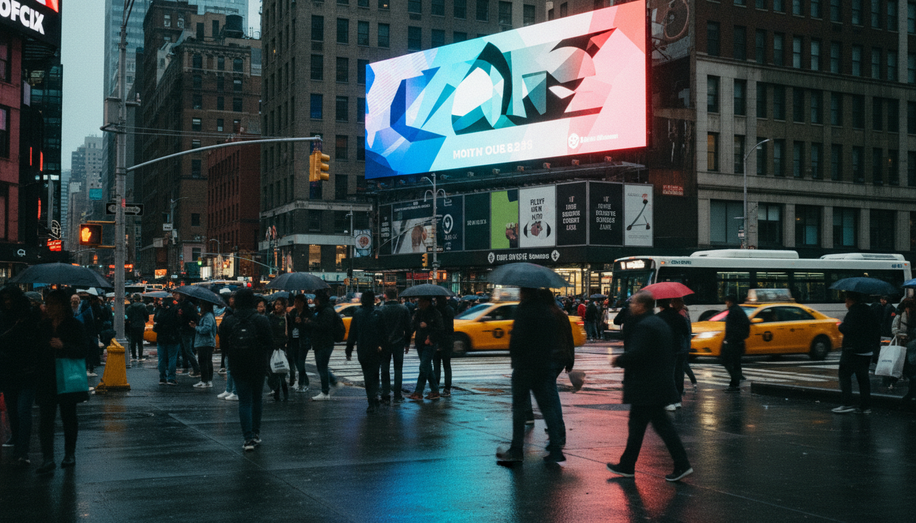

In the high-stakes world of out-of-home (OOH) advertising, where every billboard and digital screen vies for fleeting attention amid urban hustle, artificial intelligence is emerging as the ultimate strategist. By crunching vast datasets on traffic patterns, demographics, and environmental variables, AI doesn’t just suggest placements—it predicts with uncanny precision which sites will drive campaign success, transforming guesswork into measurable dominance.
Consider the challenge of site selection, long a blend of intuition and rudimentary metrics. Traditional methods relied on historical foot traffic counts or basic demographic overlays, often missing the nuances of real-time shifts. AI flips this script. Machine learning algorithms dissect historical data alongside live feeds from sensors, mobile devices, and satellite imagery to pinpoint optimal locations. For instance, in bustling transport hubs like Madrid’s interchanges, AI prioritizes screens based on passenger flows, local events, and even peak student commuting hours, ensuring ads for language academies hit their mark precisely when young learners swarm the corridors. Similarly, platforms like AdQuick’s AI Campaign Planner sift through millions of inventory data points—pricing, audience indexing, impressions—and over 10,000 audience segments across 200 markets to generate map-based strategies tailored to budgets and goals.
Traffic patterns form the backbone of this analysis. AI models forecast peak volumes by layering anonymized mobile location data with street-view imagery and digital mapping, identifying high-traffic intersections or niche spots like gym entrances and university campuses. One innovator, Billups, draws on nearly two decades of campaign data, augmented by advertiser inputs and social media trends, to evaluate individual ad locations. Their system flags obstructions like errant tree branches via satellite analysis, averting visibility pitfalls before launch. This predictive edge extends to dynamic scenarios: algorithms anticipate congestion from weather or events, recommending adjustments that boost impressions without inflating costs.
Demographics add another layer of sophistication. AI correlates site data with granular profiles—age, income, interests—derived from predictive analytics and inferred lifestyles. Computer vision enhances this by analyzing real-time audience composition near displays, detecting faces and tracking eye movements to confirm alignments with target groups. In one vivid application, storage firm PODS deployed AI-powered billboards on moving trucks via Google’s Gemini platform. These roving displays adapted content to neighborhood specifics, factoring in time, weather, traffic, and subway delays, fueling a 60% surge in website visits. Such personalization ensures ads resonate, matching inferred viewer preferences for maximum relevance.
Environmental factors seal the deal. AI ingests weather patterns, time-of-day variations, and even ESG risks like flood exposure to simulate long-term performance. Overcast skies? Algorithms swap sunny visuals for gloom-appropriate creatives on Sydney billboards, optimizing engagement without manual intervention. Real-time monitoring via IoT sensors and computer vision provides feedback loops: facial cue analysis gauges emotions—happiness, surprise, boredom—allowing dynamic content tweaks, such as resizing elements that draw gazes. This evolves into predictive modeling, where historical reactions forecast future ROI, linking OOH exposure to downstream metrics like foot traffic and conversions.
The payoff is campaign performance elevated to predictive certainty. AI-driven programmatic buying automates ad auctions with algorithmic precision, prioritizing high-value impressions and slashing waste. Machine learning continually refines models from post-campaign data, adapting to evolving behaviors—say, migration trends in growth markets like the Sunbelt. Deploy, an OOH platform, exemplifies this: its generative AI forecasts not just locations but creative elements, reading audience reactions to fine-tune messaging and spend for outsized impact.
Critics might argue AI risks over-reliance on data, potentially overlooking human serendipity in advertising. Yet evidence mounts that it amplifies creativity, not supplants it. Agencies retain veto power over AI suggestions, blending machine insight with marketer intuition. As DOOH networks proliferate, this fusion democratizes elite strategies, making data-driven OOH accessible beyond big budgets.
The result? OOH sheds its static reputation for agile, accountable potency. Brands achieve omnichannel synergy, with AI-optimized placements feeding retargeting loops and lifting overall ROI. In an era of fragmented media, predictive AI positions OOH not as a blunt hammer, but a scalpel—carving paths to audiences primed for conversion. As tools mature, expect even deeper integrations, like emotion-trend tracking over campaigns or blockchain-verified impressions. For advertisers, the message is clear: harness AI’s predictive power, or watch competitors claim the high ground.