
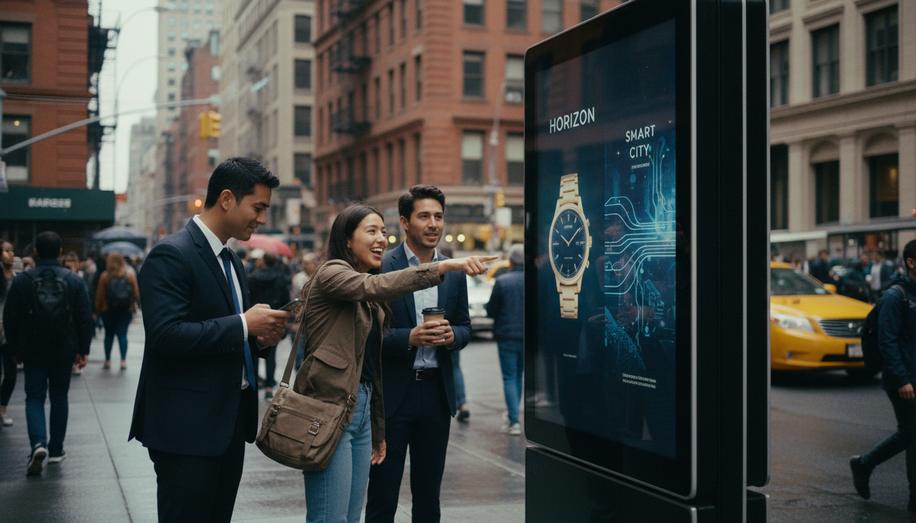

In the bustling heart of a city, a towering out-of-home (OOH) billboard catches the eye of a hurried pedestrian. The vibrant display doesn’t just advertise a product; it pulses with a QR code that, when scanned, unlocks an augmented reality (AR) try-on experience right on the viewer’s smartphone. This seamless pivot from physical exposure to digital immersion exemplifies the phygital storefront, where OOH emerges as the vital bridge in omnichannel customer journeys. By blurring the boundaries between offline encounters and online engagement, OOH transforms passive glances into active interactions, guiding consumers effortlessly between worlds.
Phygital marketing, a fusion of “physical” and “digital,” has evolved from a niche concept—coined around 2007—to a cornerstone of modern retail strategy. It merges tangible experiences with technological enhancements to deliver personalized, uninterrupted customer paths. OOH advertising plays a pivotal role here, acting as the initial spark that ignites the journey. Unlike static digital ads confined to screens, OOH permeates public spaces, reaching audiences in moments of high receptivity: commuting, walking, or simply navigating urban life. A strategically placed digital billboard or transit wrap equipped with scannable elements invites immediate digital dives, such as virtual product explorers or exclusive online offers.
Consider the offline-to-online flow. A consumer spots an OOH campaign for a fashion brand on a bus shelter. The ad features a dynamic video loop showcasing holographic try-on stations, with a prominent QR code promising “See it on you now.” Scanning propels the user to an AR app where they visualize outfits in real-time, complete with purchase links. This phygital hook not only boosts engagement but also funnels traffic to e-commerce platforms, where data from the interaction enables personalized recommendations. Research highlights how such integrations increase conversion rates; QR codes on physical ads like billboards have proven effective in drawing users to digital channels, turning ambient awareness into measurable actions.
Conversely, OOH excels in driving online-to-offline journeys, closing the loop on digital discovery. Shoppers browsing an online store might encounter a “Find in Store” prompt tied to geolocated OOH activations. For instance, a brand could deploy beacon-enabled posters near retail outlets that push notifications to nearby app users, urging them to visit for hands-on experiences like interactive touchscreens or curbside pickup. This reciprocity caters to diverse preferences: online enthusiasts get convenience via click-and-collect, while in-person shoppers enjoy enhanced interactivity, such as AR mirrors simulating virtual fittings. The COVID-19 era accelerated this shift, with curbside services blending online ordering and physical retrieval, a model that persists for its simplicity and appeal.
OOH’s strength lies in its ability to create memorable, shareable moments that amplify reach. An interactive storefront projected via OOH—think large-scale digital screens with gamified elements—encourages passersby to participate via mobile apps, generating user-generated content that spreads virally online. Pop-up shops, often promoted through hyper-local OOH, serve as phygital laboratories. These temporary spaces experiment with VR simulations of store environments or AI-driven personalization, drawing digital natives into physical realms while capturing data to refine online experiences. Brands gain a competitive edge by fostering immersion; Gen-Z consumers, in particular, crave these dynamic interactions, propelling phygital innovations forward.
Yet, success demands thoughtful execution. Effective phygital OOH strategies integrate technologies like AR, VR, beacons, and mobile apps to ensure fluid transitions. Personalization is paramount—leveraging analytics from OOH scans to tailor subsequent digital touchpoints builds loyalty. Challenges persist: ensuring accessibility for all demographics, from tech-savvy youth to less digital natives, requires intuitive designs, like simple QR prompts over complex apps. Moreover, measuring ROI across channels calls for unified tracking, attributing offline impressions to online sales and vice versa.
Real-world examples illuminate OOH’s transformative power. Fashion retailers have long used billboard QR codes linking to AR try-ons, boosting store traffic by 30% in some campaigns. Beverage brands deploy OOH with NFC tags for instant app downloads, blending event promotions with e-commerce upsells. Even luxury sectors experiment with OOH-triggered VR tours of flagship stores, luring online window-shoppers offline. These activations don’t just sell products; they craft ecosystems where physical exposure fuels digital loyalty, and online intent manifests in real-world visits.
As consumer habits solidify around hybrid preferences, OOH stands as the phygital storefront’s linchpin. It humanizes digital commerce while digitizing physical spaces, ensuring no journey feels fragmented. In an era where shoppers demand seamlessness, brands mastering OOH-driven phygital links will not only capture attention but redefine loyalty, proving that the most compelling paths are those that effortlessly weave the physical and virtual into one.