
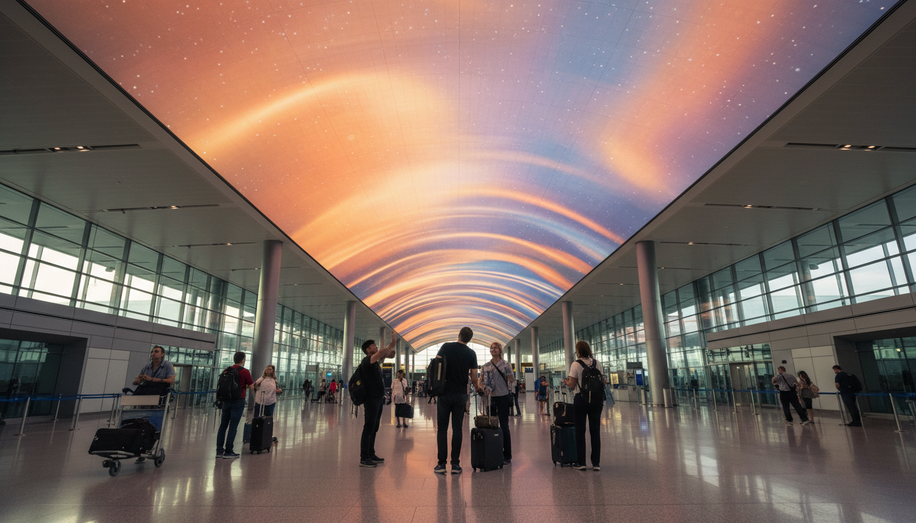

In the bustling corridors of major airports, where travelers from every corner of the globe converge, advertising has evolved into a high-stakes game of capture and conversion. With passengers lingering for an average of 45 to 120 minutes during check-in, security, and layovers, airports offer a captive audience primed for engagement, blending business elites, leisure seekers, and international tourists into a demographic mosaic unmatched by other out-of-home environments. Recent studies underscore this potency: 83% of frequent flyers notice airport ads, with three-quarters associating them with premium brands, while nearly half take action like visiting websites or downloading apps post-exposure.
This effectiveness stems from the airport’s unique psychology. Travelers enter a liminal space—anticipatory, slightly disoriented, and open to impulse. Psychologists point to “priming,” where the travel mindset heightens vulnerability to aspirational messaging, making passengers more likely to splurge on luxury goods from brands like Rolex or Chanel than in a standard mall. A Nielsen Scarborough study commissioned by Clear Channel Outdoor reinforces this, revealing that 79% of frequent flyers are receptive to trying new products on-site, and 47% are drawn to branded selfie stations for shareable moments. Business travelers, now surging back with 87% planning multiple trips annually, show particular responsiveness: 56% recall ads, and 49% act on them, from app downloads to colleague shares.
To maximize impact across this diverse audience, brands must first dissect the traveler profile. Business flyers demand efficiency—sleek digital displays at gates or lounges touting productivity tools—while leisure groups respond to vibrant, family-oriented visuals in baggage claim or food courts. International hubs amplify this need for multiculturalism: campaigns incorporating multilingual messaging or culturally nuanced imagery resonate deeper, boosting recall by 15-30% among global audiences. Airport selection is paramount; high-traffic gateways like those with robust passenger volumes ensure scale, but demographics—affluent frequent flyers averaging higher household incomes—dictate precision targeting.
Strategic placement turns dwell time into dwell impact. Zone-specific tactics shine: pre-security billboards build awareness for broad reach, while post-security digital screens near gates exploit peak receptivity. Immersive installations, such as interactive kiosks or augmented reality activations, elevate engagement, driving 20-40% lifts in ad dwell time and conversions. Clear Channel’s research highlights how these touchpoints—from ticketing to bag claim—convert passive exposure into active behaviors, with 63% of flyers interested in rewards programs glimpsed mid-journey. Frequency matters too; peak-period saturation during holidays or business surges ensures repeated impressions without saturation fatigue.
Creative execution seals the deal. Visually arresting designs, consistent with brand identity, cut through the chaos—bold colors, minimal text, and motion graphics on digital formats dominate. Yet relevance trumps flash: tailoring content to the journey stage fosters connection. A luxury watch brand might prime arrivals with heritage stories at immigration, then pivot to exclusivity at duty-free. Integrating physical ads with mobile—via QR codes or Wi-Fi device targeting—bridges to digital, enhancing ROI through seamless funnels.
Challenges persist: fierce competition for prime space and premium costs demand data-driven decisions. Aviation analytics help allocate spend to high-yield slots, while real-time metrics like impressions, reach, and engagement track performance. Tools like survey platforms embedded in digital displays capture instant feedback, enabling mid-campaign tweaks for multicultural resonance. Ipsos data even positions airport ads as outperforming online or social in key metrics like brand perception.
The payoff is tangible. Campaigns yield 10-25% conversion growth, fortified brand loyalty, and superior recall versus traditional media. As air travel rebounds—with airlines expanding schedules—brands ignoring airports forfeit a goldmine. By leveraging environmental cues, audience insights, and hybrid tech, advertisers don’t just advertise; they orchestrate journeys that linger long after takeoff. In this transient world, airport presence isn’t optional—it’s the ultimate launchpad for global impact.