
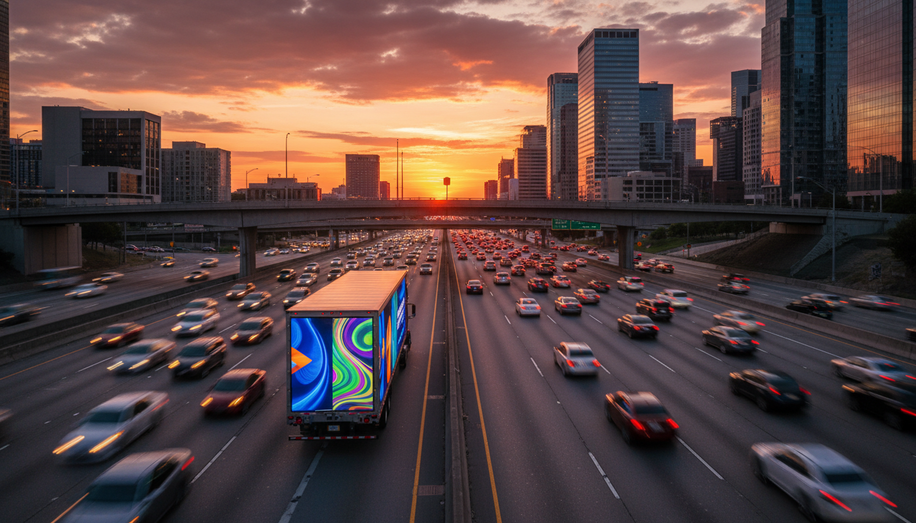

In the bustling streets of urban centers and along winding highways, out-of-home (OOH) advertising is shedding its static skin, transforming into a dynamic force propelled by mobility. Mobile OOH—encompassing truck-mounted billboards, transit wraps, and roaming digital screens—has surged as brands chase consumers on the move, capitalizing on the flexibility that fixed installations simply cannot match. This evolution reflects a broader 2026 landscape where OOH spending climbs steadily, fueled by digital innovations and data-driven precision, with digital out-of-home (DOOH) projected to claim 45.2% of total U.S. OOH ad spend by 2028, up dramatically from 22% in 2016.
The appeal of mobile OOH lies in its inherent agility. Unlike traditional billboards anchored to one spot, mobile units navigate neighborhoods, event venues, and high-traffic corridors, delivering messages precisely when and where audiences congregate. For local campaigns or live events, this mobility boosts visibility exponentially; a truck billboard circling a music festival or sports stadium can saturate a targeted zone, reaching thousands in real time without the limitations of geography. Industry observers note renewed growth in this format throughout 2026, attributing it to advertisers’ demand for adaptability amid shifting consumer patterns. As global OOH markets, valued at $28.48 billion in 2023, continue expanding—much of it via DOOH—these rolling canvases offer a cost-effective way to amplify reach, blending physical presence with mass exposure.
Technology underpins this rise, turning mobile OOH into a measurable powerhouse. Digital screens on vehicles enable rapid content swaps, tailoring ads to time of day, traffic density, or even nearby audience activity, much like programmatic digital campaigns. Advertisers schedule bursts for rush-hour commuters or weekend crowds, with a typical digital loop granting 10 seconds of airtime every minute to keep messaging fresh. Mobile location data further elevates effectiveness, tracking device movements through exposure zones to quantify not just impressions but behavioral shifts—revealing travel patterns before and after ad encounters. This data integration bridges OOH with the digital ecosystem, where QR codes and short URLs prompt instant interactions, converting roadside glances into online searches or social shares. Nearly half of mobile users who spot a DOOH ad follow up with an online search for the brand, while 47% hunt for social handles and 40% share content, underscoring the format’s cross-screen spark.
Effectiveness metrics paint a compelling picture. OOH, including its mobile variants, boasts superior brand recall—83% of shoppers remember seeing it within the last 30 minutes—fostering trust and reliability that digital alone struggles to match. Mobile billboards excel in driving immediate action, especially when paired with retail proximity or event timing, weaving into the customer journey from awareness to purchase. Programmatic DOOH spending alone is set to hit $1.35 billion by 2026, signaling investor confidence in these tech-infused mobile plays. Sequential storytelling enhances this: a commuter might encounter an initial brand tease on a moving truck, followed by a CTA-laden screen at their destination, guiding them toward a digital handover via unique URLs or QR scans that slash customer acquisition costs.
Yet mobile OOH’s ascent is about more than numbers—it’s cultural resonance. Positioned in real-world moments, from festivals to daily commutes, these ads foster shared experiences at scale, blending emotion and relevance without invasive targeting. Dynamic, location-aware content responds to live events or weather, delivering timely messages that feel helpful rather than intrusive—55% of audiences deem OOH campaigns relevant to them. Sustainability trends also play a role, with brands favoring efficient mobile fleets over expansive static networks, aligning with 2026’s push for greener media. Interactive elements, like AR prompts via mobile apps, further engage, turning passive viewers into participants and amplifying social buzz.
Challenges persist, of course. Measuring footfall and attribution in a mobile context demands sophisticated tools, but advancements in mobile data and AI are closing the gap, making OOH as accountable as online channels. Regulatory hurdles around vehicle emissions and urban clutter loom, yet innovations like electric fleets mitigate these. Still, the data is unequivocal: mobile OOH reduces reliance on paid search by priming top-of-funnel awareness organically, proving its ROI in multi-channel strategies.
As 2026 unfolds, mobile OOH stands as the vanguard of a medium reborn. No longer confined to highways, it’s on the road—literally—chasing consumers with precision, creativity, and undeniable impact. Brands ignoring this shift risk being left at the curb, while early adopters reap the rewards of advertising that moves with the world.