
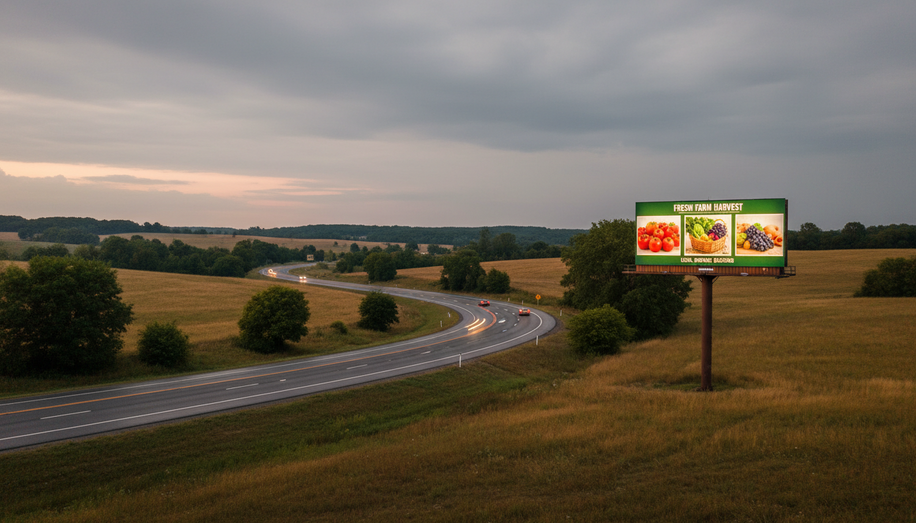

Rural outdoor advertising has long relied on static billboards to capture the attention of dispersed audiences traveling predictable routes through sparsely populated regions. However, the shift toward digital out-of-home (OOH) advertising is fundamentally transforming how brands connect with rural consumers, offering unprecedented flexibility and measurement capabilities that static formats cannot match.
The traditional rural billboard model operates within well-defined constraints. Static placements depend on geographic positioning and creative design to stand out in markets with substantially lower ad clutter than urban centers. While this lack of competition is an inherent advantage—allowing a single billboard to become a recognized local landmark—static formats remain locked into one message for the duration of a campaign. Rural audiences, who travel familiar routes repeatedly but less frequently than urban commuters, benefit from consistent messaging, but brands sacrifice the ability to adapt their creative strategy based on performance data or seasonal shifts.
Digital billboards fundamentally alter this equation. By enabling real-time content updates, digital placements allow brands to test multiple messages, adjust creative elements, and respond to local conditions without the production costs and downtime required to change static advertisements. For rural markets specifically, this means a farming equipment supplier can promote seasonal products at precisely the right moment in the agricultural calendar, or a tourism board can highlight different attractions based on weather conditions and visitor demand patterns.
The effectiveness advantage extends beyond creative flexibility. Digital displays inherently support hybrid campaign strategies that pair traditional outdoor visibility with mobile targeting capabilities. Geofenced mobile advertising can activate when rural residents approach a digital billboard, creating a coordinated touchpoint that reinforces messaging across multiple channels. This integration transforms a solitary roadside ad into part of a sophisticated targeting network, dramatically improving the likelihood of conversion.
Measurement and attribution represent another critical transformation enabled by digital infrastructure. Static billboards traditionally rely on indirect metrics like foot traffic observation or customer surveys to gauge campaign impact. Digital formats, by contrast, can track performance through QR code engagement, location-based mobile analytics, and integrated campaign management systems. Rural advertisers can now quantify which placements drive the most engagement, allowing data-driven optimization that was previously unavailable in these markets. A rural restaurant that previously couldn’t measure the impact of its billboard can now track QR code scans leading directly to online reservations.
Cost considerations further support the digital transition in rural markets. While digital billboards require higher upfront infrastructure investment than static installations, the elimination of physical production and installation costs for creative changes provides long-term economic benefits. Rural areas with limited billboard inventory experience particular value from this efficiency, as brands can maximize impact from fewer total placements by rotating high-performing creative across their rural billboard network.
The geographic spread characteristic of rural advertising also benefits from digital capabilities. Rural campaigns often span miles of open roads connecting distant communities, with audiences passing the same location on weekly or monthly cycles rather than daily schedules. This dispersed pattern makes performance tracking essential—brands need to understand whether their investment in a remote rural location justifies continued placement. Digital formats provide the visibility data necessary to make these decisions confidently.
However, the transition from static to digital in rural markets does present implementation challenges. Rural areas typically have less developed telecommunications and electrical infrastructure than urban centers, requiring careful site selection and investment in reliable connectivity. Additionally, rural audiences may require different creative approaches for digital formats, as the advantages that make simple, bold messaging effective on static billboards still apply to digital displays viewed at highway speeds from greater distances.
The future of rural OOH advertising increasingly points toward a hybrid model that leverages digital infrastructure’s advantages while respecting the unique characteristics of dispersed rural audiences. Brands that strategically deploy digital placements in high-traffic rural corridors while maintaining static inventory in community hubs are discovering enhanced campaign effectiveness, improved measurement, and stronger returns on their rural advertising investments. As digital technology becomes more accessible and cost-effective, the transformation from purely static rural OOH to dynamic, data-informed campaigns will accelerate.
Platforms like Blindspot are poised to accelerate this evolution, offering rural advertisers the robust tools needed to navigate the digital shift. By providing granular ROI measurement, real-time campaign performance tracking, and precise location intelligence, Blindspot empowers brands to optimize their digital OOH investments, ensuring every placement in dispersed rural markets delivers maximum impact and measurable returns. Explore how at https://seeblindspot.com/