
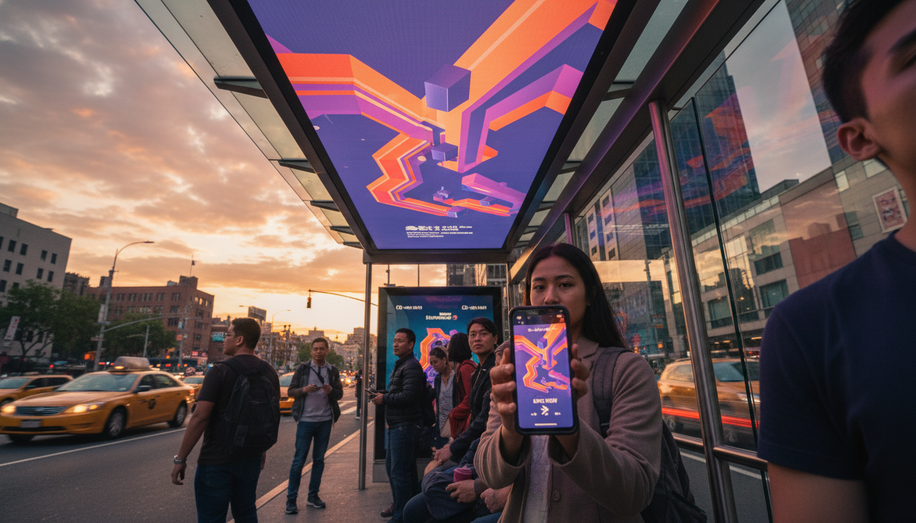

For years, digital and out-of-home teams have operated on parallel tracks: one focused on impressions, clicks, and conversions; the other on reach, impact, and location. Programmatic digital out-of-home (pDOOH) is finally collapsing that divide, giving marketers the tools to orchestrate omnichannel campaigns where a highway billboard, a transit shelter screen, and a mobile video ad all work in concert — and can be measured as part of the same customer journey.
At its core, programmatic DOOH applies the same data-driven, automated buying principles familiar from display and video to digital screens in the physical world. Instead of locking in fixed loops months in advance, advertisers define audiences, contexts, and triggers — such as weather, time of day, or proximity to a retail location — and bids are executed in real time across digital billboards, place-based screens, and transit networks. The shift from static placements to dynamic, condition-based delivery is what enables DOOH to slot naturally into omnichannel strategies already built around fluid, programmatic decisioning.
The first step to truly integrated planning is aligning audiences across channels. Many marketers still brief DOOH buys on broad demographics or geography, while digital teams operate with highly defined behavioral segments. With pDOOH, those same digital audience definitions — frequent QSR visitors, lapsed customers, in-market auto intenders, or gym-goers within a certain commute pattern — can be used to inform DOOH delivery. Location and movement data, derived from privacy-compliant mobile signals and real-world behavior, allows planners to map where these audiences actually are during the day, and which screens they are most likely to encounter.
Once the audience map is understood, DOOH formats can be matched to specific roles within the funnel and mirrored in digital. Large-format roadside screens and urban spectaculars can be synchronized with high-impact online video or rich media to reinforce brand storytelling. Place-based screens in malls, gyms, convenience stores, and transit hubs can be choreographed with paid social or app placements to nudge consideration or drive immediate action. The idea is not to treat DOOH as an isolated awareness channel, but as a physical touchpoint embedded in the same audience journeys that performance marketers are already optimizing online.
Timing and context are where programmatic DOOH closes some of the most persistent gaps between physical and digital campaigns. Weather, sports scores, stock prices, traffic conditions, and even flight arrivals can all be used as triggers so that DOOH messaging changes in sync with what people are experiencing in the real world. When these same triggers are integrated into digital buys, creative can pivot across channels in unison. A coffee brand, for example, might push “iced” messages on mobile, social, and street-level screens during hot afternoons, then automatically switch to “hot and cozy” when temperatures drop. The consumer experiences a coherent narrative, regardless of whether they are scrolling a feed or walking past a bus shelter.
Dynamic creative optimization extends this idea further. Rather than producing one generic DOOH execution, brands can develop modular creative that adapts based on audience, location, and moment — and mirror those variations in digital. Near a stadium, ads can feature team colors and game-time messaging that echo paid social targeting fans. In proximity to a retailer, DOOH can highlight store-specific promotions, while mobile banners and in-app ads deliver the same offer to users who have been exposed to those screens. Creative versioning, historically a strength of digital, becomes a shared asset set that unites the campaign visually and contextually across every touchpoint.
The other major area where pDOOH narrows the gap with digital is measurement. Traditionally, out-of-home effectiveness was gauged through reach estimates and brand lift surveys, often siloed from performance metrics. Programmatic delivery and device-level data now make it possible to link DOOH exposure to foot traffic, app installs, site visits, and even sales, using the same attribution methodologies already applied to mobile and display. By constructing control and exposed groups based on anonymized mobile IDs seen within a given screen’s viewing radius, analysts can quantify incremental behaviors and feed those signals back into both DOOH and digital optimization.
Cross-channel attribution is where the orchestration truly pays off. When DOOH and digital are planned through interoperable platforms, exposure logs and impression multipliers from DOOH can be ingested alongside online impression data, giving a more complete view of the frequency and sequence of touches that drive outcomes. Brands can examine whether a DOOH encounter followed by a social ad is more likely to produce a store visit than social alone, or how the addition of place-based screens near retail changes the conversion curve for programmatic display. This sequencing insight enables budgets to be shifted strategically: DOOH can be ramped up in markets where it is clearly amplifying digital effectiveness, and dialed back where incremental lift is lower.
To make this level of orchestration work operationally, marketers are increasingly centralizing strategy while integrating specialized partners. Programmatic DOOH platforms plug into omnichannel DSPs, allowing activation teams to manage pDOOH alongside display, video, CTV, and audio within a single environment. Data partners bring in real-world behavioral and location intelligence for audience building and measurement. Creative teams are asked to think in terms of system-level narratives, not isolated assets — designing visual frameworks that are legible on a 14-foot screen and on a four-inch one, and that can flex dynamically based on signals.
The most successful campaigns share a few traits: they start with a unified audience and outcome framework, not a media silo; they use context to make DOOH feel native to the environment, and they treat measurement as a full-funnel exercise, from awareness lift through incremental store visits and revenue. When DOOH becomes another programmable surface in an omnichannel plan, the physical world stops being a blind spot in the data and starts functioning as a powerful amplifier for digital investments.
Programmatic DOOH does not replace online, social, or mobile; it makes them work harder together. By using the same data spine, creative logic, and attribution approach across screens in both the physical and digital realms, marketers can finally deliver on the promise of a seamless, integrated customer journey — and prove its value with the same rigor they’ve long demanded from their digital media.