
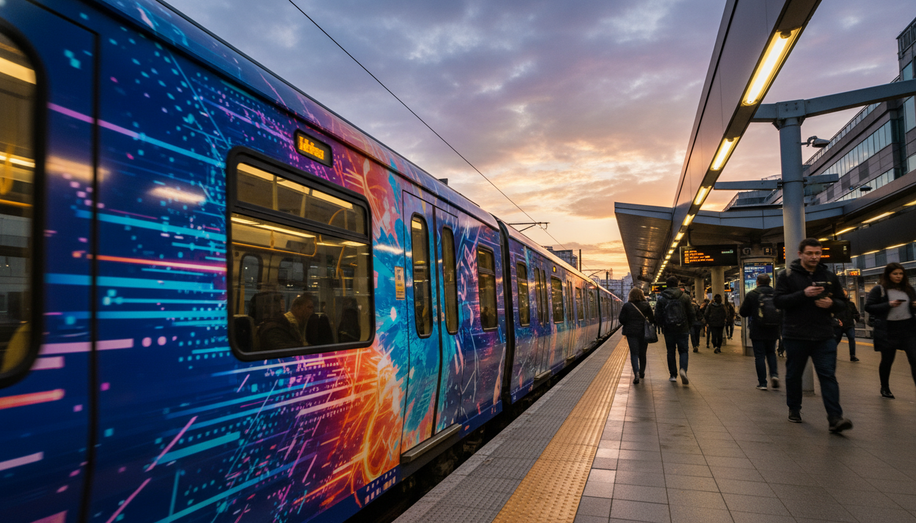

Rush-hour commuters scrolling their phones may not realize it, but they are moving through some of the most sought-after real estate in advertising. Transit environments once dominated by standard bus kings and a few interior cards have evolved into fully immersive canvases, stretching from train exteriors to entire subway stations wrapped in brand stories. For marketers navigating cluttered digital feeds and tightening privacy rules, these moving, physical touchpoints are becoming more strategic than ever.
Transit advertising’s transformation begins with scale and spectacle. Full bus wraps have long been the visual workhorses of the category, but the creative bar has risen sharply. Today’s wraps are designed as panoramic storytelling surfaces, using bold color blocking, oversized typography and clever window integrations to create a sense of motion—even when the vehicle is stopped at a light. As digital out-of-home inventory proliferates, static wraps are increasingly complemented by nearby digital street furniture and geo-targeted mobile campaigns, turning a single vehicle into the anchor of a broader omnichannel presence.
Trains have taken this logic even further. Train wraps, especially on high-frequency urban and commuter rail lines, function like rolling billboards that repeatedly pass through the same neighborhoods and business districts. The repetition drives recall, but it’s the creative integration with the travel experience that makes them stand out. Brands are designing train wraps that visually “extend” onto platforms, stairwells and concourses, creating a narrative that riders encounter multiple times on a single journey. From tech launches to entertainment premieres, the message is no longer confined to a 14-foot panel; it occupies the entire journey arc.
Underground, subway station takeovers have emerged as the marquee format for brands seeking impact at scale. A takeover replaces the patchwork of disparate ads with a single, cohesive brand environment: wall panels, floor graphics, turnstiles, escalator claddings and, increasingly, digital screens synced to a unified content plan. When executed well, the station itself becomes a temporary brand world. Commuters step into a sci-fi universe for a film release, a wellness retreat for a health brand, or a “virtual store” for a retailer previewing a new collection. The everyday routine of getting from point A to point B is punctuated by an experience that feels closer to an activation than a poster campaign.
Digital is amplifying this immersion in real time. Transit hubs are rapidly filling with large-format LEDs and networked digital screens capable of dayparting, contextual triggers and even live data integration. A transit advertiser can now serve creative tailored to morning commuters, weekend travelers or late-night crowds in the same physical space. Weather, sports scores, flight delays and traffic updates can all trigger content variations, making the message more timely and useful. As programmatic digital out-of-home matures, marketers can treat transit inventory more like online media—optimizing budgets based on audience flows, performance data and campaign objectives.
Crucially, this evolution is changing how transit campaigns fit within the broader media mix. Transit environments are inherently high-frequency and route-based, which makes them ideal for reaching defined commuter corridors and local trade areas. Brands are pairing transit formats with mobile retargeting, QR codes and NFC to bridge the gap between impression and interaction. A commuter who sees a striking door wrap on a train may later be served a complementary video ad on their social feed, reinforcing the message and nudging them toward conversion. In a world where third-party cookies are disappearing and addressable audiences are harder to track, the reliability of physical audience patterns around transit lines is a powerful asset.
The creative opportunities extend beyond big-budget national campaigns. Local businesses, DTC brands and regional players are tapping into transit as an efficient way to dominate a neighborhood visually, especially in cities where bus and rail networks define daily life. A restaurant chain can wrap buses on routes that run past its locations, while a real estate developer can own station media in the vicinity of a new project. In emerging markets and fast-growing cities, transit authorities are monetizing new surfaces—from tram shelters to airport shuttles—giving advertisers more ways to align messages with specific journeys and lifestyles.
Measurement, once the Achilles’ heel of out-of-home, is catching up. Location data, anonymized mobile signals and improved transit ridership analytics are giving marketers a clearer picture of who they are reaching and how often. Vendors can estimate impressions based on actual passenger counts, dwell times and walking paths through stations. When paired with brand-lift studies, coupon redemptions or website traffic spikes in areas served by specific routes, transit campaigns can be evaluated on more than just “eyeballs.” This shift from pure reach to performance opens the door for more performance-oriented budgets and long-term partnerships with transit media owners.
Sustainability is also reshaping the category. As cities push for greener transport and consumers scrutinize corporate environmental claims, brands are looking for ways to align their campaigns with responsible practices. Many transit systems already position themselves as eco-friendly alternatives to private cars, and advertisers can tap into that narrative. Materials are moving toward recyclable and PVC-free substrates, and digital screens are increasingly powered by more efficient systems. Brands that showcase their sustainability commitments in these public, civic spaces often gain credibility that’s harder to achieve in purely digital environments.
Ultimately, the transformation of transit advertising reflects a broader rethinking of how brands show up in the real world. The bus is no longer just a moving panel; it’s the beginning of a story that continues down the platform, up the escalator and onto a commuter’s phone. Subway stations are no longer background infrastructure; they are stages for temporary worlds that commuters pass through daily. For marketers facing fragmented attention and rising digital fatigue, these dynamic, high-impact formats offer something increasingly rare: a captive audience, a rich physical canvas and the chance to turn everyday journeys into memorable brand encounters.