
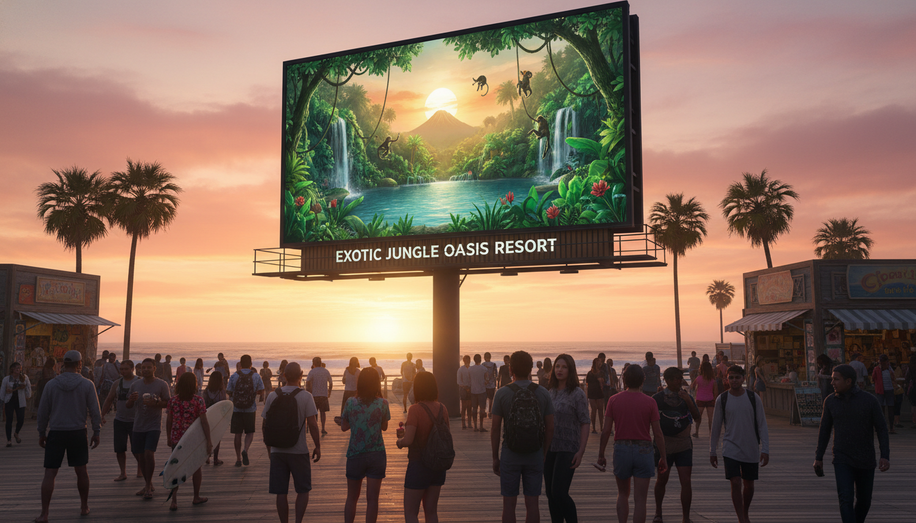

As travel demand surges back to – and in many markets beyond – pre-pandemic levels, one medium is conspicuously visible along the journey: out-of-home advertising. From airport concourses and subway platforms to digital billboards on highways and in city centres, OOH has reasserted itself as a powerful catalyst for wanderlust and a practical guide once travellers are on the move.
Recent industry research underscores the opportunity. Surveys show that more than half of consumers recall seeing travel-related OOH ads, and roughly two-thirds of those exposed say these messages influence where they go, what they do, and where they stay. Tourism specialists cite figures as high as 72% of travellers having been inspired to visit a destination after seeing it promoted in an OOH environment. For brands in the travel ecosystem, OOH is no longer just a branding play; it is a measurable driver of discovery, planning and purchase.
Destinations have been among the most aggressive adopters. National tourism boards and city marketing organisations are using large-format placements to turn everyday commutes into aspirational moments. Campaigns for island getaways, European capitals or emerging city breaks increasingly dominate key transport hubs, visually transporting passersby to turquoise waters or lantern-lit old towns. The strategy is deliberate: reach consumers when their minds are prone to daydreaming about escape, then stay present as they shift from inspiration to intent. Visit Maldives’ extensive presence across London Underground stations and UK airports, for example, has made the destination an almost constant backdrop to urban life, positioning it as the archetypal “dream trip” rather than just another option in a long list of beach resorts.
Airlines have long understood the value of that context. Today they are pairing classic large-format brand work with data-informed digital out-of-home to push specific routes, seasonal sales and fare bundles at precisely the right moments. In winter, airport and roadside DOOH screens in northern cities pivot to sun-drenched creative for flights to warmer climates; in late summer, they flip to shoulder-season city breaks or long-haul deals. Programmatic buying allows carriers to optimise by time of day, weather, or even real-time demand, making OOH not only emotive but also performance-focused. Research from multiple sources suggests that OOH campaigns are several times more likely than other offline channels to drive online activation, especially when synchronised with mobile retargeting that encourages users to complete a booking.
Hotels and resorts are using OOH to bridge the gap between generic destination marketing and specific place-based experiences. Major chains leverage airport lightboxes, urban billboards and transit formats to emphasise the comfort, reliability and perks of their brands across multiple cities, effectively following frequent travellers through their journeys. Boutique properties and resort clusters, meanwhile, often focus on hyper-local messaging once visitors have arrived, using street-level digital screens, transit shelters and city information panels to highlight neighbourhoods, beach clubs, restaurants and wellness offerings. These placements work as both branding and wayfinding, capturing last-minute decisions and upselling experiences that might never have made it into an advance itinerary.
Travel agencies and online travel platforms, once perceived as purely digital players, are rediscovering OOH as a way to cut through a cluttered online marketplace. With hundreds of sites competing in search results and on social feeds, brands like online booking engines, metasearch platforms and review sites are leveraging OOH’s scale to build mental availability. Campaigns in busy commercial districts, train stations and commuter routes showcase curated deals, flexible booking policies or unique planning tools. The goal is to embed the brand in the traveller’s planning routine: when it’s time to research a trip, the platform that has been consistently visible in the physical world has an edge in being the first tab opened in a browser.
Crucially, OOH’s power in travel and tourism lies in its alignment with the traveller’s psychological and physical journey. At the earliest stage, large, cinematic visuals trigger emotion, planting the seed of a future trip and building bucket lists. As interest turns to intent, more functional messages – promoting flight packages, hotel offers or itineraries – intercept consumers during commutes or lunch breaks, nudging them towards concrete planning. Once on the road, contextually relevant ads in airports, transit hubs and city centres help visitors navigate local attractions, events and services, converting general wanderlust into specific, bookable actions.
Digital out-of-home is amplifying this funnel-based approach. Programmatic DOOH enables marketers to spin up, pause or adjust campaigns on the fly to align with booking windows, demand surges or external factors such as currency shifts and weather events. A tourism board can promote off-peak travel when flights are cheapest; an airline can prioritise specific origin-destination pairs based on load factors; a hotel group can push last-minute weekend rates within a defined radius of its properties. Dynamic creative optimisation further tailors messaging – serving different languages, offers or imagery based on audience profiles and location – while still benefiting from OOH’s one-to-many economics.
For all its growing sophistication, the core appeal of OOH in travel remains fundamentally human. Travel is emotional, and the physicality of OOH – the sheer scale of a spectacular airport lightbox, the unexpected glimpse of a tropical shoreline on a grey city street, the reassuring presence of a familiar brand logo in a foreign transit hub – can create moments that digital banners struggle to match. In an era where consumers are increasingly screen-fatigued and suspicious of intrusive online tracking, OOH offers a visible, public, and largely welcomed form of storytelling.
As the travel industry looks ahead to continued growth, OOH sits at the intersection of inspiration and utility. Destinations, airlines, hotels and agencies that integrate it intelligently – pairing emotive, high-impact creative with data-driven placement and cross-channel amplification – are finding that the medium does more than decorate the journey. It shapes it, turning casual glances into dreams, dreams into plans, and plans into booked tickets and full hotels.