

Out-of-home advertising has long been valued for scale, visibility and cultural presence. But in an era when attention is measured not just in impressions but in interactions, the most effective OOH campaigns are doing something more ambitious: turning street-level exposure into social media momentum. The billboard is no longer the end of the conversation. For many brands, it is the beginning.
The logic is straightforward. OOH places a message in the physical world, where it can surprise commuters, interrupt routines and create a shared public experience. Social media then carries that moment further, transforming a single impression into a searchable, shareable and comment-worthy piece of content. When the two channels are designed to work together, brands can extend reach far beyond the original placement and create the kind of organic engagement that paid media alone rarely achieves.
What makes an OOH execution shareable is often not the size of the ad, but the strength of the idea. Campaigns that rely on wit, visual contrast, local relevance or cultural timing are most likely to move from billboard to feed. A clever line on a transit shelter, a striking mural on the side of a building, or a digitally dynamic screen that reacts to the moment can all prompt the same response: people take out their phones. In the best cases, the audience becomes the distribution layer. The message is not merely seen; it is photographed, posted and discussed.
Hashtags still matter, but only when they feel native to the creative. A hashtag on its own is rarely enough to drive participation. It works best when paired with a clear reason to use it, whether that is a contest, a challenge, a call to add a personal story or a prompt to react in real time. The most effective campaigns invite participation rather than requesting it. They make the audience feel like co-authors, not just observers.
User-generated content has become one of the clearest bridges between OOH and social media. Brands that encourage people to recreate, remix or respond to outdoor creative can turn a localized media buy into a broader cultural moment. A campaign that asks passersby to share a photo with a product, a phrase or a backdrop can quickly generate a stream of authentic content that carries more credibility than polished brand assets. For marketers, that authenticity is valuable because it comes with proof of public interest. For audiences, it feels less like advertising and more like participation in something current.
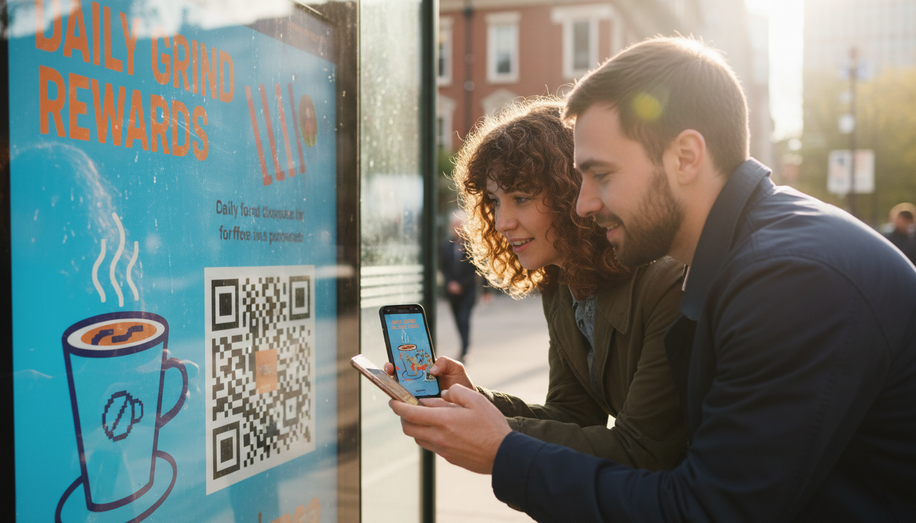
Technology has made this integration even more powerful. QR codes, NFC tags and location-based prompts give people a direct path from the street to a digital experience. A passerby can scan a code to enter a giveaway, unlock exclusive content or follow a brand on social media within seconds of seeing the ad. That immediate transition matters. It reduces friction, captures intent while it is fresh and creates a measurable link between physical exposure and online action.
Geo-targeting can reinforce that connection by extending the campaign into nearby mobile and social channels. When a brand combines a visible OOH placement with social ads aimed at people in the same area, it creates repetition across formats without feeling redundant. Someone who notices a billboard on their commute may later see a related post in their feed, making the brand more memorable and more likely to be engaged with online. The result is a coordinated presence that feels omnipresent without becoming intrusive.
Real-time content is another powerful tactic. Digital billboards that pull in live posts, audience reactions or event-related updates can create a sense of immediacy that static creative cannot match. In those cases, the billboard becomes a public screen for social conversation, and social conversation becomes part of the media experience. That loop can be especially effective around sports, entertainment launches, seasonal moments or city-specific events, when audiences are already primed to share.
Still, not every campaign needs advanced tech to create buzz. Sometimes the simplest ideas travel best. A bold visual, a memorable line, a culturally attuned joke or a perfectly placed activation in a high-footfall area can generate far more online life than a complex mechanic. The common thread is originality. People share what feels worth showing others, whether because it is beautiful, funny, surprising or distinctly local.
For advertisers, the challenge is no longer whether OOH can support social media. It clearly can. The question is how intentionally the two channels are built together. When the creative encourages interaction, the placement invites discovery and the social strategy rewards participation, OOH can become far more than a brand-awareness tool. It can become a conversation starter, a content engine and a catalyst for online community. In a crowded media landscape, that ability to turn public space into social currency may be one of the most valuable outcomes outdoor advertising can offer.