

For years, out-of-home advertising has been framed as an urban story: towering digital spectaculars, packed transit systems and dense city corridors humming with impressions. Yet some of the most promising growth for OOH now lies well beyond the downtown core, in smaller towns and sprawling suburbs where ad clutter is low, community identity is strong and hyper-local relevance can turn a single poster into a neighborhood touchstone.
Rural and suburban markets have often been treated as afterthoughts in media plans, bundled into broad regional buys or ignored altogether in favor of metropolitan reach. That approach misses a structural shift in where people live and how they move. Remote and hybrid work have pushed more professionals into exurbs and small communities. At the same time, local businesses—from clinics and colleges to credit unions and farm suppliers—are fighting harder for attention. OOH, with its street-level presence and geographic precision, is built to fill that gap.
The dynamics of rural OOH are fundamentally different from city-center media. In countryside corridors and small towns, there are fewer units and far less visual noise. A lone static billboard on a state highway or a poster near the only grocery store can command disproportionate attention simply because there is nothing else competing for the eye. Drivers on rural roads tend to travel at steady speeds for longer stretches with fewer distractions, giving them more dwell time with each message. In tight-knit communities, people also notice when something new appears on the roadside or in the town square—and talk about it.
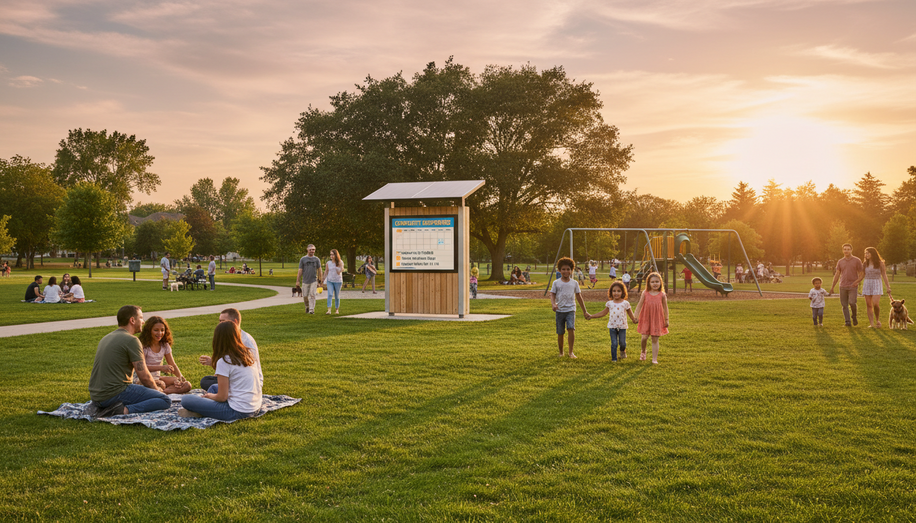
Suburban environments present their own, equally attractive, logic. These aren’t the anonymous bedroom communities of the past. Many suburbs now function as self-contained ecosystems, with distinct town centers, local festivals, school sports cultures and vibrant small-business scenes. Traffic patterns are remarkably predictable: the school drop-off loop, the commuter corridor to the nearest interstate, the Saturday route that runs from big-box stores to independent coffee shops. A small number of hyper-strategic placements—bus shelters on the road into the subdivision, digital screens near the supermarket, posters by the youth sports complex—can intercept residents multiple times a week, if not daily.
What makes rural and suburban OOH especially potent is its ability to speak in the language of place. Hyper-local targeting in these markets goes beyond radius planning; it is about understanding what matters on that particular stretch of road or in that specific ZIP code. In a farmbelt county, that might be harvest schedules, tractor dealerships and the Friday night high school football game. In a growing suburb, it could be school rankings, childcare options, new housing developments and local dining. Messages that reference familiar landmarks, local events or community rituals feel less like advertising and more like participation in local life.
The creative bar is different too. Instead of the broad, brand-led messaging typical of national urban campaigns, the most effective rural and suburban executions are often individualized and conversational. A regional health system can run a general awareness campaign in a nearby city, then feature the name of a specific clinic and its local physician on boards along the county highway. A financial institution can segment by town, promoting farm loans along agricultural routes while advertising first-time homebuyer programs on the roads leading into new subdivisions. Even national brands can localize: a quick-service restaurant chain can direct drivers to “your Tyler off-ramp, next right,” or spotlight a sponsorship of the local youth soccer league rather than leaning solely on a national tagline.
Technology is making this hyper-localization more precise and more measurable. Geospatial data and mobile location insights allow planners to identify the true high-traffic arteries in rural and suburban areas—the two-lane road that carries most commuters into town, the bypass drivers take to the industrial park, the small highway feeding a cluster of lakeside communities. Those same data sets can link OOH exposure zones with mobile devices, enabling retargeting on digital channels and tying real-world views to web visits, app downloads or store traffic. For public-sector campaigns, such as public health or emergency preparedness, this fusion of OOH and mobile allows agencies to saturate the exact neighborhoods where access to services is limited or trust in institutions is fragile, then reinforce those messages on the phones in people’s pockets.
Community trust is another, often underused, asset in these markets. In small towns and suburbs, residents tend to be more attuned to which businesses support local causes and show up at local events. When OOH buys are integrated with that civic fabric, impact multiplies. A local billboard owner partnering with a county fair, a healthcare brand underwriting signage at a regional clinic, or a university sponsoring digital kiosks used for community announcements all create a halo effect. The hardware becomes part of the public realm, not just a sales device, and campaigns that appear there benefit from that embedded trust.
Critically, all of this can be achieved at a cost that looks very different from the big-city model. Lower media rates, longer posting periods and less frequent creative turnover mean brands can maintain a standing presence across wide geographies without the burn rate of an urban digital spectacular. That cost efficiency makes it feasible to run highly customized, town-by-town creative rather than one generic message stretched over a large footprint. For multi-location retailers, franchise networks and regional service providers, this is a compelling equation: more relevance, over more time, for less money.
The industry’s next phase of growth may depend on reimagining what constitutes a “prime” OOH location. The crowded downtown and the flashy digital screen will always matter, but so will the quiet billboard at the edge of a farming community, the bus shelter outside a suburban high school, and the small-format posters that greet residents in the heart of a town they rarely leave. By committing to hyper-local strategies and community-centered messaging in rural and suburban markets, OOH can move from being simply seen to being genuinely woven into the daily lives of the people it reaches.