
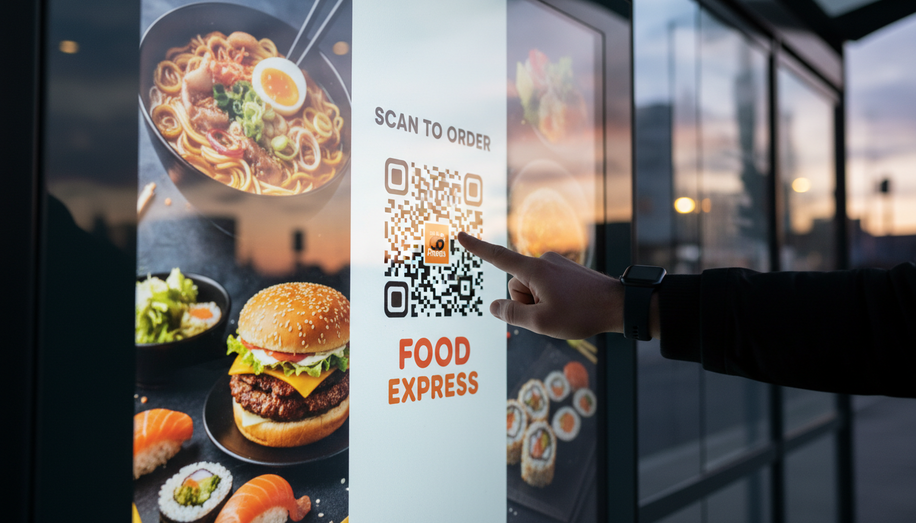

On a crowded high street or a buzzing commuter platform, a strong out-of-home (OOH) execution can stop people in their tracks. But stopping them isn’t enough. In an era where almost everyone carries a screen in their pocket, the real performance metric is not just recall, but response. The call-to-action (CTA) is the bridge between a fleeting glance and measurable behaviour, and in OOH it demands a very specific kind of discipline.
Unlike digital display or email, OOH is a low-attention, high-distraction environment. Viewers are moving, often fast, and they don’t have the luxury of reading lines of copy or comparing options. That reality reshapes what a CTA can and should be. OOH CTAs must be instantly understood at a distance, easily remembered without effort and compelling enough to trigger a search, scan or store visit, often within seconds of exposure.
Clarity is the first non-negotiable. Research from industry bodies consistently shows that design accounts for almost half of an OOH campaign’s effectiveness, and the CTA sits at the centre of that design. Yet many brands still bury their ask in dense copy, expecting passers-by to decode a paragraph while crossing a busy road. In practice, the most effective OOH CTAs are brutally simple: a single directive phrase, a short URL, a clear QR code, a recognisable app icon. Anything more risks cognitive overload; anything less risks apathy.
The strategic work starts well before the line is written. Defining the campaign objective is crucial because it determines what kind of action is both realistic and valuable in an OOH context. Is the priority to drive immediate sales, prompt app downloads, build a retargetable audience or simply push people to “search brand + product”? Each of these behaviours implies a different CTA. “Scan to save 20% before Friday” makes sense beside a supermarket, where an immediate visit is plausible. “Search ‘Brand X running plan’” may be more realistic on a moving bus, where a QR scan is risky but a quick search later is easy to recall.
Audience understanding then sharpens that objective. A late-night nurse leaving a hospital and a teenager on their way to college may both pass the same digital billboard, but their mindset, device habits and willingness to engage differ radically. Younger audiences may be more comfortable scanning QR codes or engaging with social handles in the moment. Older commuters might prefer a short, memorable URL or a clear prompt to “ask in-store.” Creating buyer personas for OOH specifically—where they’re going, what they’re doing, whether their hands are free—helps determine whether your CTA should demand an instant interaction, promise a later reward or simply plant a phrase designed to spark a Google search.
Location and format turn those insights into practical constraints. A roadside 48-sheet gives drivers three seconds at 60 miles per hour; a bus-shelter six-sheet might offer ten or fifteen seconds of dwell time; a large digital screen in a mall could earn even more. The CTA must be calibrated to that dwell time. A moving driver cannot safely scan, copy or type anything complex. For them, “Exit 12 for Brand X” or “Try Brand X coffee at the next services” is the upper limit of complexity. On a train platform, where phones are already in hand, “Scan to win your next ride” becomes viable and measurable.
Design execution is where strategy either survives or dies. Eye-tracking studies in OOH consistently show that clutter kills comprehension. For the CTA to work, it must be visually privileged: strong contrast, generous white space, and placement away from busy imagery. Colour and typography need to support legibility at distance; a “clever” typeface that blends into the background may look beautiful in a deck but will be invisible across a dual carriageway. On digital OOH, motion can help, but it should be used to draw attention to the CTA, not distract from it. A simple animation that reveals the CTA at the right moment in the loop can focus the viewer’s gaze when it matters most.
The language of the CTA itself should be grounded in behavioural reality, not copywriter bravado. Strong, concrete verbs—“scan,” “tap,” “search,” “visit,” “download”—perform better than vague encouragements like “discover” or “experience.” The best OOH CTAs pair that verb with a clear benefit and, where appropriate, a light touch of urgency: “Scan for 10% off today,” “Search ‘Brand X trial’ to start free,” “This week only – show this ad in-store.” Urgency in OOH, however, must be honest. Commuters see the same poster every day; false scarcity quickly erodes trust.
OOH also increasingly acts as a trigger for mobile interaction. Industry surveys indicate that a significant proportion of viewers search for brands after seeing an OOH ad, and this is where measurability enters the frame. Smart campaigns align OOH CTAs with trackable digital endpoints: vanity URLs, dedicated landing pages, specific hashtags, UTM-tagged QR codes and unique promotional codes tied to individual sites or formats. When a billboard says “Visit brandx.com/park” and only that location uses “/park,” the resulting traffic can be directly linked to that specific execution, transforming a historically “awareness-only” medium into a performance channel.
To fully capitalise on that performance potential, the journey cannot end at the poster. The landing environment must mirror the promise of the CTA. If the poster says “Scan for your free sample,” the QR code should lead straight to a frictionless claim page, not a generic homepage. Loading times, mobile optimisation and a clear follow-up CTA online all influence whether that initial OOH-triggered interaction converts to something meaningful. Brands that treat OOH and digital as a single, continuous experience, rather than separate silos, tend to see higher conversion rates from their CTAs.
Measurement, finally, closes the loop and informs future creative. QR scans, unique URL visits, search volume spikes for specific phrases, coupon redemptions, footfall data and app downloads can all be tied back to OOH exposure when CTAs are designed with attribution in mind. Over time, patterns emerge: which verbs drive more scans, which incentives move the needle, which environments support more complex CTAs. Those insights should feed back into creative development, helping teams refine not just the look of their OOH, but the precise actions they ask audiences to take.
As OOH evolves into a more dynamic, data-informed canvas, the CTA is becoming its most important element. The big image may win the gaze, but the small line directing what happens next is where value is created. For brands and agencies willing to treat that line as a strategic tool rather than an afterthought, OOH can do far more than decorate the urban landscape. It can guide real people from glance to action, and from public space to measurable response.