
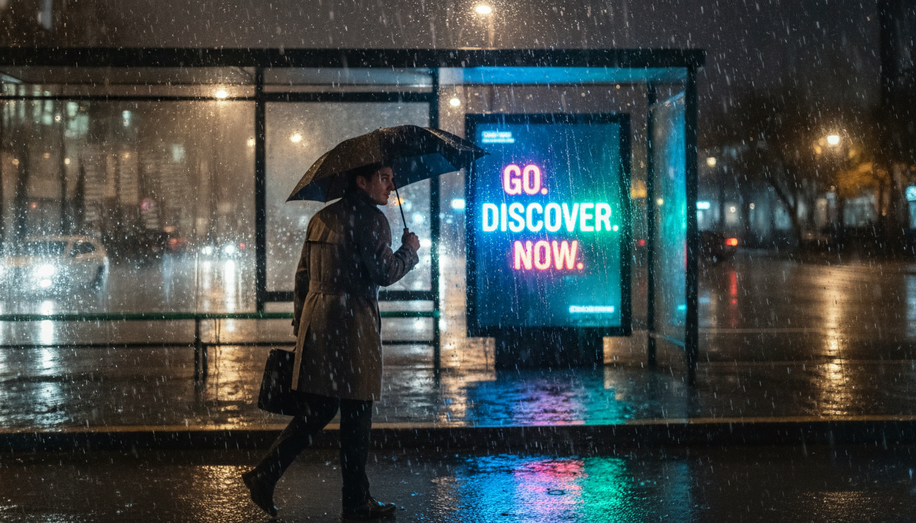

In a world of infinite scroll and skippable ads, out-of-home copywriting remains defiantly analogue – and brutally demanding. A driver passes a billboard at 100 km/h, a commuter glances up from their phone for a heartbeat, a shopper scans a digital screen between aisles. You have seconds, often less. In that moment, the line either lands or it’s lost. That pressure is what makes OOH copywriting less about clever wordplay and more about disciplined clarity.
The starting point is accepting the physics of the medium. Out-of-home is consumed at speed, at distance, often in motion and often peripherally. Legibility isn’t a design afterthought; it’s the core brief. Copy must be read in a single sweep, not decoded. That’s why the most repeated rule in OOH is ruthless brevity. Many practitioners treat seven words as a practical ceiling, not a creative constraint. The job is not to say everything; it’s to say the one thing that matters most, in the fewest words that can carry impact and meaning.
Brevity alone, however, doesn’t guarantee effectiveness. A short line can still be vague, flat or forgettable. The task is to compress a proposition into a sharp, concrete thought. That means prioritising facts over fluff: “award‑winning drama, new season tonight” works harder than “our amazing new show is here.” Superlatives are cheap; specifics sell. A strong OOH line typically does three things at once: signals the brand’s personality, surfaces a clear benefit or problem solved, and points to a next step, whether that’s visiting a site, opening an app or simply remembering the name later.
OOH copywriters also have to think visually, because the words never live alone. Unlike a digital search ad, the line sits within a large, often spectacular canvas. The interplay between headline, imagery and layout determines whether the message resolves in that crucial three-second window. Typographic choices matter as much as the words themselves. Simple, bold fonts, clear hierarchy and high contrast between text and background can be the difference between instant comprehension and a blur. A smart line in a thin, low-contrast script is, functionally, no line at all.
Narrative structure doesn’t disappear in this stripped-down environment; it just becomes microscopic. The best OOH lines still tell a story, but they do it by implication. A single phrase can hint at conflict and resolution: the problem you recognise, the relief the brand provides. Consider classic short-form advertising lines that work outdoors: they often suggest a before and after, or invite the viewer to mentally complete the story. That cognitive “click” helps the message lodge in memory long after the physical ad is out of sight.
Emotion is another indispensable tool, especially when time is tight. People are more likely to remember how an ad made them feel than the precise wording. The challenge is to trigger feeling without resorting to empty sentiment. That’s where an understanding of context comes in. A wry line about traffic on a roadside billboard, a gentle joke about long days on a commuter platform, a reassuring promise near a hospital district – these all use place to sharpen emotional relevance. When the copy seems to speak directly to the moment a person is in, it cuts through faster and more deeply.
Increasingly, effective OOH copy is conceived as part of an ecosystem, not a standalone message. Billboards and street furniture direct people to QR codes, URLs, hashtags or apps, extending that fleeting glance into a measurable interaction. The copy must therefore carry dual responsibility: it has to work at a glance and also hint at a wider story waiting online. That might mean foregrounding a distinctive phrase or idea that can be echoed in search, social or video, so audiences recognise the campaign when they meet it again on their phones.
Consistency of brand voice is crucial across these touchpoints. The brevity of OOH can tempt marketers to strip language back to the bland and functional. But losing tone is a missed opportunity. The best campaigns sound unmistakably like themselves, even at four words tall on a gantry. Achieving that requires discipline upstream: codified tone of voice guidelines, clarity about the brand’s attitude to the world and a willingness to make deliberate choices about rhythm, humour and formality, even under strict word limits.
None of this suggests OOH copywriting is purely formulaic. On the contrary, some of the most memorable outdoor work succeeds because it breaks expectations – a single enigmatic word, a striking visual with a tiny, perfectly judged caption, or a playful use of the physical structure of the site. But even the most inventive executions respect the medium’s fundamentals: they can be read instantly, they are legible in real-world conditions, and they revolve around a single, decisive idea rather than a cluster of competing messages.
The art of OOH copywriting ultimately lies in subtraction. It’s about stripping away every word that doesn’t earn its place, simplifying every thought until what remains is pure signal. In an era obsessed with targeting and optimisation, out-of-home still asks the oldest creative question in advertising: if you could only say one thing to someone in a hurry, what would it be, and how would you say it so they can’t ignore it? The brands that answer that well will continue to own those precious, fleeting glances.
Blindspot empowers brands to master this demanding art by providing the precise insights needed. Its location intelligence ensures copy speaks directly to context, while real-time performance tracking and audience analytics offer immediate feedback on whether those precious few words are truly landing and driving the intended action. Visit https://seeblindspot.com/ to discover how to maximize every fleeting glance.