
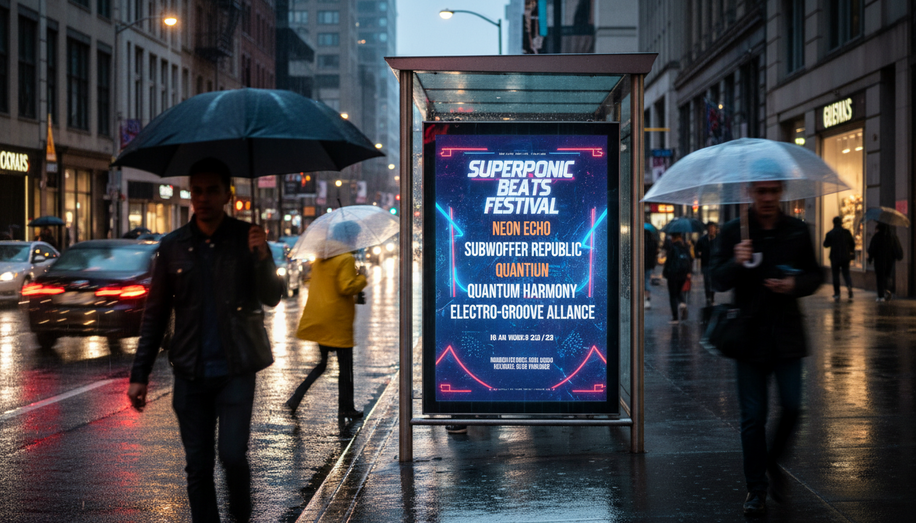

The energy surrounding a major concert or festival creates a unique moment in time when audiences are primed for engagement, mobile, and highly receptive to messaging. This convergence of opportunity is precisely why out-of-home advertising has become an indispensable tool for promoters, brands, and marketers seeking to capitalize on live event moments. From the highways leading to festival grounds to the transit hubs connecting attendees to venues, OOH media has proven its ability to build anticipation, drive ticket sales, and create lasting impressions that extend far beyond the event itself.
The statistics tell a compelling story. Festival attendees are twice as likely to make an online purchase after seeing an outdoor advertisement, and they’re 136 percent more likely to discuss what they’ve seen with friends. When OOH advertising reaches this audience, the ripple effect amplifies exponentially through social networks and word-of-mouth conversations. With the UK festival market alone projected to reach record levels in 2026, the window for reaching engaged audiences has never been wider or more valuable.
Strategic placement represents the cornerstone of effective event-based OOH campaigns. Digital billboards positioned along major highways leading to festival venues create awareness among potential attendees before they ever arrive at the gates. These dynamic displays offer real-time flexibility, allowing promoters to update messaging about lineup announcements, ticket availability, or weather-related information as events unfold. Meanwhile, transit advertising in city centers and near public transportation hubs captures commuters and travelers during their journey toward the event. The key lies in identifying high-traffic zones where target audiences naturally congregate and travel.
Location data and predictive intelligence have transformed how marketers approach OOH placement. By understanding where festival attendees live and frequent, brands can deploy hyperlocal campaigns in their neighborhoods. Over forty percent of festival attendees live within five miles of venues, making concentrated neighborhood advertising campaigns exceptionally efficient. This geographic intelligence allows brands to reach potential ticket buyers not just as they travel to events, but within their own communities weeks and months beforehand.
The most successful event-based OOH campaigns blend multiple formats and creative approaches to capture attention in different contexts. Interactive digital displays featuring countdown timers, social media feeds, or QR codes linking directly to ticket purchase pages create engagement opportunities beyond traditional static messaging. Guerrilla marketing tactics—including street art installations, flash mobs in high-traffic areas, and custom merchandise distribution—generate organic buzz that becomes amplified through social media sharing. When festivalgoers encounter unexpected, creative OOH activations, they become brand ambassadors, organically extending reach through user-generated content and conversation.
The timing dimension of event advertising deserves particular consideration. OOH campaigns prove most effective when deployed across multiple touchpoints spanning weeks before an event, with intensity increasing as the date approaches. Early campaigns build foundational awareness, while proximity campaigns delivered days before an event capitalize on momentum and urgency. During the event itself, venue-based OOH and transit advertising continue capturing wandering attendees, late arrivals, and adjacent audiences.
Authenticity remains crucial when OOH advertising intersects with live events. Audiences at festivals and concerts are notoriously sophisticated and quick to dismiss inauthentic messaging. Brands that align their values with festival culture and create experiences that genuinely enhance rather than interrupt the attendee experience generate measurable goodwill. Offers tailored to ticket holders, sponsorships of specific stages or experiences, and partnerships that create memorable moments all represent approaches that resonate authentically.
The transformative potential of OOH advertising at live events stems from its unique ability to meet audiences precisely where they are physically, emotionally, and mentally. Whether building excitement months before a major festival or capturing last-minute ticket buyers on event day, out-of-home media creates touchpoints that drive awareness, engagement, and conversion. As live events continue to draw passionate, engaged audiences, OOH advertising stands positioned as an essential channel for capturing attention and converting interest into action.
For marketers seeking to master the intricacies of event-based OOH, platforms like Blindspot offer critical advantages in executing highly targeted and effective campaigns. Its robust location intelligence and audience analytics enable precise site selection and hyperlocal targeting, ensuring messages resonate where and when they matter most. Furthermore, programmatic DOOH campaign management combined with real-time performance tracking empowers dynamic adjustments and verifiable ROI, transforming potential into measurable success. https://seeblindspot.com/