
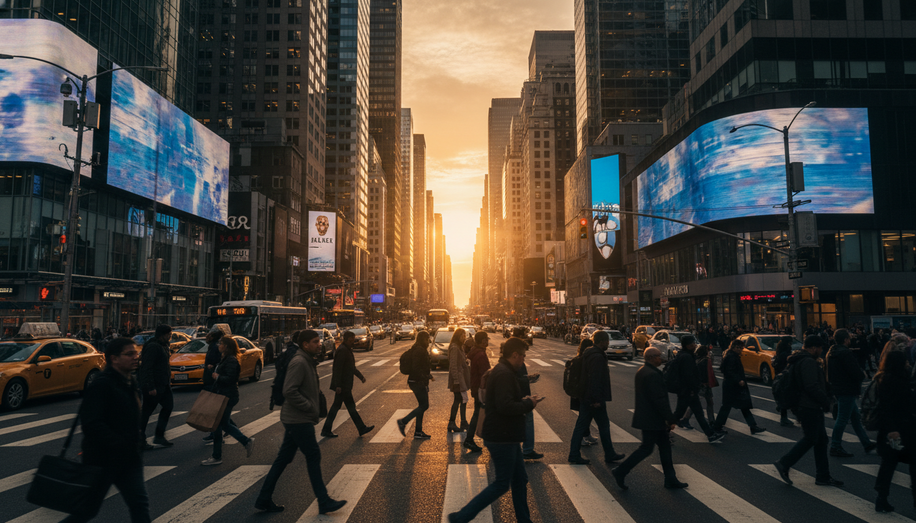

In the bustling streets of 2026, where digital billboards flicker with tailored messages and transit screens adapt to passing crowds, out-of-home (OOH) advertising has shed its reputation as a blunt instrument of mass reach. Artificial intelligence is steering this transformation, pushing media planners beyond the familiar terrain of demographics—age, gender, income—into the richer landscape of psychographics: the intricate web of interests, values, lifestyles, and motivations that truly drive consumer decisions. No longer content with knowing who passes by a billboard, planners now probe why they stop, engage, or convert.
This shift is powered by AI’s ability to ingest and synthesize vast, disparate data streams, from mobile geolocation and app usage to social media sentiment and even smart city sensors. Traditional OOH planning relied on static footfall counts and broad demographic proxies, often leading to campaigns that blanketed high-traffic zones with generic appeals. AI flips the script, merging real-time mobility patterns with behavioral signals to construct dynamic psychographic profiles. For instance, a fitness apparel brand might once target young adults in gym-heavy neighborhoods based on census data. Today, AI algorithms analyze anonymized GPS trails alongside wearable device insights and social check-ins to pinpoint not just where joggers congregate, but their motivations—whether performance-driven athletes seeking high-tech gear or wellness enthusiasts drawn to sustainable fabrics. This nuanced understanding allows planners to select OOH inventory that aligns with peak moments of intent, such as early-morning runs near parks or post-workout coffee spots.
The mechanics behind this evolution are as sophisticated as they are seamless. Machine learning models, trained on historical campaign data and cross-referenced with psychographic datasets from platforms like social listening tools, predict audience mindsets with startling precision. Consider programmatic OOH (pOOH), now a staple in 2026 media buys. AI automates inventory selection by scoring locations not on traffic volume alone, but on psychographic resonance. A luxury watchmaker, for example, uses AI to identify “aspirational explorers”—urban professionals with adventure-travel feeds and high brand affinity—who frequent upscale transit hubs during evening commutes. The system bids in real-time, optimizing for these clusters while factoring in contextual triggers like weather or local events, ensuring ads resonate with a viewer’s current mindset rather than a generic profile.
Predictive analytics takes this further, forecasting psychographic shifts before they fully emerge. AI dashboards simulate campaign outcomes by modeling how seasonal trends—say, a surge in eco-conscious sentiment during Earth Month—influence movement patterns and engagement. Planners at agencies like those leveraging Vistar Media or StreetMetrics report slashing planning cycles from weeks to hours, with simulations revealing that psychographic targeting boosts ROI by up to 30 percent over demographic baselines. One case in point: a beverage brand targeting “mindful indulgers,” those balancing indulgence with health, deployed AI to map their routines across city bike lanes and organic markets. The result? Dynamic digital OOH screens swapping cocktail imagery for low-sugar variants based on time-of-day psychographic peaks, driving a measurable uptick in foot traffic to partnered retailers.
Yet, AI’s leap into psychographics isn’t without challenges. Privacy regulations demand anonymized data handling, and planners must navigate the “black box” of algorithms to maintain creative intuition. Still, the payoffs are evident in measurement revolutions. AI-powered attribution tracks psychographic lift through omnichannel signals—linking OOH exposure to subsequent app downloads or in-store purchases—proving campaigns’ true impact. Tools from providers like Anima and Elyts now visualize these insights, showing how a psychographically attuned transit wrap outperformed demographic targeting by engaging “culture curators” who value artistic expression, evidenced by heightened social shares.
As cities grow smarter and connected devices proliferate, AI promises to deepen this psychographic frontier even further. Imagine OOH creatives that evolve in real-time, swapping messaging for detected motivations: motivational quotes for “achievement seekers” near corporate towers or serene visuals for “harmony pursuers” in green spaces. For OOH professionals, this means planning that’s not just data-driven, but empathetically attuned—elevating outdoor advertising from visible spectacle to invisible influence. In 2026, the medium that once shouted to crowds now whispers precisely to minds, redefining relevance one insight at a time.
For OOH professionals navigating this new psychographic frontier, platforms like Blindspot offer the precise tools needed to operationalize AI-driven insights. By integrating robust audience measurement and location intelligence, Blindspot empowers planners to pinpoint psychographic clusters and optimize site selection, while its programmatic DOOH capabilities ensure dynamic, real-time campaign execution. Ultimately, its advanced ROI measurement and attribution prove the tangible impact of these nuanced strategies, redefining what’s possible in a data-rich landscape. Discover how to unlock this potential at https://seeblindspot.com/