
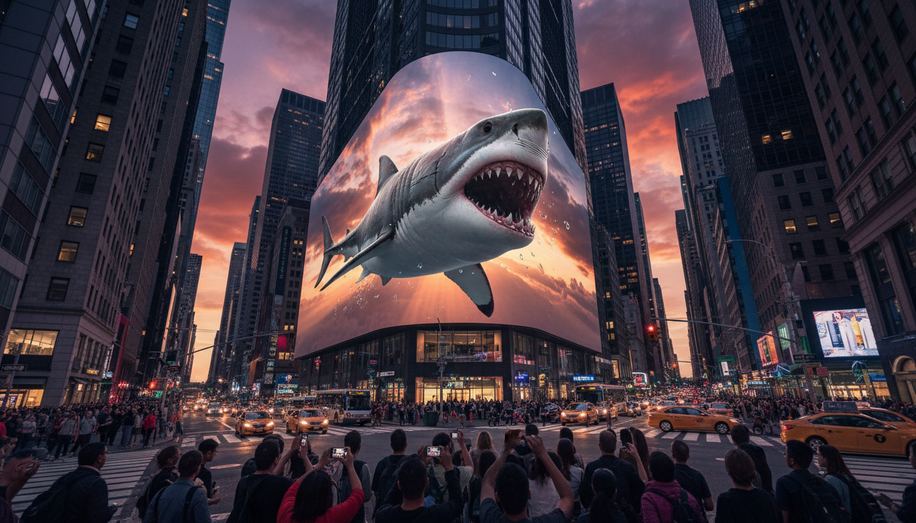

The rapid transformation of out-of-home advertising has ushered in a remarkable renaissance for optical illusions, where cutting-edge artistic techniques breathe stunning three-dimensional life into flat surfaces without a single line of augmented reality code. As digital displays saturate urban landscapes, brands and creative agencies are discovering that the most captivating advertising doesn’t always require the latest technology—sometimes it simply requires a masterful understanding of human perception.
Optical illusions in OOH advertising represent a creative evolution rather than a technological revolution. Designers and marketers are weaponizing age-old principles of visual deception, combining shadowing, scene setting, fixed light sources, and perspective to manufacture depth where none physically exists. This elegant approach harnesses fundamental truths about how our brains process visual information. When confronted with two-dimensional imagery, our minds naturally attempt to construct three-dimensional meaning, and skilled creators exploit this cognitive tendency to craft memorable experiences.
Two primary techniques dominate the landscape of contemporary 3D-effect billboards: anamorphic design and forced perspective. Anamorphic billboards employ mathematical algorithms to deliberately distort imagery so that it appears correctly proportioned only when viewed from specific angles. This technique creates an almost magical effect—viewers approaching from certain directions witness the image morph and resolve into perfect three-dimensionality, rewarding their position with visual clarity. Forced perspective, by contrast, manipulates perception by deliberately altering object scale within compositions, manufacturing the illusion of depth and dimension through strategic spatial relationships.
The appeal of these techniques extends far beyond mere novelty. When executed effectively, 3D-effect billboards command attention in ways that conventional advertising simply cannot match. Passersby stop. They engage. They pause mid-stride to comprehend what their eyes are telling them, creating precious moments of brand connection in an oversaturated media environment. This involuntary attentiveness represents the holy grail of outdoor advertising—genuine, unforced consumer engagement.
The staying power of these illusions further amplifies their marketing value. Unlike static advertisements that fade from memory within seconds, 3D-effect billboards create visceral, memorable experiences that persist in viewers’ minds long after they’ve passed the display. This cognitive residency translates directly into enhanced brand recognition and loyalty, giving advertisers substantial return on creative investment. The Museum of Illusions capitalized on this principle when it unveiled a striking 3D billboard in Las Vegas, featuring a photorealistic eye overlooking the Vegas Strip—a perfect demonstration of how ambitious anamorphic vision can command attention in one of the world’s most visually competitive environments.
The technical sophistication underlying these illusions operates largely invisibly to the average observer. By skillfully manipulating light, color, shape, and perspective, designers trick viewers into perceiving motion and dimensionality in static imagery. This manipulation requires both artistic sensibility and technical precision—a deep understanding of geometry, optics, and human visual processing. A Frontline flea treatment advertisement exemplifies this principle, presenting a photorealistic dog scratching vigorously, with individual fleas rendered in meticulous detail that makes the image almost uncomfortably convincing.
The emergence of digital out-of-home platforms has dramatically expanded creative possibilities for optical illusions. Dynamic, motion-activated anamorphic displays can adapt their appearance as viewers move through space, adding temporal dimension to spatial manipulation. This technological enablement hasn’t replaced traditional techniques but rather amplified them, allowing advertisers to layer optical illusion with digital interactivity.
As advertising continues evolving in an increasingly crowded marketplace, optical illusions and anamorphic art represent a return to fundamental principles of human perception. They remind us that the most powerful advertising often transcends technology, relying instead on artistic sophistication and psychological insight. For OOH advertisers seeking to break through the visual noise, these techniques offer a proven pathway to genuine consumer engagement—one carefully calibrated angle at a time.