
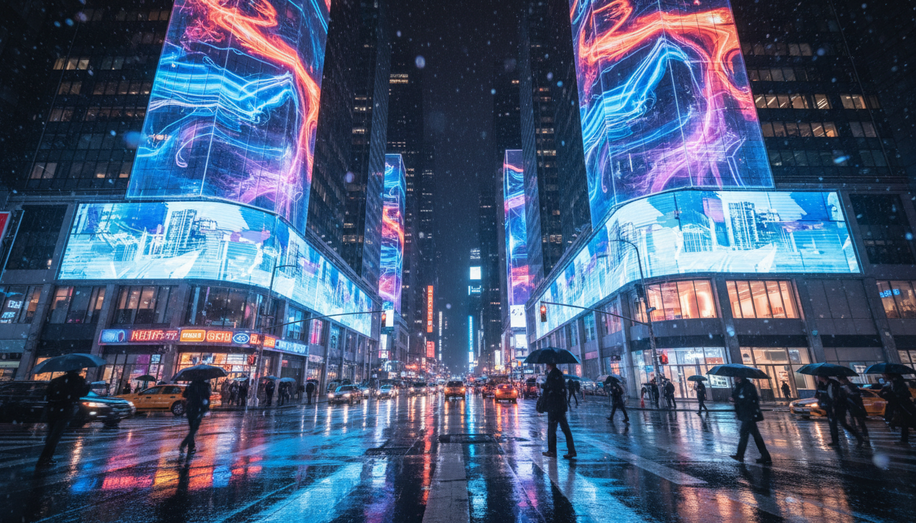

In the bustling streets of global cities, where advertisers vie for fleeting glances, out-of-home (OOH) screens are evolving from static billboards into dynamic canvases powered by revolutionary technologies. Micro-LEDs, transparent displays, and next-generation interactive surfaces promise to redefine visibility, engagement, and integration in outdoor environments, delivering unprecedented resolution and adaptability even under harsh sunlight.
Micro-LED technology stands at the forefront of this transformation, refining traditional direct-view LEDs into arrays of microscopic pixels that achieve 4K resolution and beyond. Unlike conventional LEDs suited for distant viewing in stadiums or Times Square spectacles, Micro-LEDs excel in close-up scenarios, smoothing out the pixel matrix for seamless imagery visible from mere meters away. Visionair-E’s Helios outdoor Micro-LED screens, for instance, boast pixel pitches as fine as 1.2mm and a staggering 3,500 nits of brightness, rivaling indoor quality while thriving in direct sunlight—ideal for poolside retail displays or open-air cinemas. This self-emissive pixel structure eliminates burn-in risks plaguing OLEDs, offers superior contrast with deeper blacks via gob resin coatings, and ensures energy efficiency and longevity, slashing long-term maintenance for always-on OOH installations.
What elevates Micro-LEDs for OOH is their scalability and modularity. Cabinets in 16:9 ratios snap together effortlessly for custom orientations—curved corners, 90-degree angles, wall mounts, or floor stacks—enabling frameless video walls that wrap architecture or form immersive outdoor theaters with IP65 front protection against dust and water. Industry experts note that as production costs drop, Micro-LEDs could supplant multi-monitor videowalls in sports bars, lobbies, and retail facades, processing multiple feeds like Super Bowl highlights alongside targeted ads. Their wide-angle viewing outperforms backlit LCDs, maintaining vibrancy from off-angles, while ultrahigh brightness suits augmented-reality overlays competing with ambient light.
Complementing this sharpness are transparent displays, unlocking OOH’s holy grail: integration without obstruction. Micro-LED’s modular architecture lends itself to semi-transparent formats, embedding vivid visuals into windows or glass facades for storefronts that blend advertising with unobstructed views. Imagine a high-street boutique where dynamic promotions pulse across a see-through screen, layering product visuals over the passing crowd below. These surfaces preserve architectural flow, turning building envelopes into ambient interfaces that draw eyes without dominating space—perfect for urban retail or transit hubs where transparency fosters seamless brand storytelling.
Yet the true game-changer lies in next-gen interactive capabilities, fusing these displays with touch, gesture, or sensor-driven engagement. Micro-LED’s durability supports rugged touchpoints for real-time customer interactions, such as on-shelf signage updating inventory or interactive kiosks in public spaces. High contrast and low latency enable responsive ambient interfaces, where passersby swipe for personalized offers or trigger AR experiences via proximity sensors. In outdoor cinemas or event venues, effortless front-maintenance modules minimize downtime, while intelligent controls allow remote content swaps, ensuring campaigns stay fresh amid variable weather. LG’s outdoor LED solutions and similar Micro-LED hybrids already power stadiums and public arenas, hinting at a future where screens anticipate viewer behavior, boosting dwell time and conversion rates.
Challenges persist—high upfront costs and manufacturing scale—but momentum is building. Giants like Samsung invest heavily, while suppliers like Visionair-E deliver deployable outdoor units today, with warranties up to two years and sunlight-proof performance. For OOH operators, the ROI crystallizes in reduced energy bills, extended lifespans, and novel applications: curved embedded surfaces in vehicles, window displays holding crisp visuals in glare, or resilient video walls for 24/7 urban pulses.
As 2026 unfolds, these technologies herald an era where OOH screens transcend mere messaging. Micro-LEDs deliver pinpoint clarity, transparency weaves ads into the environment, and interactivity turns spectators into participants. The result? Hyper-targeted, immersive experiences that capture attention in an oversaturated world, propelling OOH into its most vibrant chapter yet.