
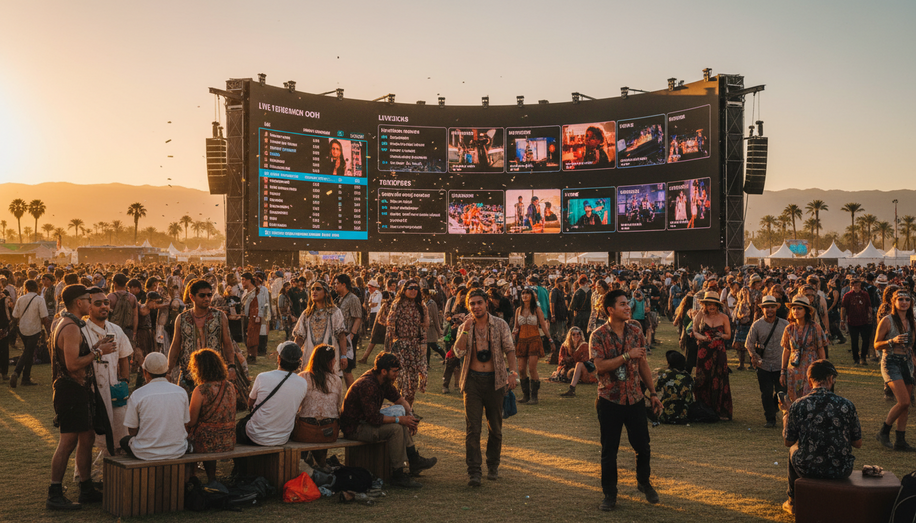

In the vibrant streets of Charlotte, digital billboards pulsed with a live PGA Championship leaderboard, updating in real time as golfers battled for the title before seamlessly shifting to invitations for Elijah Craig bourbon happy hours each evening. This out-of-home (OOH) campaign, orchestrated by Adams Outdoor Advertising and Vistar Media, racked up over 15 million impressions across 41 screens and captured 5 million unique devices, transforming the city into an extension of the tournament itself. Far from mere announcements, such integrations position OOH as a dynamic catalyst in experiential marketing, priming audiences for events, boosting attendance, and weaving brands into the narrative of concerts, festivals, and sports spectacles.
Event marketers have long valued OOH for its scale and immediacy, but digital out-of-home (DOOH) elevates it into a strategic force, layering real-time relevance onto high-traffic zones. During the Charlotte activation, pre-event countdowns built hype five days prior, live data dominated mid-tournament, and post-round celebratory messaging sealed the deal—dayparting precision enabled by Vistar’s ad server that created a persistent “real-time brand experience.” This temporal agility distinguishes event-driven OOH from static brand launches, where the focus is recall rather than urgency; here, ads pivot to match audience mindset, driving foot traffic and onsite engagement.
Real-world results underscore this power. A Los Angeles campaign wrapped an electric bus and deployed posters with sustainability messaging tied to local events, spiking sales 42 percent and TikTok followers 14 percent. In New York, weather-responsive DOOH ads adapted to conditions mirroring festival energy, lifting fashion promotion foot traffic by 35 percent. Tokyo’s digital signage delivered safety alerts during gatherings, boosting app downloads 47 percent, while London’s interactive “smile campaign” gamified streets for a 22 percent sales increase. These examples reveal OOH’s conversion edge: QR codes on screens near parking garages prompted 15 percent more app downloads for retailers syncing with concerts or seasonal sales, turning intrigue into purchases.
Interactivity and omnichannel fusion amplify OOH’s role further. At Bridgestone Arena, a permanent digital wallscape narrated fan stories during games, fostering community that spilled into higher attendance. Luxury car brands in high-traffic garages synced DOOH with mobile retargeting during auto shows, surging test drive bookings. A grocery chain’s QR-enabled ads let passersby build lists en route to pop-up markets, while interactive mirrors teased event-exclusive deals for 30 percent sales lifts. Projection mapping and large-scale activations turn buildings into immersive teasers, blending OOH with live experiences at retail venues like malls and bars, where contextual promotions reach relaxed audiences primed for nearby events.
Seamless integration with digital channels multiplies impact, avoiding siloed efforts. Pairing OOH with social media boosts exposure 13 percent and sales 8 percent, as visual creatives spark shares and viral posts. Geofencing retargets mobile users exposed to screens with ticket offers, while programmatic DOOH uses event data—predicted attendance, venue details, timing—to place ads precisely where fans converge, like building wraps en route to concerts. A beverage brand’s Delhi hoardings teased “Feeling the Heat?” before digital reveals drove “Taste the Chill,” yielding 3.8 million impressions, 45 percent more test drives, and 60 percent of digital conversions from OOH zones. Mobile billboards with beacon analytics maintain brand voice across channels, expanding reach to offline audiences and fueling sustainable growth.
Data backs the metrics: OOH bolsters mobile click-through rates 15 percent, weather-triggered ads prompt 25 percent more store visits—ideal for unpredictable festivals. Nielsen data shows DOOH paired with mobile or social enhances recall and engagement. For venue owners, platforms linking point-of-sale data to OOH deliver real-time revenue insights, optimizing tactics mid-event. Intelligent event data navigates privacy laws by targeting high-volume gatherings without personal tracking, placing eye-catching displays where swells of music or sports fans pass.
Yet execution is key: premium inventory, dynamic creative, and audience targeting redefine boundaries, as Adams Outdoor’s Matt Hood emphasizes. Run OOH teasers first, echo with social hashtags and influencers, then layer PR, email, and digital for unified messaging. Tech brands at bus stops demo interactives that resume on phones for tailgates; drink companies display live social reactions on billboards during broadcasts.
Ultimately, OOH doesn’t just promote events—it becomes their prelude, turning urban canvases into co-stars that amplify cheers, ticket scans, and shared moments. As experiential campaigns proliferate, this street-to-stadium bridge proves indispensable, converting passive passersby into immersed participants and delivering measurable narrative depth.