
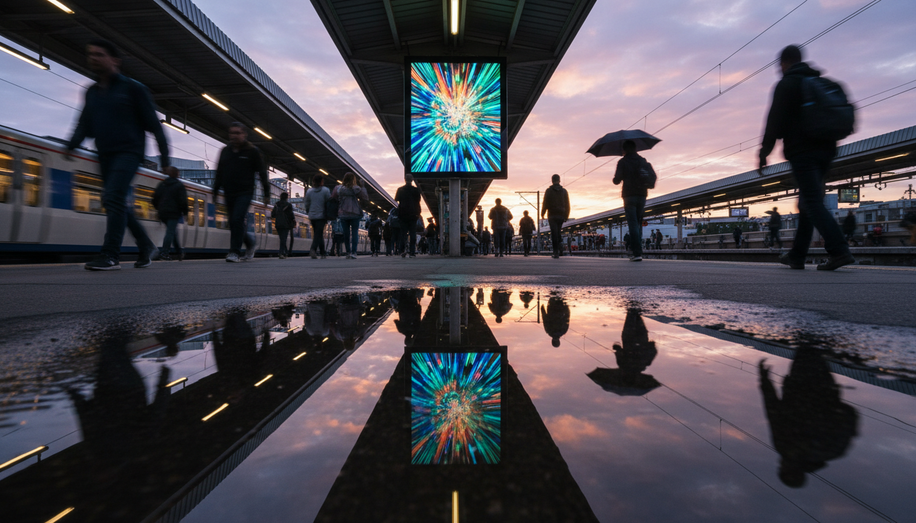

Urban commuters spend increasingly less time engaging with traditional media, yet they remain captive audiences during their daily journeys through city streets and public transportation systems. This shift has transformed transit advertising into one of the most powerful channels for reaching diverse demographics at scale, making 2026 a defining year for brands seeking to master movement-based marketing.
The evolution of transit advertising reflects a fundamental change in how brands approach audience engagement. Unlike static outdoor advertising confined to fixed locations, transit media delivers repeated exposure to consumers within their established daily routines, where ad fatigue remains remarkably low. A single marketing bus can traverse marketplaces, office districts, residential areas, and highways in one day, creating unmatched mobility that traditional channels struggle to match. With rising traffic congestion extending dwell time on roads, every traffic signal and bus stop becomes a branding opportunity, multiplying impressions exponentially.
Strategic placement now drives campaign success more than ever before. Media planning has evolved beyond demographic targeting to embrace mobility-led approaches rooted in understanding where, when, and how people move through cities. Advertisement on taxi fleets is increasingly mapped to business districts, airports, and premium residential zones, while bus advertisements align with high-recall corridors such as office routes, college zones, and shopping clusters. This precision targeting enables hyperlocal campaigns where messages reach specific communities along routes, rather than broadcasting generic content to undefined audiences.
The formats themselves have become increasingly sophisticated. Full bus wraps create massive moving canvases for brand storytelling, while tail wraps and super tails—covering the entire back of buses—occupy a uniquely strategic position at eye level for drivers stuck in traffic and pedestrians walking behind. These rear-facing placements benefit enormously from traffic congestion, which extends viewing time and creates the extended exposure necessary for memorable messaging. Side panels offer more budget-conscious alternatives, functioning as moving posters that place messages directly at eye level with passing audiences. Interior ads capture captive commuters during their journeys, transforming otherwise passive transit time into engagement opportunities.
Subway and train station environments present different strategic possibilities. Station takeovers transform entire spaces—walls, pillars, turnstiles, and stair risers—into immersive brand zones, while in-train placements target audiences already committed to focused attention. The New York City Subway alone recorded over 2 billion riders in recent years, illustrating the scale available through transit infrastructure. Taxi tops and car decals continue to circulate through nightlife districts, business hubs, and tourist areas, with illuminated signage on taxi tops proving especially effective during high-traffic evening hours.
The data supporting transit advertising’s effectiveness speaks clearly. Research indicates that 86% of bus passengers spontaneously recall bus advertising, while 80% of consumers say they respond to bus ads and 73% of commuters state they prefer buses with advertising. These engagement metrics significantly outperform many digital channels, particularly when integrated with modern measurement techniques and data-driven campaign management.
Creative execution has become equally critical. Designing for transit requires bold visuals, short messaging, and high contrast to communicate effectively to viewers in motion. Leading brands now employ full-body LED-lit wraps for nighttime visibility and integrate QR codes connecting offline audiences to digital funnels. Prestige Flowers demonstrated this integration’s power through a transit campaign featuring only a QR code, which generated nearly 8,000 scans and successfully drove new online audiences into their funnel.
For brands preparing transit campaigns, success demands embracing transit media as a dynamic, movement-based channel rather than static outdoor advertising. Alignment with urban behavior patterns, combined with creative optimized for motion and demand for transparent data measuring campaign execution and outcomes, separates effective transit strategies from undifferentiated placements. As cities continue evolving and consumer attention fragments across channels, the ability to reach audiences within their daily routines positions transit advertising as an indispensable tool for urban brand building in 2026 and beyond. Maximizing this dynamic channel requires granular insights and accountability. Platforms like Blindspot empower brands with critical location intelligence for strategic placement, precise audience measurement, and real-time ROI tracking, ensuring every movement-based campaign is optimized for measurable impact and delivers tangible business outcomes. Discover more at https://seeblindspot.com/