
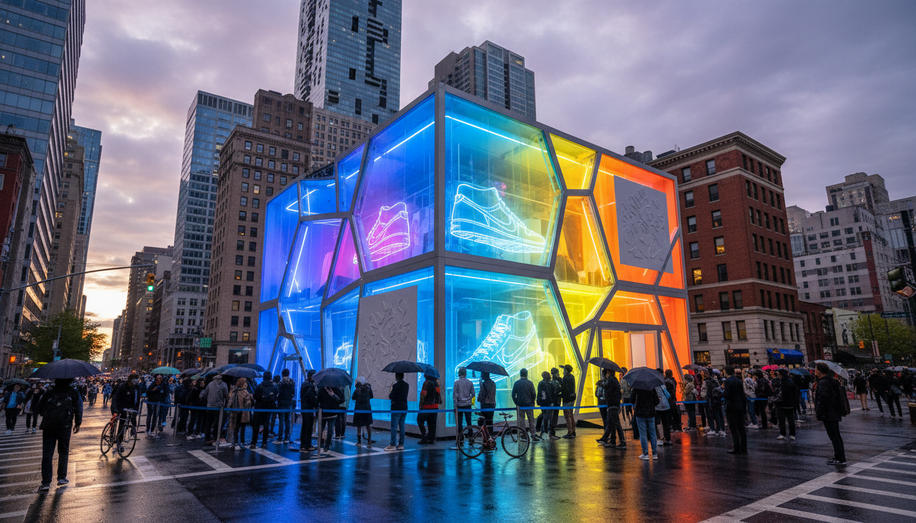

In the fast-paced world of advertising, where consumer attention is fleeting and budgets demand precision, temporary outdoor (OOH) campaigns have emerged as a potent force, blending immediacy with enduring impact. Pop-up structures, mobile billboards, and projection mapping deliver flexibility unmatched by static formats, igniting buzz for special events and limited-time pushes while etching brands into public memory. These transient activations capitalize on high-visibility moments, turning urban landscapes into canvases for creativity that drive both immediate action and lasting recall.
Consider pop-up installations, which thrive on surprise and immersion. Brands erect temporary structures in high-traffic zones—pedestrian intersections or event corridors—where dwell times soar above 95%, ensuring near-total visibility. During the 2023 U.S. Grand Prix in Austin, Cash App deployed building murals, large-format billboards, and wild postings across six key locations for four weeks, generating over 15.5 million impressions in a single month. This concentrated spend during a cultural peak not only maximized qualified reach but primed conversions, proving how pop-ups align message with moment for outsized returns. Such tactics extend beyond events; pop-up activations have surged in popularity by 2025, with experiential elements boosting consumer recall and loyalty as 56% of viewers discuss memorable OOH encounters.
Mobile billboards amplify this dynamism, roaming city streets to chase audiences where they live and play. Unlike fixed placements, these vehicles navigate festivals, product launches, or flash sales, achieving low cost-per-thousand impressions from $2 to $7 while complementing digital efforts for up to 316% ROI uplift. OOH’s overall potency shines here: billboards alone yield a staggering 497% average ROI, with every dollar spent returning $6, per Out of Home Advertising Association of America (OAAA) data. Mobile variants excel in driving behavior—65% of exposed consumers search online post-exposure, and 40% visit sites within minutes, often spurred by QR codes that lift response rates by 50%. A Kantar study underscores their edge, showing billboards outperform TV (9.6% lift), digital (1.7%), and connected TV (2.7%) in purchase intent at 9.8%. Wrapped trucks or bikes prowling urban cores ensure brands intercept commuters who encounter 5,000+ OOH ads monthly, with 71% deeming them more standout than online equivalents.
Projection mapping elevates temporality to spectacle, projecting vivid narratives onto buildings or landmarks for nights-only campaigns. This digital out-of-home (DOOH) innovation captivates with dayparted messaging—weather-tied deals or time-specific offers rated useful by 81-86% of consumers—prompting actions like store visits (51% follow-through, 93% purchase completion). At events, projections create “wow” moments that fuel social sharing, especially among Gen Z, where interactive or animated DOOH sees higher engagement. Humorous or 3D extensions encourage photography and reposts, while human faces and bold typography extend read times even from afar. With 73% viewing DOOH favorably and 76% acting on it—from restaurant trips to word-of-mouth—projections turn ephemera into viral currency.
The genius of these formats lies in their dual punch: temporary impact for buzz, lasting impression for ROI. OOH reaches 90% of urbanites weekly, with 75% of travelers spotting billboards monthly and 55% highly engaged. Adding location-based targeting hikes returns 15-40%, and geo-fenced retargeting post-exposure boosts conversions 20-30%. Creative breakout sparks earned media, as seen when ads go viral on TikTok, exceeding paid impressions. Even brief views stick—OOH ads average 12 seconds of attention, with 90% surpassing the 2.5-second threshold for long-term memory.
Critics once dismissed OOH as outdated, yet 2025 data flips the script: it trumps rivals in awareness, favorability, and intent. For limited campaigns, flexibility reigns—DOOH slashes production costs for rotations, while pop-ups and mobiles dodge permitting hurdles for quick deploys. Localized copy lifts engagement 20-45%, and placements near decision points like stores amplify recall. Brands like those at music festivals or pop-up shops reap 48% higher store visits, with QR-driven app installs surging in activity zones.
Ultimately, these campaigns redefine OOH’s role in a digital-saturated era. Temporary doesn’t mean forgettable; it means agile, buzzworthy, and bankable. As investment in DOOH hits billions and experiential tactics proliferate, pop-ups, mobiles, and projections prove that a fleeting encounter can forge unbreakable brand bonds, delivering ROI that endures long after the lights dim.
For brands eager to harness the full, measurable power of these agile, temporary campaigns, platforms like Blindspot become indispensable. By leveraging location intelligence for optimal site selection, programmatic DOOH campaign management for dynamic content delivery, and robust ROI measurement, Blindspot ensures every temporary activation—from pop-ups to projections—delivers quantifiable impact and enduring value, transforming fleeting encounters into bankable brand bonds. Explore how at https://seeblindspot.com/