
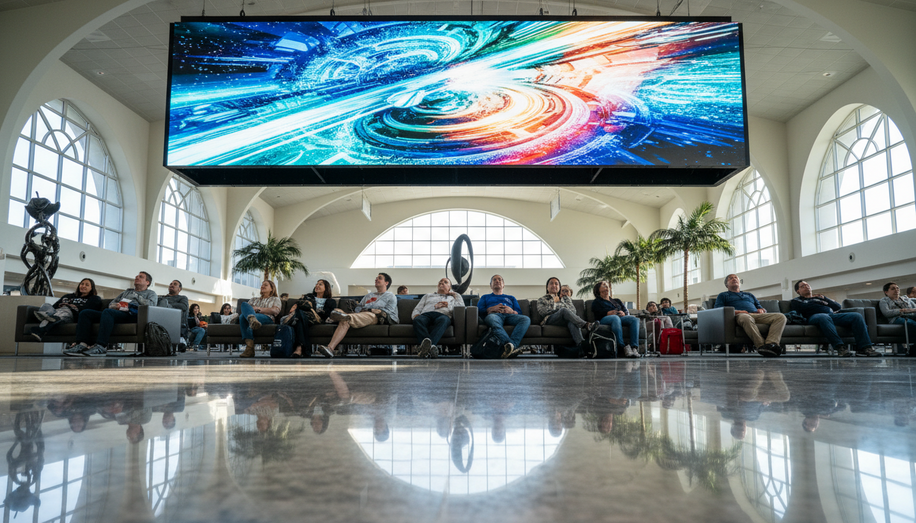

In the bustling corridors of the world’s airports, where global travelers converge in a symphony of haste and anticipation, out-of-home (OOH) advertising has emerged as a powerhouse for brand exposure. With passenger volumes soaring to 9.5 billion in 2024 and projected to climb further into 2026, airports offer advertisers a captive audience of affluent business executives, leisure seekers, and high-income professionals, all primed for engagement amid dwell times averaging over 60 minutes. This premium environment, valued at $4.24 billion for airport media in 2024 and forecasted to reach $4.5 billion in 2025, capitalizes on travelers’ discovery mindset, where distractions like mobile scrolling give way to heightened receptivity.
The appeal lies in the demographics: frequent flyers who are twice as likely to be AI decision-makers in their companies, boasting elevated purchasing power and a penchant for luxury, finance, and technology brands. A Nielsen study commissioned by Clear Channel Outdoor reveals that 83 percent of these travelers notice airport ads, with 75 percent taking action—visiting websites, scanning QR codes, or making purchases. In the latest data, 82 percent read airport advertisements, 61 percent recall them, and 57 percent act upon them, marking an eight percent uptick from 2022. Actions are tangible: 61 percent head to advertised locations, 53 percent visit websites, and 45 percent scan QR codes, a six percent increase driven by digital integration. This translates to superior cost-per-thousand impressions compared to roadside billboards, as airports command the outdoor advertising market’s strongest growth at a 7.19 percent compound annual growth rate (CAGR) through 2031, outpacing the overall sector’s 3.67 percent trajectory from $41.62 billion in 2026 to $49.86 billion.
Yet, maximizing impact demands navigating unique challenges. Diverse traveler profiles—business nomads rushing through premium lounges, families lingering in gates, or international tourists decoding unfamiliar signage—require tailored creative strategies. Short-haul commuters might dwell for mere minutes at security checkpoints, while long-haul passengers offer 90-plus minutes in lounges, ideal for narrative-driven campaigns. Variability peaks during disruptions like delays, which paradoxically boost exposure but test ad fatigue. Premium positioning comes at a cost: decade-long concessions ensure stable revenue for operators but inflate tenancy fees, with higher CPMs reflecting the affluent skew. Regulatory hurdles, from airport authority approvals to content guidelines ensuring brand safety, add layers of complexity, especially as digital screens proliferate under programmatic platforms.
Technological evolution addresses these hurdles head-on. Digital OOH (DOOH) dominates, enabling dynamic content synced to flight schedules, weather, or real-time data, transforming static displays into interactive experiences. Programmatic buying, projected to surge by 2026, allows precise targeting—pushing luxury retail to international gates or local business ads to domestic hubs. Clear Channel Outdoor’s portfolio spans over 55 U.S. commercial airports and 115 private jet terminals, reaching 52 percent of American air travelers with tools for personalized messaging. Immersive activations, like augmented reality QR codes or large-format video walls, foster engagement; travelers crave local relevance, with 88 percent favoring hometown business ads, 53 percent sports teams, and 48 percent educational institutions.
Success stories underscore the high-flying returns. National brands leverage airports for prestige amplification, where the uncluttered, high-intent space rivals digital channels but with physical immediacy—prompting immediate scans or post-flight conversions. Local advertisers tap into “sense of place” transformations, as airports evolve into commercial hubs with retail integrations and experiential zones. Amid surging travel demand fueled by post-pandemic recovery and infrastructure upgrades, challenges like audience fragmentation yield to data-driven precision, hedging economic volatility through guaranteed ad minimums.
For brands eyeing airport OOH, the formula is clear: blend premium demographics with dwell-time optimization via digital agility. Roadside may claim 42.55 percent of 2025 outdoor revenue for mass reach, but airports drive margin expansion, proving indispensable for engagement in an era of fragmented media. As global footfall hits records and DOOH adoption accelerates, this channel soars, delivering not just visibility, but measurable lift in a sky of opportunity.
Effectively navigating these complexities and leveraging the full potential of airport OOH demands advanced technological solutions that enable precision and measurable outcomes. Blindspot empowers brands and agencies to achieve this through sophisticated audience measurement, location intelligence for optimal site selection, and programmatic DOOH campaign management, ensuring dynamic, high-impact engagement and clear ROI attribution across diverse traveler segments. Learn more at https://seeblindspot.com/