
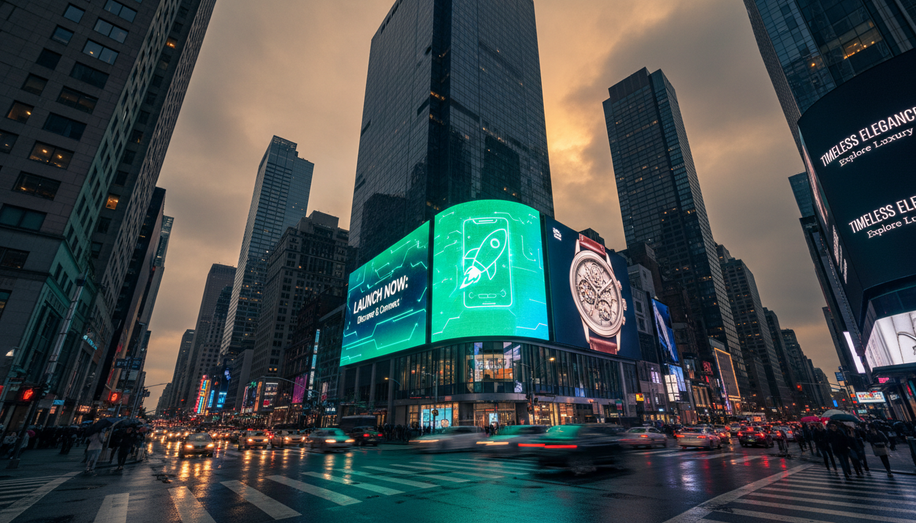

In the fragmented landscape of modern marketing, out-of-home (OOH) advertising stands as a resilient force, bridging the gap between enduring brand equity and immediate direct response tactics. Marketers increasingly recognize that OOH’s strategic sweet spot lies not in choosing one over the other, but in orchestrating a balance that leverages its unique physical presence for both long-term familiarity and tactical action.
OOH’s power in brand building stems from its unavoidable integration into daily life. Unlike digital ads that consumers can block or scroll past, a billboard on a commute route or a transit wrap on a bus delivers repeated, unskippable exposure. This “always-on” quality fosters cumulative familiarity, turning passive encounters into subconscious associations. Research shows that 71% of drivers notice roadside billboards, with 37% looking each time they pass, building strong recall along habitual paths. Extended dwell times—far longer than the milliseconds of online impressions—allow for nuanced storytelling, unfolding narratives across sequential displays or layered formats like street-level screens and guerrilla installations. For emerging brands, this rapid visibility accelerates awareness; for established ones, it reinforces architecture in physical space, creating trust through contextual relevance, such as summer refreshment ads near beaches or winter warmers on chilly commutes.
Yet OOH has evolved beyond mere awareness. Once dismissed as a “brand-building-only” medium due to measurement challenges, it now delivers quantifiable direct response through analytics revolutions. Mobile location data, social lifts, and sales correlations track footfall and conversions, narrowing the gap with digital precision. A global study of 150 OOH campaigns across seven markets found high-performing creatives—those earning a “double take”—deliver double the commercial impact, over three times stronger brand sentiment, nearly three times better message recall, more than twice the unaided awareness, and a 50% higher chance of driving action. Digital OOH (DOOH) amplifies this with real-time updates for time-sensitive promotions, blending flexibility with scale to spur immediate behaviors like store visits or scans.
This dual capability positions OOH as a complement to digital, not a competitor. In a world of ad fatigue, where online messages blend into clutter, OOH cuts through with sheer physicality: massive installations command attention impossible on screens, while creative dimensionality—lighting, movement, interactivity—leaves lasting impressions. Consumers encounter OOH during screen-free moments, like walks or drives, anchoring digital touchpoints. Picture a social media prompt reinforced by a towering building wrap en route to work, then a transit shelter call-to-action at lunch—each layer amplifies the next, creating a “surround-sound” effect in fragmented media diets.
Strategic balance demands calibration. For brand equity, prioritize high-reach formats like billboards, which dominate OOH spend and boast 80% noticeability rates, ideal for top-of-funnel awareness. Transit and street-level ads extend storytelling, while experiential elements build emotional ties. Shift to direct response with targeted DOOH near retail clusters, incorporating QR codes or geo-fenced promotions that drive measurable lifts. Cost-effectiveness bolsters the case: OOH generates impressions and leads at lower costs than digital in high-traffic zones, with durable static formats offering longevity and DOOH enabling agility.
Challenges persist. Not all OOH excels—nearly 40% of tested campaigns scored minimally for long-term effectiveness, underscoring the need for creative pre-testing to ensure “double take” impact. Placement matters: commuter corridors maximize repetition, while pedestrian hubs suit interaction. Sustainability also weighs in, with eco-friendly materials enhancing brand affinity without compromising reach.
Forward-thinking marketers treat OOH as the linchpin of integrated strategies. It reaches people where they live, work, and move—not just on devices—earning attention organically amid rising digital skepticism. High trust in OOH ads, perceived as less intrusive, sustains its edge. By balancing equity-building scale with response-driving precision, OOH equips brands to thrive in attention wars, proving that in 2026’s hybrid ecosystem, physical presence remains profoundly digital-proof.
Mastering OOH as the linchpin of integrated strategies requires precise tools to achieve this critical balance and demonstrate tangible ROI. Blindspot empowers marketers with location intelligence for optimal site selection and programmatic DOOH management to dynamically tailor messages for both brand building and direct response. Its robust ROI measurement and real-time performance tracking provide the crucial data to quantify impact and continually refine strategy, proving OOH’s profound digital-proof value. Learn more at https://seeblindspot.com/