
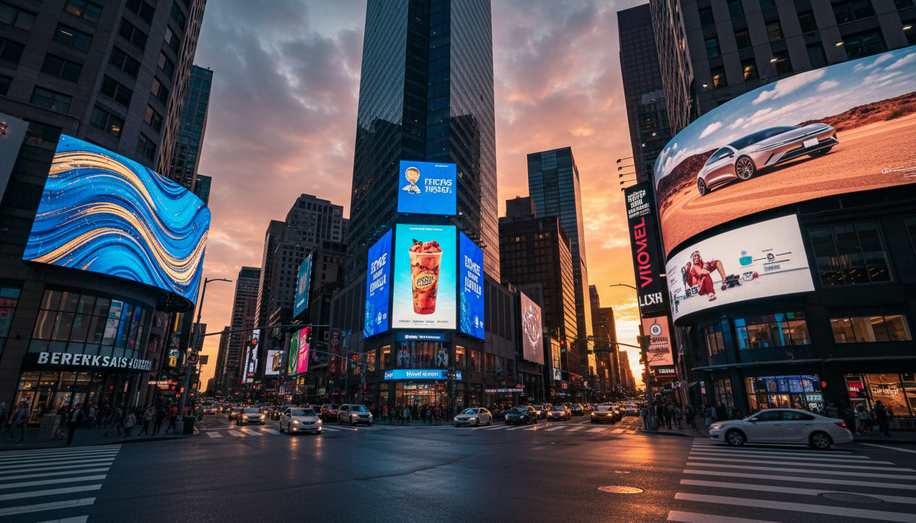

In the annals of advertising, out-of-home (OOH) campaigns stand as monumental testaments to human ingenuity, transforming cityscapes, highways, and public squares into canvases of persuasion and provocation. These towering billboards, interactive spectacles, and audacious installations have not only sold products but reshaped cultures, sparked conversations, and elevated agencies to legendary status. From the dusty roads of early 20th-century America to the digital projections of today, the maestros behind these efforts wielded creativity like a conductor’s baton, harmonizing strategy, spectacle, and societal pulse to craft messages that endure.
Few OOH efforts rival the Burma-Shave series, launched in 1925 by the small Minnesota company and masterminded by agency Allen, Hull & Salzberg. What began as roadside rhyming signs—short, witty poems spaced along highways like “Ben Met Anna/Made a Hit/Neglected Beard/Brunette Turned Blonde/Burma-Shave”—evolved into a cultural phenomenon. By the 1940s, over 40,000 signs dotted U.S. roads, blending humor with hygiene evangelism. The agency’s strategic genius lay in serialization: drivers anticipated the next verse, turning monotonous drives into engaging narratives. This low-tech innovation boosted sales dramatically and proved OOH’s power in sequential storytelling, influencing generations of highway advertising.
Decades later, political provocation took center stage with Saatchi & Saatchi’s 1979 “Labour Isn’t Working” billboard for the UK’s Conservative Party. Created amid economic turmoil, the stark black-and-white image showed a snaking unemployment line morphing into a breadline, with the tagline piercing the gloom. Positioned opposite London’s unemployment office, it weaponized real-time relevance, capturing public frustration and propelling Margaret Thatcher to victory. Saatchi brothers Charles and Maurice didn’t just advertise; they engineered cultural insurgency, demonstrating how OOH could hijack national discourse with unflinching simplicity and site-specific shock.
Across the Atlantic, Allstate Insurance’s dangling car stunt in the U.S. exemplified environmental integration, courtesy of an unnamed but bold creative team. A real vehicle hung precariously from a tower beside a billboard querying, “Are you in good hands?” Passersby gawked, double-took, and debated, the visceral imagery etching the message into memory. This 3D illusion blurred advertising with stunt, leveraging shock value to underscore insurance’s protective promise. It highlighted agencies’ penchant for physical metaphors, turning urban vertigo into viral conversation fodder.
Interactive brilliance shone in The Economist’s UK billboard, crafted by agency Abbott Mead Vickers BBDO. A light bulb dangled above a pedestrian sensor; as walkers passed, it illuminated with the slogan implying enlightenment from the publication. One of the earliest digital OOH experiments, it transformed passive viewing into personal epiphany, proving billboards could respond to human presence. The agency’s foresight in merging tech with metaphor set a blueprint for engagement, influencing a wave of sensor-driven ads that made media environments feel alive.
No survey of OOH icons omits the Burma-Shave heir in rhythmic innovation: Taj Mahal Tea’s 2023 “Raag Megh Malhar” billboard in India, engineered by Ogilvy. This rain-activated santoor installation played classical Indian raga notes as monsoon drops struck its strings, evoking the tea’s refreshing essence. Earning a Guinness World Record, it fused cultural heritage with meteorological whimsy, immersing Mumbai commuters in sensory poetry. Ogilvy’s strategic alchemy—timing nature’s drama with brand tradition—redefined experiential OOH, proving ambient integration could transcend screens.
Even architectural landmarks became billboards under agency wizardry. Samsung’s 2013 Sydney Opera House projection, via Leo Burnett, bathed the sails in user-submitted Galaxy S4 images, turning Australia’s icon into a luminous canvas. This guerrilla projection celebrated national identity while showcasing camera prowess, blending public participation with monumental scale. The controversy it sparked only amplified reach, underscoring agencies’ skill in commandeering spaces for democratic storytelling.
Austria’s Oldtimer rest stop ad pushed literal immersion: a tunnel-mouth billboard declaring “All You Can Eat,” forcing drivers through its maw. The unnamed agency’s meta-physical pun—vehicles “consumed” en route—guaranteed notice, forging instant brand bonds through enforced interaction. Such audacity echoed earlier feats like the 1975 Outdoor Advertising Inc. campaign featuring Miss America Shirley Cochran on nationwide billboards, which skyrocketed her recognition 940 percent and validated OOH’s measurable clout.
These campaigns, from rhyme to rain, reveal the agencies’ shared playbook: exploit context, provoke reaction, and embed emotionally. Chiat/Day’s Apple “1984” Super Bowl spot, though TV-born, inspired OOH echoes in its rebellious silhouette, while Wieden+Kennedy’s Nike “Just Do It” permeated posters with universal grit. Red Bull’s 2012 Stratos jump, sponsored experiential OOH at stratosphere scale, embodied boundary-pushing ethos. Today, as digital OOH evolves, these maestros remind us: the street is the ultimate focus group, and true brilliance turns it into legend.