
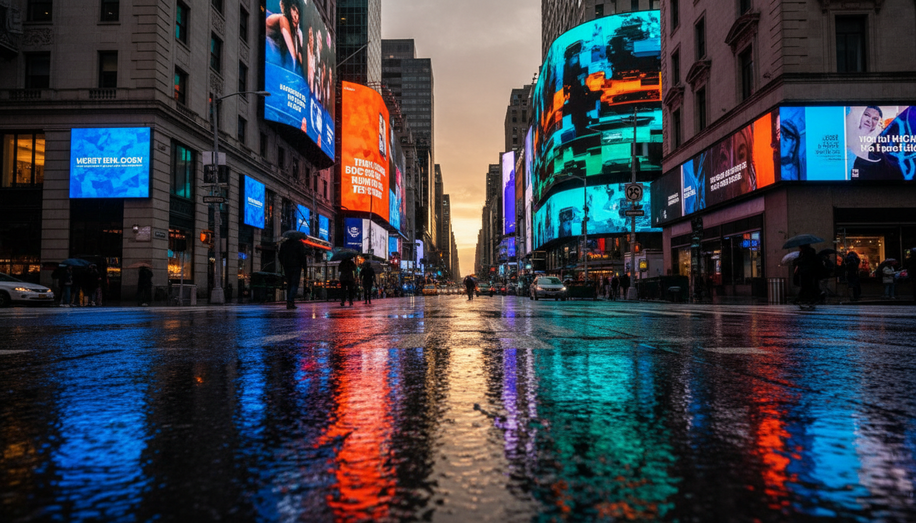

Outdoor advertising has long served as a bold canvas for creativity, transforming public spaces into arenas of persuasion and spectacle since its rudimentary beginnings in the 1830s. Printer Jared Bell sparked the first billboard boom by designing large, colorful posters to hype traveling circus acts like Barnum & Bailey, using bold text and striking imagery to snag the eyes of passersby. These early efforts evolved rapidly as America’s roads expanded; by the 1920s, national giants such as Coca-Cola and Palmolive blanketed highways with campaigns that capitalized on the rise of automobile travel, turning long drives into rolling galleries of commerce. Yet it was the post-World War II era that truly ignited OOH’s golden age, when advertisers harnessed the medium’s scale to deliver messages that didn’t just sell products but reshaped culture and sparked national conversations.
Few campaigns embody this transformative power as vividly as the U.S. Military’s “I Want You” poster from 1917-1918. James Montgomery Flagg’s depiction of Uncle Sam pointing sternly at the viewer with the words “I Want You for U.S. Army” became an enduring emblem of patriotic urgency during World War I. Its direct gaze and emotional charge made it one of history’s most recognizable ads, proving OOH’s unmatched ability to forge personal connections on a massive scale. Decades later, the Burma-Shave series took this intimacy to highways nationwide in the 1920s through 1960s. Clusters of small signs strung along roadsides delivered rhyming jingles like sequential poetry—“Ben Met Annette at the A&W / They Laughed, They Danced, They Had a Swell Spree / Thru By-Passed Burma-Shave”—culminating in the brand name. This innovative roadside storytelling not only boosted sales of the brushless shaving cream but elevated OOH from static pitches to dynamic narratives, influencing generations of sequential advertising.
The 1990s ushered in OOH’s cheeky provocateurs, none more infamous than Wonderbra’s “Hello Boys!” billboard starring Eva Herzigova in 1994. The supermodel’s arched pose and flirtatious greeting halted traffic—literally—sparking accidents, media frenzy, and debates over public decency. Voted the most iconic billboard of recent decades by the Outdoor Media Centre, it catapulted Herzigova to stardom and demonstrated how sheer audacity could turn a lingerie ad into cultural shorthand for sex appeal in advertising. Chick-fil-A’s “Eat Mor Chikin” cows, debuting in 1995, flipped the script with wholesome humor. Dyslexic bovines “painting” pleas like “Eat Mor Chikin” on billboards positioned chicken as the anti-beef hero, running for over two decades as one of OOH’s longest campaigns. Its self-deprecating wit and visual consistency built a loyal following, showing how personality-driven characters could sustain engagement across vast outdoor networks.
As technology intertwined with tradition, campaigns grew more immersive. Allstate’s dangling car stunt in the U.S. paired a real vehicle suspended from a tower with the stark question “Are you in good hands?” The visceral imagery forced double-takes and underscored insurance’s promise of security, masterfully leveraging a billboard’s physical environment for unforgettable impact. Samsung elevated this further in Australia by projecting user-submitted photos onto the Sydney Opera House sails at night, merging public participation with a national landmark. This 2000s spectacle reinforced the brand’s innovative edge while forging communal ties, proving OOH could evolve into interactive cultural events.
Even experiential feats transcended traditional formats. Red Bull’s 2012 “Stratos Jump” sponsored Felix Baumgartner’s stratospheric freefall, live-streamed to millions and splashed across OOH displays worldwide. The death-defying plunge embodied the energy drink’s extreme ethos, blending physical billboards with global media to redefine sponsorship as stratospheric storytelling. Meanwhile, IBM’s 2013 “Outdoor as Utility” by Ogilvy Paris turned street furniture into smart city demos, dynamically displaying real-time data to illustrate urban intelligence—a subtle yet revolutionary nod to OOH’s data-driven future.
These moments didn’t just capture attention; they set benchmarks for creativity, engagement, and results. Apple’s dystopian 1984 Super Bowl spot, evoking Orwellian rebellion to launch the Macintosh, influenced OOH by inspiring cinematic ambition in public spaces. Nike’s 1988 “Just Do It,” featuring 80-year-old Walt Stack jogging the Golden Gate Bridge, infused billboards with motivational grit that persists today. Regulatory hurdles, like Lady Bird Johnson’s 1965 Highway Beautification Act, even shaped the medium by curbing sprawl and forcing smarter placements. Today, as digital OOH merges LED screens with AR, these icons remind us that the industry’s enduring strength lies in bold ideas that turn everyday commutes into encounters with the extraordinary. From Uncle Sam’s finger to stratospheric leaps, OOH has always been more than advertising—it’s the pulse of cultural change.
As OOH continues its evolution into a dynamic, data-driven realm, platforms like Blindspot become indispensable. They empower brands to sustain this legacy of extraordinary encounters by leveraging precise audience measurement, optimal site selection, and real-time performance tracking to ensure every bold idea resonates culturally and delivers measurable impact in our increasingly digital public spaces. Visit https://seeblindspot.com/ to learn more.