
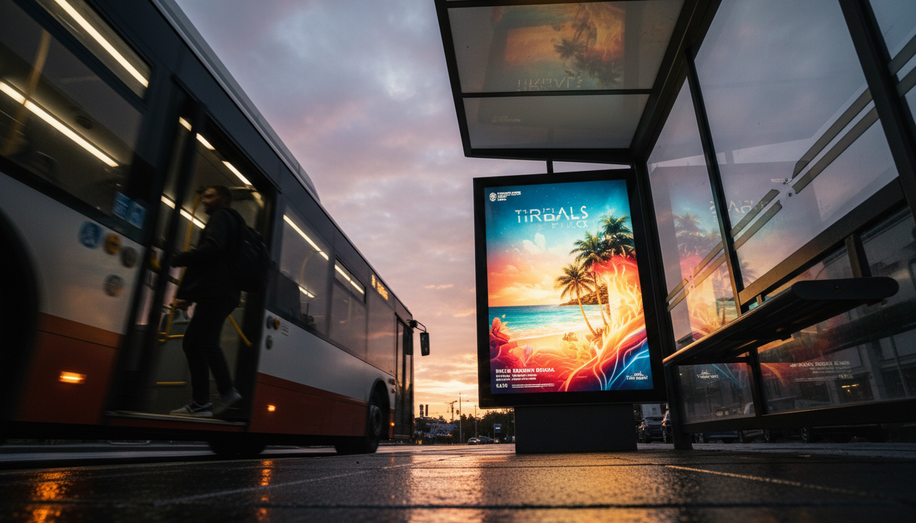

Out-of-home advertising for moving audiences presents a paradox: capturing attention in mere seconds while competing with the distraction of commutes, traffic, and urban environments. Vehicle wraps, bus backs, and transit shelters represent some of the most dynamic canvases available to marketers, yet their ephemeral nature demands a fundamentally different creative approach than static billboards or digital displays.
The primary challenge lies in the temporal constraint. Unlike a storefront ad where consumers linger, transit advertisements are consumed in brief, fragmented moments as people move through their daily routines. A commuter on a train may encounter the same shelter ad repeatedly, but each exposure lasts only seconds. This reality necessitates a design philosophy centered on immediate comprehension and visual hierarchy. Creative must communicate its core message through a single, dominant visual or bold graphic that captures attention instantly, with supporting copy playing a secondary role. A striking image or graphic can communicate the entire message at a glance, allowing accompanying text to reinforce rather than carry the burden of explanation.
The physical context of these placements fundamentally shapes effective creative strategy. Vehicle wraps and bus backs operate in dynamic environments where viewers see them from multiple angles and distances—from directly beside the vehicle to several car lengths away. This spatial variability demands high-resolution imagery and typography scaled appropriately for distance visibility. Text must be bold and legible, avoiding small fonts or complex designs that dissolve into visual noise at 20 meters. For bus shelters, where audiences often wait in closer proximity, detailed imagery and longer copy become viable, though simplicity in messaging remains paramount. The strategic difference between these formats reflects their viewing conditions: wraps prioritize impact at distance, while shelters can accommodate marginally more detail.
Context-aware creative represents an emerging best practice that transforms generic messaging into location-specific relevance. A health-focused message positioned outside a gym resonates differently than the same message near a shopping district. Transit environments provide natural opportunities for this customization. Retail promotions placed on routes leading to shopping centers drive foot traffic through strategic placement and tailored messaging. Restaurant advertisements on shelter ads near dining establishments leverage proximity to purchase decisions. This contextual alignment between placement and message content amplifies resonance, transforming passive exposure into purposeful brand communication.
The rise of programmatic capabilities has introduced a new dimension: temporal and environmental customization. Weather-triggered messaging, time-of-day adjustments, and audience-segment variations allow creative to remain fresh and relevant throughout campaigns. A beverage brand might display different creative during summer heat versus winter cold, or a ride-share advertisement might feature different messaging during peak commute hours versus leisure travel windows. This sophistication transforms what could be static, repetitive exposure into dynamic conversations adapted to real-world conditions.
Consistency across multiple placements creates powerful storytelling opportunities. Sequential vehicle wraps or grouped shelter ads along a commuter route can unfold narrative arcs, with each placement revealing a new story element or product feature. This approach transforms scattered touchpoints into a cohesive brand journey, inviting consumers to piece together a larger narrative across multiple encounters.
Digital integration bridges the gap between physical and digital engagement. QR codes embedded in vehicle wraps or shelter ads transform passive viewing into interactive experiences, directing audiences to promotional offers or digital content. Augmented reality components can bring static imagery to life through smartphone cameras, creating memorable interactions that extend the advertisement’s impact beyond initial exposure. Social media hashtags and handles provide secondary engagement opportunities, allowing audiences to continue brand interaction once they’ve moved beyond the physical placement.
The fundamental principle underlying successful creative for moving audiences is clarity combined with strategic context. Designers must embrace constraint rather than resist it—leveraging the brevity of exposure as creative limitation that drives focus and impact. When audiences encounter advertisements in transit, effectiveness emerges not from comprehensive information delivery but from memorable visual statements that resonate emotionally or intellectually in seconds, supported by seamless integration of physical and digital touchpoints that extend engagement beyond the fleeting moment of initial exposure.