
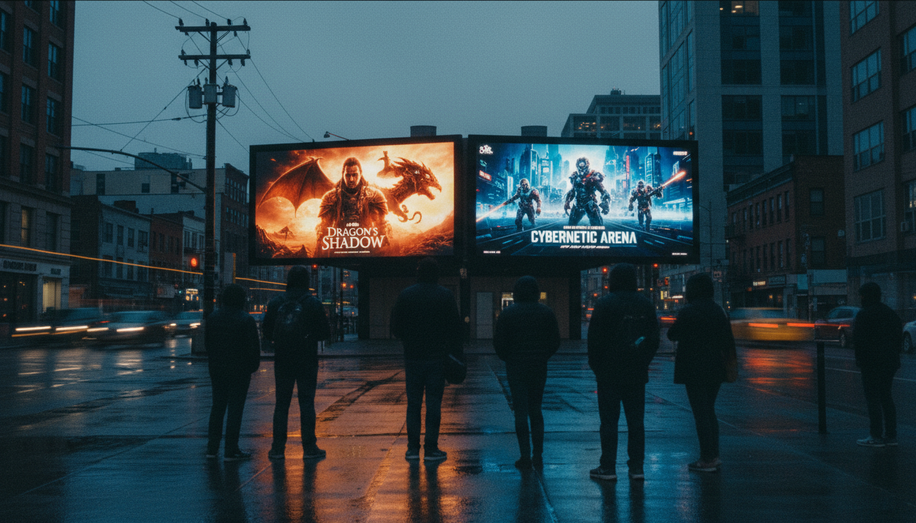

In the glittering chaos of Hollywood’s Sunset Strip, where digital billboards pulse with real-time updates on box office triumphs and award buzz, the entertainment industry has mastered out-of-home (OOH) advertising as its ultimate hype machine. Movie studios, gaming giants, and music labels deploy massive screens, mobile fleets, and immersive installations not just to announce releases, but to weave narratives that blur the line between advertisement and cultural event, captivating audiences from tourists snapping selfies on Hollywood Boulevard to industry insiders navigating Vine Street corridors. This strategic saturation turns passive passersby into active promoters, fueling word-of-mouth and social media virality that amplifies reach far beyond the physical space.
For films, OOH serves as the frontline in building pre-release frenzy. Studios like those dominating the Sunset Strip leverage premium digital placements—costing $35,000 to over $100,000 monthly—to showcase trailers that evolve with cultural momentum, swapping creatives for nominations or viral moments. During award season, coordinated mobile campaigns via fleets of wrapped vehicles, known as SWARM technology, swarm premieres and ceremonies, delivering GPS-tracked precision around high-profile venues. These efforts create geographic concentration, saturating neighborhoods like Los Feliz and Silver Lake where entertainment professionals reside, at a fraction of static billboard prices. The result? Memorable executions that generate industry conversation and tourist snapshots, with nearly 50% of entertainment ad viewers prompted to search online, boosting visibility by up to 300% when paired with digital channels.
Video games, thriving in an era of blockbuster launches akin to summer tentpoles, harness OOH’s flexibility for global announcements. Large-format digital networks along high-traffic arteries mirror the explosive visuals of titles like epic open-world adventures, using daypart scheduling to target commuters with gameplay teasers by day and immersive calls-to-action at night. In markets like Las Vegas, where gaming conventions draw decision-makers, DOOH screens wrap building sides and kiosks, extending campaigns from airport arrivals to Strip explorations. Experiential formats elevate this further: Wild Posting campaigns plaster street-level posters in urban hubs, inviting close-up photos that spark organic shares, while mobile billboards patrol event perimeters for localized dominance. Gaming brands thrive on urgency—”Pre-Order Now: Launch This Friday”—pairing eye-catching graphics with strategic timing to convert hype into downloads, much like films drive ticket sales.
Music artists and labels, meanwhile, transform OOH into concert countdowns and album drops that feel personal yet inescapable. Times Square’s towering screens and large-format transit ads have long spotlighted tours, with artists’ portraits dominating for weeks to instill familiarity before tickets go live. In entertainment epicenters, three-dimensional installations on digital spectaculars create shareable spectacles, such as holographic stage previews that light up the night and trend online. Subway wraps and street furniture extend this intimacy, targeting fan groups in high-traffic zones like malls, theaters, and stadiums where audiences linger. During peak cycles—summer tourist surges or fall TV tie-ins—mobile fleets align with artist rhythms, deploying around venues or festivals for buzz that increases engagement and word-of-mouth among friends and family. Las Vegas exemplifies this fusion, with Sphere ads going viral for millions of organic views, blending in-person spectacle with digital amplification for acts playing the Strip.
What unites these sectors is OOH’s power to deliver unskippable immersion in fragmented media landscapes. Billboards remain kings for mass awareness, but hybrids like digital DOOH and experiential Wild Posting offer agility, adapting to real-time data for peak impact. In Los Angeles, the world’s entertainment nerve center attracting 49.1 million visitors yearly, campaigns integrate with social activations: a Sunset Strip teaser prompts TikTok recreations, while Highland Avenue wraps catch executives en route to meetings. Success hinges on precision—defining objectives like industry targeting versus tourist reach, then matching formats: static for prestige, mobile for flexibility, street-level for virality.
Yet, execution demands sophistication. Entertainment pros, with their trained eyes, demand standout creative; generic ads fade into Hollywood’s visual noise. Seasonal savvy is key: award peaks demand early bookings with operators like Clear Channel or OUTFRONT, while mobile alternatives activate in weeks. Analytics from GPS-tracked fleets verify impressions, proving ROI through engagement patterns. High-traffic venues—airports, ballparks, the Sphere—amplify this, turning ads into journey companions that resonate where audiences congregate.
Ultimately, OOH isn’t mere signage for entertainment; it’s a cultural accelerator. By dominating screens in key corridors, from Hollywood’s strips to Vegas spectacles, films, games, and music don’t just advertise—they orchestrate the hype that defines hits. In an industry where buzz is currency, these strategies ensure releases don’t launch; they explode.