
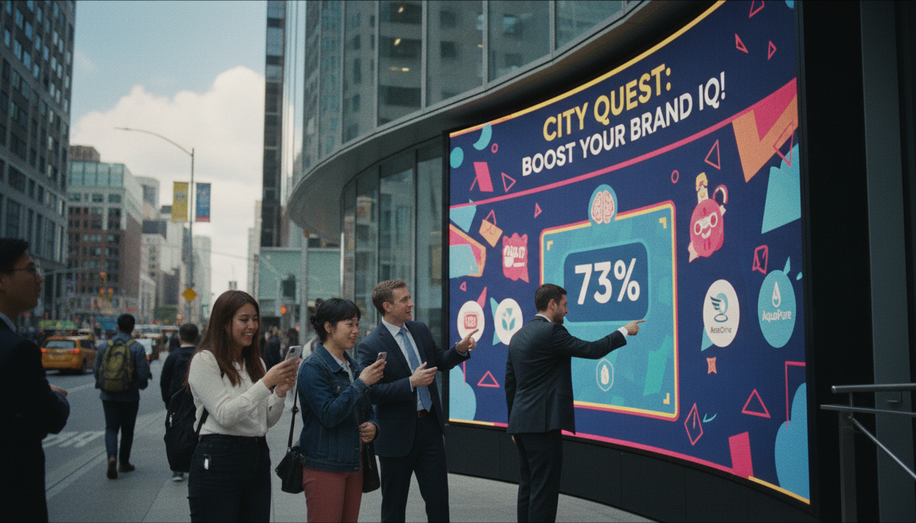

In the bustling streets of New York City, commuters paused mid-stride as massive digital screens at Times Square and MTA stations flashed trivia questions about iconic landmarks, urging them to scan QR codes and test their knowledge on the spot. This was Trivia Moments, a gamified digital out-of-home (DOOH) campaign by OUTFRONT Media and the NYC Landmarks60 Alliance, which drew 5,600 active players, generated 6 million points scored, and racked up 1.8 billion impressions while turning passive passersby into engaged participants. Such initiatives exemplify a growing trend: integrating gamification into DOOH to transform static billboards into interactive playgrounds that extend dwell time, sharpen brand recall, and forge memorable connections in an era of fleeting attention spans.
Gamification—the application of game-like elements such as points, challenges, and rewards to non-game contexts—has long proven its psychological pull, tapping into innate desires for achievement and competition. In DOOH, where audiences typically glance and go, this approach flips the script. Interactive displays encourage physical or digital interaction, whether through smartphone scans, motion sensors, or touchscreens, holding viewers for seconds that stretch into minutes. Research underscores the impact: Comscore’s 2022 study highlighted OOH’s high return on digital activation, a finding validated by campaigns like Trivia Moments, where real-time score tracking via a dedicated website created addictive loops of play. Brands report boosts in engagement metrics; for instance, Verizon Wireless saw a 30% increase in browsing time from gamified elements, while McDonald’s Monopoly campaign worldwide lifted sales through sustained interaction.
Real-world executions reveal the versatility of this strategy. In the Netherlands, PLUS supermarkets turned an entire town into a live Monopoly board, where residents bid on streets and buildings via digital prompts, blending DOOH with point-of-sale promotion to spark community buzz and real-life gamification. Similarly, RCBC Bank’s financial literacy drive in Bonifacio Global City featured touchscreen loan calculators and puzzles on bus shed displays, alleviating commuter boredom while embedding educational messaging that stuck. Oreo’s London campaign by Mondelēz International invited bus shelter users to download an app for minigames, with winners earning holidays or daily prizes, directly building brand loyalty through reward-driven play. These touchpoints not only extended dwell time—passersby lingered to complete challenges—but also amplified recall, as participants internalized brand messages amid the fun.
Motion and augmented reality (AR) take gamification further, leveraging DOOH’s digital capabilities for immersive experiences. Motion-based games, where sensors detect hand movements to “catch” virtual objects on screens, create visceral engagement without requiring downloads. Nike’s 3D Air Max billboard in Tokyo built suspense with a shoebox that periodically opened to reveal designs, going viral as a global social phenomenon and proving how game-like anticipation drives shares and buzz. AR scavenger hunts hide virtual treasures in urban landscapes, discoverable via phone cameras linked to DOOH prompts, turning cities into huntable playgrounds. The New York Times amplified its Spelling Bee puzzle in transit hubs with QR codes offering hints; players sharing “Genius” statuses triggered $1 donations, merging philanthropy with competition to extend interaction beyond the screen.
Programmatic DOOH supercharges these efforts with data-driven precision. The NBA’s playoff campaign used a single template populated dynamically with local scores, countdowns, and fan tweets, scaling nationwide to capture fans in real time and build excitement without manual updates. Mad Mex restaurants targeted hungry consumers near stores, tailoring messages to sales data—emphasizing taste or value—and exposed 2.9 million people, yielding a 9% sales uplift. New Balance celebrated athlete Femke Bol’s victory with adaptive creatives that shifted from pre-race encouragement to post-win jubilation, fostering timely, personal resonance. PrizePicks, in daily fantasy sports, combined programmatic buys near venues with influencer content, achieving an 80% lift in consideration and 103% in brand favorability. These examples demonstrate measurable ROI: longer dwell times correlate with higher recall, as interactive friction imprints brands deeper than passive views.
Challenges remain, from technical hurdles like seamless QR integration to ensuring accessibility across diverse audiences, particularly Gen Z and Alpha, who demand authenticity over sales pitches. Yet, as DOOH networks expand with touch-enabled pods in malls, parks, and transit, gamification positions the medium as a leveler in fragmented media landscapes. The Star Casino’s Lunar New Year game in Sydney’s Chinatown doled out vouchers for task completion on interactive displays, blending cultural celebration with commerce. Dreamies cat installations in London, while more sculptural, evolved into photo-challenge zones that echoed gamified sharing.
Ultimately, “Play to Engage” isn’t a gimmick—it’s a strategic evolution. By weaving games into the urban fabric, DOOH advertisers don’t just interrupt commutes; they invite participation, turning fleeting exposures into lasting affinities. As screens grow smarter and data richer, expect more brands to play—and win—in this interactive arena.