
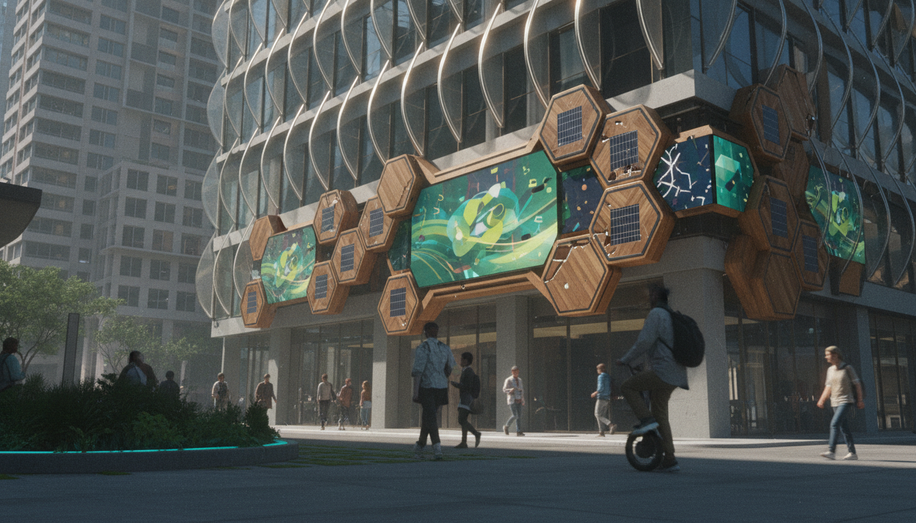

In the bustling arteries of tomorrow’s cities, out-of-home (OOH) structures are poised to transcend their role as mere canvases for messages, evolving into intelligent, adaptive ecosystems that harmonize with urban life. By the late 2020s, these displays will leverage modular designs and sustainable materials, powered by self-sustaining energy sources and embedded sensors, redefining infrastructure as a seamless blend of form, function, and environmental stewardship.
Imagine billboards that disassemble and reconfigure like living organisms. Modular frameworks, constructed from recyclable composites and bio-based polymers, will allow OOH installations to adapt on demand—expanding for peak-hour crowds or contracting during off-times to minimize visual clutter. This shift addresses urban density challenges, enabling structures to integrate with architecture rather than dominate it. Engineers are already prototyping lattice systems where panels snap into place via magnetic or electromagnetic connectors, slashing installation times by up to 70% and reducing waste from traditional fixed builds. In high-traffic hubs like airports and transit nodes, these designs will play with infrastructure itself, morphing bus shelters into dynamic media walls or elevating street furniture with interchangeable facades that respond to seasonal needs.
Sustainability, no longer a peripheral concern, will anchor this evolution as green mandates intensify. Expect widespread adoption of energy-efficient LEDs and OLEDs paired with solar-integrated panels that harvest ambient light, rendering many displays off-grid and carbon-neutral. Recyclable aluminum alloys and mycelium-derived foams—fungi-based materials with strength rivaling steel but fully biodegradable—will replace legacy metals, cutting embodied carbon by half. Cities embracing circular economies will favor these innovations; for instance, structures designed for end-of-life disassembly could see components repurposed into new builds, aligning with projections of OOH market growth to over $26 billion by 2034, driven by eco-conscious infrastructure. Brands prioritizing these materials won’t just comply—they’ll gain a competitive edge, as sustainability influences media buying decisions amid rising consumer demand for ethical advertising.
Energy efficiency will extend beyond power sources to intelligent management. Future OOH frames will incorporate kinetic harvesters in pedestrian zones, converting footfall vibrations into electricity, while AI algorithms optimize brightness based on real-time ambient light, weather, and audience density—potentially halving consumption compared to today’s digital out-of-home (DOOH) setups. This responsiveness ensures displays remain vivid without excess draw, supporting programmatic DOOH’s dominance in large-format networks by 2026, where campaigns adapt dynamically to factors like time of day or events.
Integrated technologies will elevate these structures from passive to participatory. Holographic and 3D anamorphic displays, already captivating at premium sites, will become standard, projecting immersive visuals that leap from surfaces without glasses, powered by edge-computing modules embedded in modular frames. Sensor arrays—LiDAR for gesture recognition, cameras for anonymized crowd analytics—will enable real-time interactions: wave a hand to trigger personalized content, or scan a QR for AR extensions bridging physical and digital realms. Programmatic platforms will fuse this with mobility data and real-time bidding, turning OOH into a “global operating system” for liquid audiences, where displays target demographics on the move with precision unattainable by static media.
In urban corridors and transit environments, these advancements converge to create experiential hubs. Floor-to-ceiling digital walls with motion-responsive facades will blend brand storytelling with architecture, using gesture controls for immersive engagement that boosts recall and social amplification. Data intelligence—tracking dwell time, footfall, and even sentiment via thermal imaging—will feed back into campaigns, allowing holographic narratives to evolve mid-flight delay or rush hour. Traditional billboards, far from obsolete, will hybridize with e-ink layers for low-power static holds, switching to full DOOH bursts only when needed, preserving trust through contextual clarity absent in algorithm-driven feeds.
Yet this future demands collaboration. Regulators will enforce standards for light pollution and data privacy, while advertisers treat OOH as core infrastructure, anchoring omnichannel strategies with measurable lift in search, traffic, and visits. Structural growth in both digital and static formats signals enduring demand, as OOH bypasses platform volatility for reliable, frictionless reach.
As 2026 unfolds, tomorrow’s OOH structures will stand as testaments to ingenuity: lightweight, resilient, and alive with possibility. They won’t just advertise—they’ll inhabit the cityscape, fostering connections that endure beyond the glance. For an industry long defined by visibility, the true evolution lies in becoming indispensable to the environments they illuminate.
Navigating this intricate future of intelligent OOH demands sophisticated platforms that can synthesize vast data streams into actionable insights. Blindspot’s advanced Audience Measurement and Analytics will empower advertisers to understand engagement with unprecedented precision, while its Programmatic DOOH Campaign Management ensures dynamic content adapts seamlessly across these adaptive urban ecosystems. By providing ROI Measurement and Attribution, Blindspot enables brands to validate the significant impact of their innovative OOH investments, turning visibility into verifiable business outcomes. Explore how at https://seeblindspot.com/