
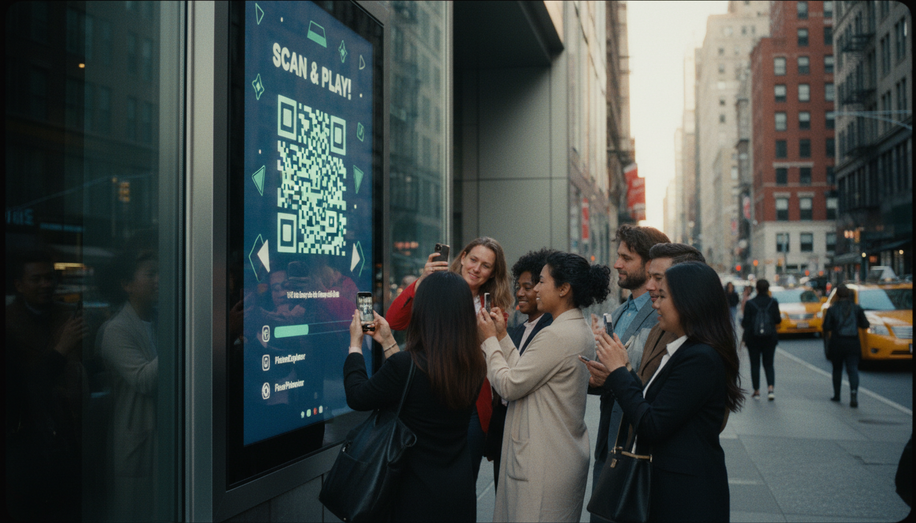

Out-of-home advertising has long commanded attention in public spaces, but a new wave of campaigns is transforming static billboards into playgrounds of interaction. By weaving gamification elements like QR codes, mobile apps, and direct display touchpoints into their strategies, brands are not just capturing eyes—they’re sparking participation, collecting valuable data, and forging lasting connections with audiences. This shift turns passersby into active players, boosting engagement metrics far beyond traditional metrics like impressions.
Consider the tactile thrill of physical challenges fused with digital rewards. In Lithuania, chocolate brand Pergalė challenged urban dwellers to form human pyramids to reach a button atop an OOH installation, pressing it to claim free samples. This simple yet collaborative game encouraged teamwork among strangers, turning a street-side ad into a communal event that amplified brand recall through shared social proof. Similarly, PLUS supermarkets in the Netherlands reimagined an entire town as a giant Monopoly board, where residents bid on streets and properties via interactive displays. The campaign gamified everyday navigation, prompting real-world trades and conversations that extended the brand’s reach organically.
Digital screens elevate these concepts with seamless tech integration. RCBC’s financial literacy push in Bonifacio Global City featured touchscreen bus sheds equipped with loan calculators and picture puzzles laced with educational tips. Commuters solved challenges to unlock insights, alleviating boredom while subtly capturing interaction data like completion rates and user demographics. Oreo took a mobile-first approach in London bus shelters, urging riders to scan QR codes and download an app for minigames. High scorers snagged daily rewards or a grand-prize holiday, driving app installs and repeat visits while the OOH served as a persistent call-to-action.
QR codes act as portals to extended play, bridging physical exposure with digital persistence. HOKA’s Mafate X sneaker launch in Manhattan created a pop-up desert treadmill amid urban concrete, where runners scanned codes to sync their pace with real-time Unreal Engine visuals of shifting landscapes—from dawn runs to twilight sprints. Participants earned personalized footage shareable on social media, blending exertion with branded storytelling and generating user-generated content at scale. Meanwhile, the Star Casino in Sydney’s Chinatown dangled Lunar New Year prizes like dinner vouchers for those who bested video games on interactive displays, with QR follow-ups capturing emails for loyalty programs.
Mobile apps supercharge this interactivity by enabling persistent challenges. Heineken’s Star Player app let UEFA Champions League fans predict live match outcomes—”Will a goal fall in the next 30 seconds?”—via OOH prompts at pubs and stadiums. Correct guesses accrued points for leaderboards, fostering competition among friends and tying the brand to high-stakes soccer fandom. Duracell’s F1 tie-in with Williams Racing rewarded battery buyers with receipt-scanned access to reaction-based mini-games mimicking race reflexes, complete with live leaderboards and prizes like pit passes. OOH elements amplified the call, directing traffic to the platform and measuring uplift in purchases through tracked redemptions.
These tactics excel at data capture without feeling intrusive. When Acadia GMC deployed AI-driven face analysis on digital signage, cameras detected age and gender to serve one of 30 tailored ads, then invited scans for personalized extensions—gleaning opt-in data while personalizing the pitch. The Dallas Cowboys’ “Pose with the Pros” AR kiosks at AT&T Stadium let fans select virtual players for selfies, emailed or shared post-scan, yielding emails and social tags for retargeting. Even subtle triggers, like Hjärtat’s smoke-detecting anti-smoking signs in Sweden that displayed coughing avatars to nearby smokers, prompted QR scans for cessation resources, converting shock value into consented leads.
The payoff is undeniable. Gamified OOH drives dwell time—up to 10 times longer than static ads—while interaction rates soar, often hitting 20-30% participation in high-traffic zones. McDonald’s Monopoly, though not purely OOH, illustrates the model: game pieces from purchases fuel set completions for prizes, mirrored in OOH by QR-linked boards that track progress across visits. Brands like Chick-fil-A with “Code Moo” car races unlock food rewards weekly, a blueprint for OOH apps that sustain engagement loops.
Critically, success hinges on frictionless design. Overly complex games deter casual audiences, so brands prioritize quick wins—30-second puzzles or one-tap spins—like Tito’s Vodka’s holiday spin-to-win, accessed via OOH QR for instant prizes. Proximity matters too; bus stops and malls yield higher conversions than highways. Privacy compliance is non-negotiable, with clear opt-ins turning data into goldmines for CRM nurturing.
As AR and AI mature, expect gamified OOH to evolve further—think NFC taps for instant leaderboards or geofenced challenges syncing with wearables. Posterscope envisions a “sandbox” of formats expanding brand universes, from Lego portals at bus stops sucking viewers into blocky dimensions to Nutella jars dispensing street-side compliments via voice activation. The message is clear: in an an attention economy, play wins. OOH brands playing to engage aren’t just advertising—they’re architecting experiences that audiences crave, data they covet, and loyalty they sustain.
To fully capitalize on this interactive shift, brands require advanced analytics to not only deploy but also meticulously track and optimize their gamified OOH investments. Platforms like Blindspot offer crucial real-time campaign performance tracking and robust audience measurement, providing clear insights into who is engaging and how effectively. This enables precise location intelligence for maximizing interaction points and delivers comprehensive ROI measurement and attribution, ensuring every playful engagement translates into measurable business value. Discover more at https://seeblindspot.com/