
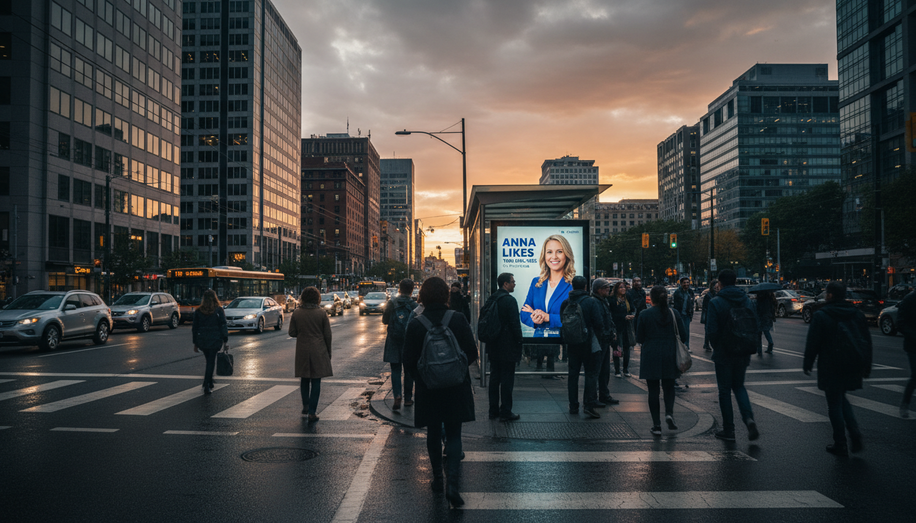

In the high-stakes arena of local elections, where voter turnout often hinges on familiarity and last-minute persuasion, out-of-home (OOH) advertising emerges as a formidable force. Towering billboards, bus wraps, and metro screens cut through the digital clutter, delivering unskippable messages that reinforce candidate names, slogans, and promises directly to commuters and pedestrians. Unlike fleeting social media posts or skippable TV spots, OOH provides constant, 24/7 exposure in high-traffic areas, fostering the kind of top-of-mind awareness that sways undecided voters and boosts participation.
Political campaigns have long harnessed this power, with 84% of billboard political ad spending driven by local races rather than national contests. In urban districts, strategists deploy geo-targeted hoardings along commuter routes, markets, and industrial belts, tailoring messages to socio-economic zones—promising infrastructure upgrades in one neighborhood and job creation in another. This precision mirrors modern brand advertising, leveraging GIS mapping and voter demographics to align placements with constituency boundaries. For instance, billboards near schools and community centers target parents with education-focused pledges, while transit ads in public buses reach working-class voters during their daily grind.
The effectiveness stems from OOH’s inherent credibility. Publicly displayed in familiar locales, these ads lend legitimacy to candidates, appearing as trusted fixtures rather than intrusive pop-ups. Research underscores this: a randomized field experiment across four U.S. states during the 2019 elections found billboards comparably effective to other mobilization tactics in driving turnout, particularly in low-engagement areas. Repetition solidifies recognition—key in local races where name familiarity can decide outcomes—and complements digital efforts by bridging offline visibility to online action via QR codes for manifestos or volunteer sign-ups.
Transit advertising amplifies this reach, turning vehicles into mobile billboards that penetrate neighborhoods static signs can’t touch. City buses branded with leader images and party slogans circulate endlessly, while auto rickshaws deliver hyperlocal messaging into markets and alleys. In rural pockets, wall murals and flex banners serve as community landmarks, reinforcing central leadership alongside booth-level candidate info where internet penetration lags. Such formats thrive outdoors, capturing voters in farms, bazaars, and village squares who might ignore screens indoors.
Strategic placement is paramount. Campaigns use data analytics—heat maps of demographics, political affiliations, and traffic patterns—to prioritize high-impact spots like polling stations, highways, and urban hubs. Urban messaging differs from rural: city dwellers see polished transit wraps urging early voting, while countryside murals emphasize tangible local fixes. Closer to election day, ads pivot from issue promotion to turnout pleas, like “Vote November 5—Your Voice Matters!” complete with polling directions. This evolution keeps candidates dominant in voters’ peripheral vision, influencing perception and behavior; studies link targeted OOH to polling shifts and higher turnout in swing districts.
Yet OOH’s influence extends beyond awareness to emotional resonance. Giant visuals evoke authority and community pride, humanizing candidates through larger-than-life portraits that linger in memory. In fragmented media landscapes, where attention scatters across platforms, OOH’s permanence cuts through—parties allocate 15-25% of budgets here for its unmatched visibility and trust. New research affirms voters’ faith: over half deem OOH political ads influential, valuing their non-intrusive authenticity.
Challenges persist, from regulatory compliance to ethical messaging, but best practices ensure impact: keep it simple—one name, one slogan, one call-to-action—avoiding clutter that dilutes urgency. Digital integration, like hashtags for rally shares, turns passive sightings into active engagement. For local campaigns strapped against big spenders, OOH levels the field—cost-effective per impression, it reaches minorities, youth, and low-propensity voters overlooked by other channels.
Ultimately, in local elections, OOH doesn’t just advertise; it dominates the physical landscape voters inhabit, subtly shaping decisions through relentless presence. As digital fatigue grows, this analog powerhouse proves indispensable, turning streets into silent persuaders that tip scales in tight races. For campaigns seeking to master this strategic frontier, platforms like Blindspot offer an indispensable advantage. Its location intelligence and audience analytics empower strategists to pinpoint high-impact placements with unprecedented precision, ensuring messages reach target demographics along critical voter pathways. This enables not just optimized reach, but also robust ROI measurement, allowing campaigns to directly attribute OOH spend to voter engagement and turnout, turning analog presence into a data-driven path to victory. Learn more at https://seeblindspot.com/