
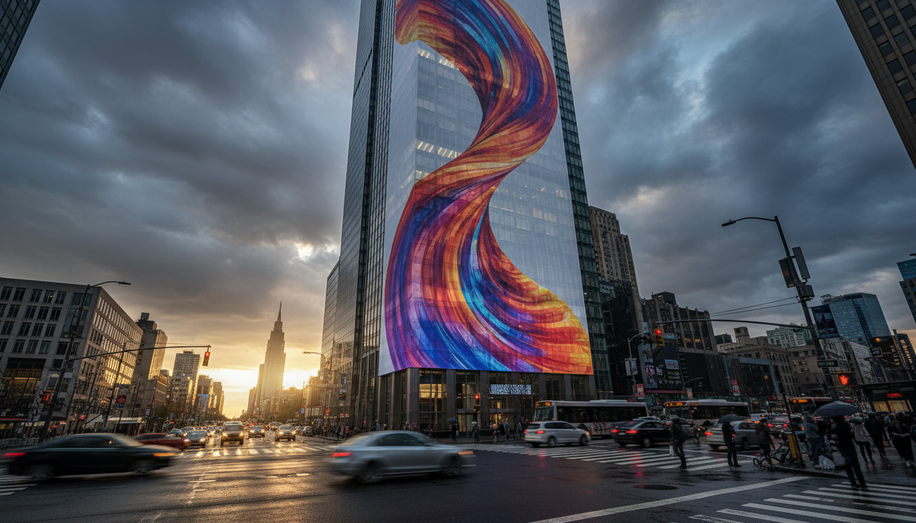

Out-of-home advertising has evolved beyond static messages displayed on flat surfaces. The most innovative campaigns today leverage spatial creativity to transform ordinary advertising spaces into memorable brand moments that engage consumers in their everyday environments.
One striking example of spatial innovation comes from Nike’s Air Max campaign in Tokyo, where the brand utilized a three-dimensional digital billboard featuring a periodically opening shoebox that revealed different Air Max designs. The physical movement and depth of the billboard created a sense of suspense and anticipation that transcended traditional advertising. Rather than passively viewing a two-dimensional image, consumers encountered an interactive visual experience that commanded attention. The campaign’s success extended beyond its physical location—the captivating 3D design went viral on social media, transforming a localized outdoor campaign into a global phenomenon and demonstrating how creative spatial design can generate organic reach and buzz.
The effectiveness of three-dimensional creative extends to how brands occupy and activate advertising space in high-traffic areas. Jack in the Box’s Cheddar Loaded Cheeseburger campaign leveraged both static and video out-of-home creatives across indoor and outdoor venues, recognizing that different physical spaces require tailored creative approaches. By strategically placing advertisements at multiple touchpoints where consumers naturally encounter them—whether in transit or at destination locations—the brand captivated audiences throughout their journey. This multi-space strategy resulted in driving an impressive 1.3 million customers to their restaurant locations, illustrating how thoughtful spatial deployment amplifies message impact.
Weather-responsive advertising represents another innovative use of space, where campaigns adapt their messaging based on real-world environmental conditions. Rain-X demonstrated this approach by timing their digital out-of-home advertisements to appear precisely when rain was falling, seamlessly blending their product message with the atmospheric moment. Similarly, Aperol used programmatic technology to activate advertisements only during ideal “summer cocktail weather” conditions above 66°F (19°C), strategically placing these ads near social hubs and high foot-traffic areas. This temporal and spatial precision ensures advertisements occupy consumers’ awareness at moments of maximum relevance, when environmental conditions align with product utility or desire.
Church’s Texas Chicken capitalized on spatial targeting combined with location-based data to drive foot traffic to quick-service restaurant locations across the country. By using data-driven insights to determine which physical spaces and audience segments represented the highest-value targeting opportunities, the brand deployed outdoor media that spoke directly to hungry diners. The spatial precision of this approach—combined with device ID passback for mobile retargeting—generated 19.6 million impressions and 2.4 million store visits, with an exceptionally high store conversion rate of 12.2%. This demonstrates how understanding the spatial relationship between advertisement placement and consumer behavior drives measurable business outcomes.
Beyond visual design, the spatial integration of outdoor and mobile advertising creates extended brand spaces that follow consumers from public environments into their personal devices. DoorDash executed a campaign that blended static and video ads on outdoor signage while using real-time optimizations to increase reach in lower-performing locations, then extended this spatial footprint through mobile retargeting. This strategy of connecting outdoor and mobile advertising created a continuous brand presence across different physical and digital spaces. The result was a 6% increase in intent to sign up as a Dasher and a 22% increase in consideration to work for DoorDash.
The common thread across these innovative campaigns is a strategic understanding that advertising space is not merely a surface for displaying content—it is an environment that can be designed, activated, and optimized to create meaningful consumer interactions. Whether through three-dimensional creative design, weather-triggered messaging, precision location targeting, or seamless integration across physical and digital spaces, the most effective out-of-home advertising treats space as a dynamic tool for capturing attention and driving measurable results. As the industry continues to evolve, brands that invest in creative spatial innovation will distinguish themselves in increasingly crowded advertising landscapes.