
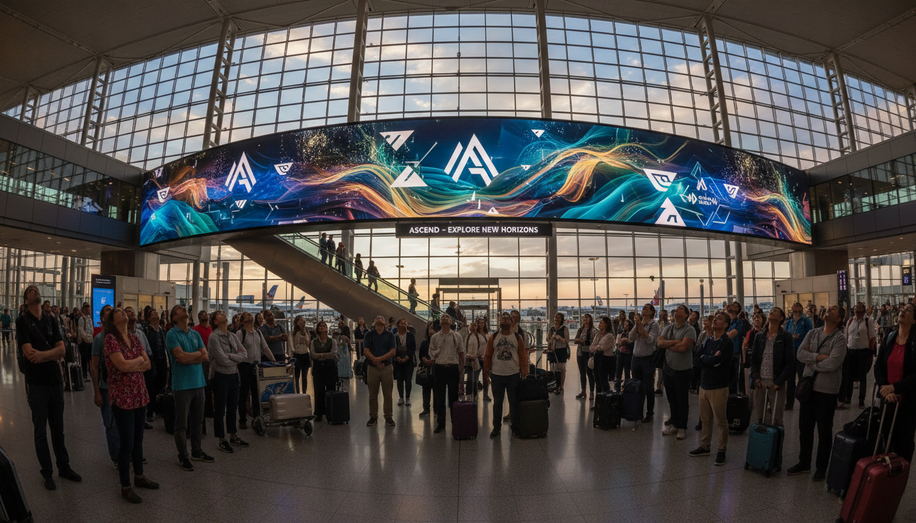

Airports, once mere transit hubs, have evolved into dynamic commercial ecosystems where advertisers wield unprecedented influence over captive audiences. With U.S. Transportation Security Administration screenings hitting record highs in 2025 and projections for even stronger growth into 2026, driven by pent-up travel demand and widespread airport modernizations, these spaces offer brands a premium environment free from digital clutter. Travelers, lingering for 45 to 120 minutes during check-in, security, and boarding, absorb messaging in a state of heightened attentiveness, making airports fertile ground for innovative out-of-home (OOH) strategies.
Recent research commissioned by Clear Channel Outdoor (CCO) and conducted by Nielsen underscores this potential, revealing that 82 percent of frequent flyers read airport ads, 61 percent recall them, and a striking 57 percent take action afterward—an eight percent jump from 2022. Among those prompted to act, 61 percent visited advertised locations, 53 percent hit websites, 45 percent scanned QR codes (up six percent), and 36 percent checked social media. Morten Gotterup, president of CCO’s airports division, emphasizes that as airports morph into “vibrant commercial hubs,” this medium influences decisions at moments of high intent, urging local and national brands to amplify their presence.
The psychology behind airport advertising’s effectiveness lies in extended dwell times and multi-sensory immersion. Passengers, surrounded by the hum of crowds and aromas of coffee shops, enter a novel environment that sharpens sensory perception, rendering ads more memorable. Proximity to retail amplifies this: a perfume billboard near check-in can funnel impulse buyers straight to the duty-free counter. Frequent flyers, in particular, crave resonant content—88 percent favor local business ads in hometown airports, followed by sports teams at 53 percent and educational institutions at 48 percent—proving relevance trumps flash.
Digital out-of-home (DOOH) formats dominate this transformation, with video walls, digital screens, and interactive displays surging in adoption. At hubs like Heathrow, screens proliferate in central areas, lounges, and corridors, often blending ads with flight updates or weather to boost engagement, much like television interstitials. Programmatic targeting elevates precision: real-time personalization tailors messages by time, weather, or location—breakfast promotions in the morning, hotel deals at night—while geofencing differentiates ads for lounges versus food courts. Looking to 2026, interactive displays, 3D billboards, and augmented reality (AR) experiences are projected to eclipse static formats, with digital penetration exceeding 36 percent in major airports. JCDecaux’s upgrades at Brussels Airport, including advanced screens, signal this global shift toward immersive tech.
Beyond mainstream terminals, premium segments unlock high-ROI niches. VIP lounges and private jet facilities target affluent travelers via sponsored WiFi portals, tablet kiosks, and branded wall wraps, ideal for luxury services like wine tastings or private charters. CCO’s network spans over 115 private jet terminals nationwide through its Signature Aviation partnership, delivering unskippable displays to wealthy influencers. StackAdapt highlights DOOH in such venues, alongside taxis and event-adjacent spots, to stay top-of-mind with executives during travel “in-between” moments.
Static options persist for cost efficiency, with banners and signage in bathrooms, retail zones, and high-traffic paths offering broad reach. Baggage reclaim areas stand out for their end-of-journey relaxation vibe, where floor decals or overhead screens peddle immediate needs like car rentals or dining. These layered tactics—digital dynamism atop traditional placements—create a full-funnel assault, building familiarity during dwell time and spurring conversions at purchase points.
Data-driven audience matching further refines impact, as airports leverage anonymized tracking to optimize formats and timing. For 2026 campaigns, brands should prioritize hybrid strategies: programmatic DOOH for personalization, AR for virality, and localized statics for community ties. Alluvit Media’s recap of 2025 standouts, from soaring visuals to tech-infused activations, previews this trajectory, with OOH evolving to capture lifetime value.
Ultimately, airports’ blend of captivity, affluence, and intent positions them as advertising powerhouses. As infrastructure investments accelerate—exemplified by JCDecaux’s record-breaking enhancements—these venues will not only host travel but redefine brand-traveler connections. Advertisers who innovate here, harnessing dwell time’s psychology and digital precision, stand to reap outsized returns in an era of surging mobility.